Why Your Solar Panels Aren’t Making Enough Power (And How I-V Curves Show You Exactly What’s Wrong)
Updated:
Grab your multimeter and head to your solar array during peak sunlight hours—the voltage and current readings you’re about to take will reveal everything about your system’s health. An I-V curve is simply a graph showing how your solar panels behave when you measure voltage (I) against current (V) under different electrical loads, and learning to read this curve transforms you from someone who owns solar panels into someone who truly understands them.
Think of it like a medical checkup for your solar system. When I first started tracing I-V curves on my own installation, I discovered one of my strings was producing 30% less power than the others—not because of shading or dirt, but because of a sneaky mismatch issue I never would have caught by just looking at total system output. The curve showed a distinct double-hump pattern that screamed “mismatched panels,” and fixing it boosted my overall production significantly.
String mismatch happens when panels in the same series circuit don’t match up perfectly—maybe you’ve got different wattage ratings, one panel is partially shaded, or degradation has affected panels differently over time. Your solar charge controller or inverter tries to find the best operating point for the entire string, but when panels don’t agree, you lose power. The I-V curve makes this invisible problem visible.
Modern curve tracing doesn’t require expensive professional equipment anymore. Handheld tracers and even some advanced charge controllers now include built-in I-V curve functions that cost a fraction of what they used to. You’ll learn to spot the telltale signs: reduced short-circuit current indicating shading or soiling, decreased open-circuit voltage suggesting cell damage, and those characteristic bumps and kinks that reveal mismatches.
This guide walks you through interpreting curve shapes, identifying common problems at a glance, and using accessible monitoring tools to keep your DIY solar system running at peak performance—because understanding your system shouldn’t require an engineering degree.
What Is an I-V Curve? (Breaking It Down Simply)
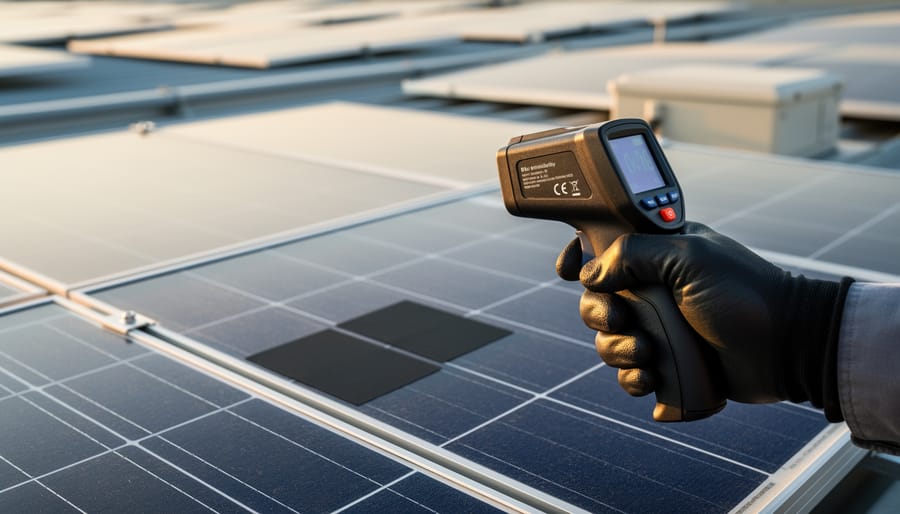
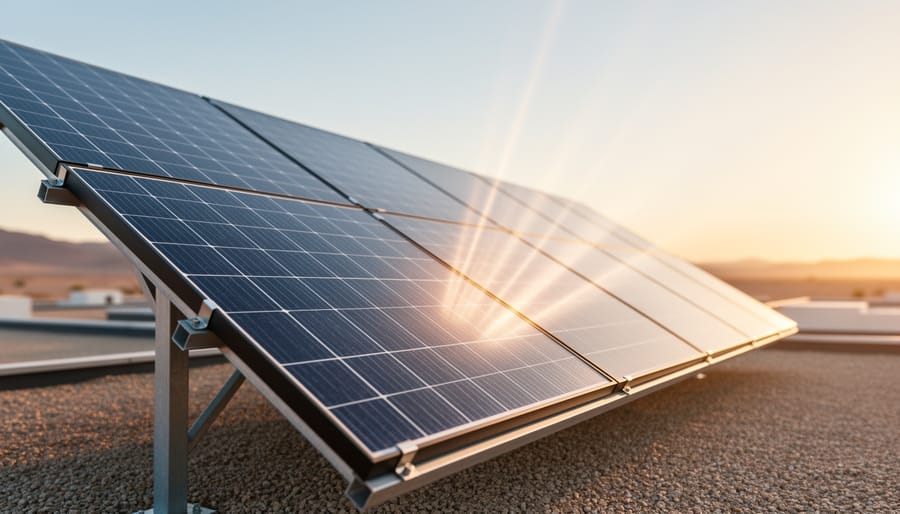
Solar panel surfaces can accumulate water, dust, and debris that affect performance in ways visible through I-V curve analysis.
The Three Key Points Every DIYer Should Know
When I first started testing solar panels for my backyard setup, I kept hearing about three magic numbers on the I-V curve that would tell me everything I needed to know. Let me break these down in plain English.
First up is short-circuit current, or Isc. This is what happens when you connect the positive and negative terminals of your panel directly together (though don’t actually do this without proper equipment). On the I-V curve, it’s the point where the line hits the far left on the current axis. Think of it as your panel’s maximum possible current output when there’s zero resistance. In practical terms, if your panel’s Isc is lower than expected, you might have shading issues or dirt blocking your cells.
Next is open-circuit voltage, or Voc. This is the voltage your panel produces when nothing is connected to it at all, found at the far right of the curve where it meets the voltage axis. It’s like checking your battery’s voltage before you turn anything on. A lower-than-expected Voc usually means you have damaged cells or your panel is running too hot.
The real star of the show is the maximum power point, or MPP. This sweet spot sits somewhere in the middle of your curve where voltage multiplied by current gives you the absolute highest wattage output. Your charge controller or inverter works constantly to keep your system operating at this point. When I installed my first system, understanding MPP helped me realize why my panels weren’t delivering their rated power during certain times of day. These three points essentially give you a complete health report of your solar setup.
Reading Your Solar Panel’s Story: What I-V Curves Reveal
Shading and Partial Shadows
One of the most common curve problems you’ll encounter in real-world solar setups is shading, and trust me, I learned this lesson the hard way during a camping trip last summer. I set up my portable solar panel near a tree for some afternoon shade (for myself, not the panel!), and my battery charged at a crawl. When I checked the I-V curve later, it looked like a staircase instead of the smooth knee shape I expected.
Here’s what happens: when part of your solar panel gets shaded, even just a little bit, those shadowed cells produce less current than the sunny ones. Since cells in a panel are connected in series, the shaded cells act like bottlenecks. On your I-V curve, this creates distinctive steps or plateaus rather than one smooth curve. Each step represents a different portion of your panel operating under different light conditions.
On rooftop installations, I’ve seen this play out constantly. A chimney casting morning shadows, a neighbor’s tree growing taller each year, or even bird droppings can create these telltale steps. The curve might show two or three distinct levels, each representing groups of cells getting different amounts of sunlight.
What makes this particularly frustrating is that partial shading doesn’t just reduce output proportionally. A small shadow covering 10 percent of your panel can sometimes reduce power output by 50 percent or more because of how the cells interact. By learning to recognize these stepped patterns in your I-V curve, you can quickly diagnose shading issues and reposition panels or trim back vegetation before your power production takes a serious hit.
Partial shading from trees or structures creates distinctive performance patterns that appear as irregularities in I-V curve measurements.
Dirty Panels and Performance Drop
When dust, dirt, leaves, or bird droppings accumulate on your solar panels, they act like tiny shadows that block sunlight from reaching the cells. The effect shows up clearly in your I-V curve, and once you know what to look for, it’s pretty easy to spot.
I remember Charles mentioning how surprised he was when a week of pollen season dropped his system’s output by nearly 15 percent. When he traced the I-V curve, he immediately noticed the short-circuit current had decreased significantly while the open-circuit voltage stayed about the same. That’s the telltale sign of soiling.
Here’s what happens: dirty panels reduce the amount of light hitting the cells, which means fewer photons are generating electricity. On your I-V curve, you’ll see the entire curve shift downward and to the left. The short-circuit current drops because less light means less current generation. However, the voltage at the far right of the curve typically remains close to normal since voltage depends more on the cell material and temperature than on light intensity.
If you’re monitoring your system and notice this pattern, a simple cleaning might restore 10 to 20 percent of your lost power. The curve doesn’t lie—it’s telling you exactly where the problem is.
Cell Damage and Hot Spots
When a solar cell gets damaged—whether from micro-cracks, water intrusion, or physical impact—it shows up as a telltale wobble or dip in your I-V curve. Healthy cells produce smooth, predictable curves, but damaged ones create noticeable abnormalities. You might see a sudden drop in current at certain voltage points, or strange bumps that shouldn’t be there.
Hot spots are particularly nasty. They occur when one damaged cell in a string starts consuming power instead of producing it, heating up like a tiny electric stove. This doesn’t just reduce your output—it can actually become a fire hazard if left unchecked. The I-V curve will show this as a distinctive flattening or step pattern.
I remember Charles telling me about a neighbor who ignored curve irregularities for months, thinking it was just “normal aging.” By the time they investigated, one panel had developed serious hot spots and needed replacement. The lesson? catching performance issues early saves money and prevents safety risks. Regular I-V curve checks act like health screenings for your solar array, revealing problems before they become expensive disasters.
String Mismatch: The Silent Performance Killer
Solar panels connected in series strings where one underperforming panel can reduce the output of the entire chain.
How Mismatched Panels Drag Down Your Entire String
I learned this lesson the hard way during my first rooftop installation. I had one panel partially shaded by a chimney, and I couldn’t figure out why my entire system was producing about 30% less power than expected. The problem? In a series string, all your panels are connected like links in a chain, and just like a chain, you’re only as strong as your weakest link.
Here’s what happens: when you wire solar panels in series, the same current has to flow through every single panel in that string. Think of it like water flowing through a garden hose. If one section of the hose gets pinched, the flow through the entire hose drops to match that restriction point.
Let’s say you have five panels in a string, and four of them are producing 8 amps in full sun. But one panel is dirty, shaded, or damaged and can only produce 5 amps. The entire string gets limited to that 5 amp output, even though 80% of your panels are working perfectly. You don’t just lose the output from that one panel—you drag down all the others to match its reduced performance.
This is where your I-V curve becomes incredibly valuable. When you trace the curve of your string, that telltale dip or step in the curve points directly to mismatch issues. It’s like having an X-ray that shows you exactly where the weak link is hiding, so you can fix it and get your whole system back to peak performance.
Spotting String Mismatch in Your I-V Curve
When you’re examining your I-V curve, string mismatch shows up like a hiccup in what should be a smooth line. I learned this the hard way when I was helping my neighbor troubleshoot his rooftop array. We pulled up his monitoring data, and instead of seeing one clean curve, we got what looked like a staircase pattern with multiple bumps and plateaus.
Here’s what healthy versus mismatched curves look like: A properly functioning string produces a smooth, continuous curve that swoops gracefully from your open-circuit voltage down to your short-circuit current. Think of it like a gentle ski slope. But when you’ve got string mismatch, you’ll see distinct steps or kinks in that curve. These irregularities happen because different strings are producing power at different voltages, and your inverter is struggling to find the sweet spot.
Look for these telltale signs in your curve data. First, multiple power peaks instead of one clear maximum power point. Second, unusual flatness or plateaus in sections where the curve should be smoothly declining. Third, a jagged or stepped appearance rather than a continuous line. Even a noticeable dip or valley in the middle of your curve signals that something’s off.
The steeper the steps or the more pronounced the bumps, the more significant your mismatch problem. Minor shading might create small ripples, while a severely underperforming panel creates dramatic gaps. Your monitoring system should let you compare curves over time, so watch for changes from your baseline healthy curve.
IV Curve Tracing: Your Solar System’s Health Monitor
How Curve Tracers Work (Without Getting Too Technical)
Think of a curve tracer as a really smart voltage tester that takes a bunch of measurements in rapid succession. Here’s the simple version of what’s happening inside.
The device starts by applying a very small voltage to your solar panel—maybe just a fraction of a volt. It measures how much current flows at that exact voltage point, then records both numbers. A split second later, it bumps the voltage up just a tiny bit and takes another measurement. Then it does it again. And again. And again.
This process, called “sweeping,” happens incredibly fast—usually in less than a second. The tracer keeps increasing the voltage step by step, from zero all the way up to the panel’s maximum voltage, measuring current at each point along the way. Plot all these measurement pairs on a graph, and boom—you’ve got your I-V curve.
When I first used a curve tracer on my own array, I was amazed at how quick it was. You literally just connect the leads, press a button, and watch the curve appear on the screen. No complicated setup required.
The beauty of modern curve tracers is that they do all the heavy lifting for you. You don’t need to understand the electronics behind the sweep—you just need to know how to read the resulting curve. Most devices designed for DIY solar folks come with simple interfaces that display the curve alongside the key numbers you care about, like maximum power output and efficiency.
DIY-Friendly Curve Tracing Options
Getting hands-on with I-V curve tracing doesn’t mean emptying your wallet anymore. When I first started diagnosing my DIY solar setup, professional-grade curve tracers cost thousands of dollars, putting them well out of reach for hobbyists. Thankfully, times have changed, and there are now several budget-friendly options that deliver solid performance.
One of the most exciting developments is smartphone-connected curve tracers. These compact devices plug into your phone and use free or low-cost apps to display and analyze your I-V curves in real-time. Models like the Solmetric PVA-600 and various handheld options from manufacturers targeting the DIY market typically range from $300 to $800, a fraction of what professional units cost. The smartphone interface makes data logging and sharing incredibly easy, perfect for troubleshooting with fellow solar enthusiasts online.
If you’re looking for even more affordable entry points, some advanced solar power meters now include basic curve tracing capabilities. While they won’t match dedicated tracers for precision, they’re excellent starting points for understanding your system’s performance patterns. These often integrate with broader solar monitoring solutions that track multiple parameters over time.
When shopping for a DIY-friendly curve tracer, prioritize these features: data export capability for record-keeping, clear visual displays that highlight problem areas, temperature compensation to ensure accurate readings, and community support through active user forums. My experience taught me that good documentation and responsive customer service matter just as much as technical specs when you’re learning the ropes. Don’t overlook used equipment either—many professionals upgrade regularly, creating opportunities for bargain hunters willing to browse online marketplaces.
Modern curve tracing devices make professional-grade solar diagnostics accessible to DIY enthusiasts and small system owners.
When Should You Trace Your I-V Curves?
How often should you actually be checking your I-V curves? Well, it depends on your setup and what you’re trying to accomplish.
For a permanent home installation, I recommend running a baseline trace right after installation, then checking quarterly for the first year. After that, twice a year is usually plenty unless you notice a drop in performance. Think of it like changing your car’s oil – regular checkups prevent bigger problems down the road.
RV and mobile solar systems need more frequent attention. I trace mine before every major trip and monthly during extended travel. Roads kick up debris, connections vibrate loose, and panels face different conditions constantly. Charles actually learned this the hard way during a cross-country trip when a loose connection went unnoticed for weeks, costing him valuable charging time at remote campsites.
Off-grid cabin owners should trace seasonally, especially before winter when you’ll rely most heavily on stored power. Also trace after any severe weather events – hail, heavy snow loads, or strong winds can damage panels in ways that aren’t immediately visible.
Here’s my personal routine: I do a quick visual inspection weekly, checking for obvious debris or damage. Monthly, I review my monitoring system’s data for performance trends. Then quarterly, I run a full I-V curve trace to catch issues before they become serious problems.
The key is consistency. Pick a schedule that fits your lifestyle and stick with it. Even infrequent tracing beats never checking at all.
What to Do When Your Curve Looks Wrong
When your I-V curve doesn’t look like the textbook examples, don’t panic. Most issues are fixable once you know what you’re looking for. Let me walk you through the most common problems I’ve encountered over the years.
If your curve looks flat or horizontal instead of showing that characteristic knee shape, you’re likely dealing with shading issues. Check for new tree growth, debris on panels, or even bird droppings. I once spent an hour troubleshooting a mysterious drop in performance, only to discover a family of pigeons had made my array their favorite hangout spot. Clean your panels and retest. The difference can be dramatic.
A curve with multiple steps or bumps instead of one smooth transition usually indicates string mismatch. This happens when panels in the same string are operating at different performance levels. Start by checking if all your panels are the same model and age. Mixed equipment creates these telltale stair-step patterns. If your panels match, look for partial shading on just one or two panels in the string, or check for loose connections that might be creating resistance in specific spots.
When your curve shifts downward but maintains its shape, you’re seeing reduced current, often from dirty panels or seasonal changes in sunlight intensity. Compare your current readings to baseline measurements taken under similar conditions. Understanding your solar readings in context helps you distinguish normal variation from real problems.
A curve that shifts left indicates voltage loss. Check all your connections first, then test individual panel voltages. Corroded terminals or loose wiring are common culprits. I keep dielectric grease handy specifically for preventing this issue at connection points.
If nothing looks obviously wrong but your curve still seems off, take measurements at different times of day. Temperature affects panel performance significantly. Early morning tests provide the clearest baseline since panels are cooler and perform closer to rated specifications.
You’ve just taken a big step forward in your solar journey. Understanding I-V curves might have seemed intimidating at first, but now you’ve got the knowledge to diagnose your system like a pro. I remember when I first started tracing curves on my own setup—it felt like I’d finally unlocked the secret language my panels were speaking all along. That’s exactly what this is: translating what your system is telling you from mysterious numbers into clear, actionable insights.
The beauty of I-V curve monitoring is that it transforms solar energy from guesswork into precision. Instead of wondering why your output dropped last month, you can pinpoint whether it’s shading, a failing panel, or string mismatch. You’re no longer flying blind—you’re making data-driven decisions that maximize your investment and keep your system running at peak performance.
Here’s my challenge to you: start monitoring. You don’t need to invest in expensive equipment right away. Begin by understanding your system’s baseline performance, then explore curve tracing tools that fit your budget and technical comfort level. Head over to Spheral Solar’s calculator tools to estimate your system’s ideal performance characteristics and compare them with what you’re actually seeing.
And don’t do this alone. Join our community discussion to share your curve traces, ask questions, and learn from fellow DIY solar enthusiasts who’ve been exactly where you are now. Someone in the community might have already solved the exact problem you’re facing.
Your solar system is an investment in your future and our planet. With I-V curve knowledge in your toolkit, you’re equipped to protect that investment for decades to come.
How useful was this post?
Click on a star to rate it!
Average rating 0 / 5. Vote count: 0
No votes so far! Be the first to rate this post.
We are sorry that this post was not useful for you!
Let us improve this post!
Tell us how we can improve this post?
charlesnoble
Here at Spheral Solar, I’m a hands-on solar power enthusiast, constantly exploring and experimenting with DIY solutions. I’m dedicated to sharing my discoveries, insights, and even the bumps I hit along the way, all in the pursuit of a more sustainable future.
Your Multimeter Can Tell You Everything About Your… by Charlesnoble March 8, 2026 Grab your multimeter and set it to AC voltage mode—typically marked as “V~” or “VAC”—which allows you to measure the alternating current output from your solar inverter, the device that converts your panels’ DC power into usable household electricity. You’ll want to verify that your system is delivering the standard…
Why Your DIY Solar Project Needs a Calibrated… by Charlesnoble February 3, 2026 Point your infrared thermometer at your solar panel surface on a sunny afternoon, and you might get a reading of 145°F—but is that number actually accurate? Without proper calibration, that measurement could be off by 10, 20, or even 30 degrees, leading you to misdiagnose hot spots, overestimate efficiency losses,…
Why Your Solar Meter Numbers Don’t Match Your… by Charlesnoble January 20, 2026 Look at your solar meter display right now and locate the kWh reading—this number tells you exactly how much electricity your panels have generated since installation, and if it’s climbing daily, your system is working. Check whether your meter’s digital arrows or symbols are moving forward (you’re using solar power…
Read Your Solar System Like a Pro: What Every Wire… by Charlesnoble October 31, 2025 Locate the single-line diagram in your solar system documentation—it’s your roadmap to understanding how energy flows from panels through inverters to your home’s electrical panel. This schematic shows every critical component: charge controllers, battery banks, breaker boxes, and safety disconnects, all connected by lines representing wire runs with their corresponding…
The Data Your Solar Panels Are Begging You to Track… by Charlesnoble May 3, 2026 Track your solar panel voltage, current, and power output every 15 minutes using a simple data logger or smartphone app connected to your charge controller. This baseline information reveals whether your system performs as promised and helps identify problems before they cost you money. A $30 Bluetooth monitor paired with…
Why Your RV Solar Panels Aren’t Charging (And How to… by Charlesnoble November 30, 2025 Check your multimeter readings at each connection point along your solar charging path—from panels to charge controller to battery—to pinpoint exactly where voltage disappears. Most RV solar systems lose 10-30% of their potential power to voltage drop, but this invisible thief often goes undetected until you systematically measure and compare…
Subscribe for handpicked DIY projects, exclusive tips, and giveaways.
There is something special about a mature tree. Decades of growth, shade that actually cools the house, branches that the kids climbed, a root system that has quietly held the yard together through every storm. So when circumstances force a move, whether it is a home renovation, a new driveway, or a construction project that… Read more: How to Move a Mature Tree Without Killing It: The Complete Relocation Guide
A mass energy conversion calculator lets you determine how much energy is locked inside any amount of matter using Einstein’s famous equation E=mc². Whether you’re working on a physics assignment or simply curious about the enormous energy potential in everyday objects, the calculation itself takes just seconds once you understand the formula’s three components: energy… Read more: How to Use a Mass Energy Conversion Calculator (Step-by-Step Guide)
Low voltage circuit protection in DIY solar systems boils down to matching the right fuse or breaker to your wire size and expected current, not to the capacity of your battery bank or inverter. Most fires and equipment failures happen when people oversize protection devices, thinking bigger is safer, when the opposite is true. Your… Read more: How to Size Low Voltage Circuit Protection for Your DIY Solar System