Why 9 Volt Solar Panels Are Perfect for Your First Portable Power Setup
Updated:
Grab a 9-volt solar panel from your local electronics supplier and test it with a multimeter in direct sunlight—if it produces 9-12 volts under load, you’ve got a working unit ready for small-scale projects. These compact panels excel at trickle-charging rechargeable 9V batteries, powering LED lighting systems for camping, or running low-draw electronics like portable radios and small fans.
Understanding what these panels can and cannot do saves you from frustration. A typical 9V panel outputs between 100-500 milliamps, which means charging a smartphone directly won’t work—you’ll need a voltage regulator and USB adapter, plus the charging time will stretch into days. Instead, focus on applications where slow, steady power delivery shines: maintaining battery charge in rarely-used devices, running educational electronics projects, or creating off-grid sensor systems for your garden.
I learned this the hard way during my first camping trip with a bargain 9V panel. I expected to keep my phone charged, but ended up with a dead battery and a valuable lesson. Now I use these panels specifically for what they’re built for—powering my trail camera setup and keeping backup AA battery packs topped off through a simple step-down converter.
The real power of 9-volt solar panels lies in their simplicity and accessibility. You don’t need engineering knowledge to wire one up, and mistakes won’t fry expensive equipment. They’re your training wheels for understanding solar voltage, current limitations, and charge controller basics before scaling up to larger portable systems.
What Exactly Are 9 Volt Solar Panels?
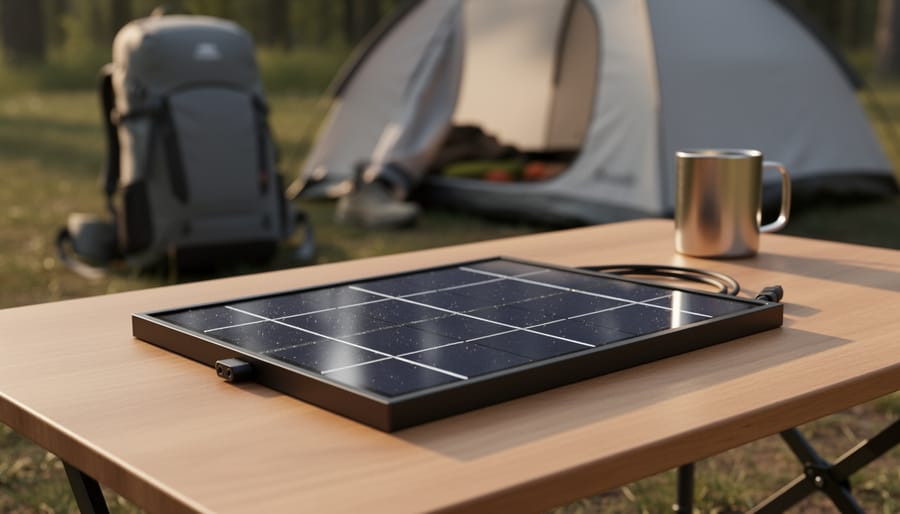
A typical 9 volt solar panel is compact and lightweight, making it ideal for portable power applications and camping setups.
Understanding the Voltage vs. Wattage
When I first started tinkering with solar panels, I thought voltage was everything. A 9 volt panel should power 9 volt devices perfectly, right? Not quite. Here’s what I learned the hard way: voltage is like water pressure in a garden hose, while wattage is the actual amount of water flowing through it.
Think of it this way: your 9 volt solar panel might have the right “pressure” to power a small device, but if it only produces 0.5 watts, it’s like trying to fill a swimming pool through a coffee stirrer. The pressure is there, but you’re not getting much flow. A typical 9V battery from the store delivers around 500 milliamp-hours, which translates to actual usable power for your projects.
Wattage is calculated by multiplying voltage times amperage (current). So a 9V panel producing 0.1 amps gives you 0.9 watts of actual power. This is crucial for understanding what your panel can realistically run. A small LED? Absolutely. Charging your phone? You’ll need much more wattage than most 9V panels provide. Always check both the voltage and wattage specifications before starting your project to avoid disappointment.
Common Sizes and Power Output
When you’re shopping for 9V solar panels, you’ll find they come in surprisingly compact packages. Most measure between 4 to 8 inches in length and width, making them about the size of a paperback book or smaller. I remember my first panel could easily slip into my backpack’s side pocket, which was perfect for weekend camping trips.
The power output typically ranges from 1 to 5 watts. Now, I know those numbers might sound small compared to rooftop solar systems, but here’s the thing: they’re absolutely perfect for what they’re designed to do. A 2-watt panel, for instance, can keep small batteries topped up or power basic electronics like LED lights or small sensors.
Here’s a practical example: a standard 1.5-watt panel measuring about 5×5 inches will generate roughly 170 milliamps of current in good sunlight. That’s enough to slowly charge rechargeable batteries or run a small garden fountain. The 5-watt versions, while slightly larger at around 8×6 inches, offer more versatility for running multiple small devices or charging faster.
The beauty of these modest dimensions is portability. You’re not committed to permanent installation, so you can experiment, learn, and adapt your solar setup as you go.
What Can You Actually Power with a 9V Solar Panel?
Perfect Applications for 9V Panels
The beauty of 9V solar panels lies in their versatility for small-scale applications. I’ve found these compact powerhouses perfect for projects where you need just enough juice without the bulk of larger panels.
One of the most practical uses is charging rechargeable 9V batteries. Whether you’re keeping spare batteries topped up for smoke detectors or maintaining your guitar pedal power supply, a small solar panel creates a self-sustaining charging station. Just add a simple charge controller to prevent overcharging.
Emergency preparedness is another sweet spot. A 9V panel paired with a portable radio keeps you connected during power outages or camping trips. I keep one in my emergency kit year-round, and it’s given me peace of mind during several unexpected situations.
LED lighting projects absolutely thrive with 9V panels. A single panel can power multiple LEDs for pathway lighting, garden accents, or even a reading lamp in your shed. The low power requirements match perfectly with what these panels deliver.
Hobbyists and makers find endless possibilities here. From powering Arduino projects to running wireless sensors for weather stations or garden monitoring systems, 9V panels offer just the right amount of power. They’re ideal for remote locations where running electrical wire isn’t practical.
The key is matching your project’s power consumption with what the panel can realistically provide. Start small, experiment, and you’ll discover these little panels punch above their weight class.
What You Shouldn’t Expect
Let me be straight with you here—9 volt solar panels are wonderful little learning tools and work great for specific small-scale projects, but they’re not going to replace your camping power station or charge your phone for the weekend. I learned this lesson the hard way on my first camping trip with my DIY solar setup, expecting to keep my smartphone juiced up while taking photos. Spoiler alert: it didn’t work out as planned.
The reality is that most 9V solar panels output somewhere between 50-200 milliamps under ideal sunlight conditions. Your smartphone battery? That’s typically 3,000 to 5,000 milliamp-hours. Do the math, and you’re looking at painfully slow charging—if it works at all. Most phones won’t even register a charge from such low power input.
Running a laptop is completely off the table. Even small camping appliances like portable fans, LED lanterns with USB charging, or electric coolers draw far more power than a 9V panel can provide. These panels simply weren’t designed for those applications.
Here’s what really matters: understanding these limitations upfront saves you frustration and helps you use 9V panels for what they do best. They’re perfect for trickle-charging small batteries, powering hobby electronics, running simple science experiments, or keeping a small backup battery topped off. Think of them as your entry point into solar energy—a hands-on way to learn the fundamentals without breaking the bank.
Setting realistic expectations means you’ll actually enjoy working with these panels instead of feeling disappointed. They’re stepping stones, not powerhouses, and that’s perfectly okay.
Building Your First 9V Portable Solar Setup
Components You’ll Need
Getting started with a 9-volt solar panel is exciting, but you’ll need a few additional components to build a functional system. Don’t worry, though—these items are straightforward and widely available, even if you’re just dipping your toes into solar energy.
First up, you’ll need a charge controller. I learned this lesson the hard way when I overcharged a battery on my first solar experiment! For 9V systems, you can use a simple voltage regulator or a small PWM charge controller designed for low-voltage applications. These prevent your battery from overcharging and typically cost between $5-15. Look for ones rated for 12V or lower—they’ll work perfectly with your 9V setup.
Next, consider your battery options. Standard 9V rechargeable batteries (NiMH or lithium-ion) work great for simple projects, but they have limited capacity. For longer runtime, a small battery pack made from AA or AAA rechargeable cells wired in series gives you more juice. I often recommend 3.7V lithium cells with a boost converter as a reliable alternative.
You’ll also need connectors to link everything together. Battery snap connectors for 9V batteries, barrel jack connectors, or simple alligator clips all work depending on your comfort level with soldering.
Finally, think about mounting accessories if you’re taking your panel outdoors. A basic stand made from coat hanger wire, suction cups for car windows, or Velcro strips for backpack attachment can maximize sun exposure. Weatherproof cases are invaluable for camping trips—trust me on this one!
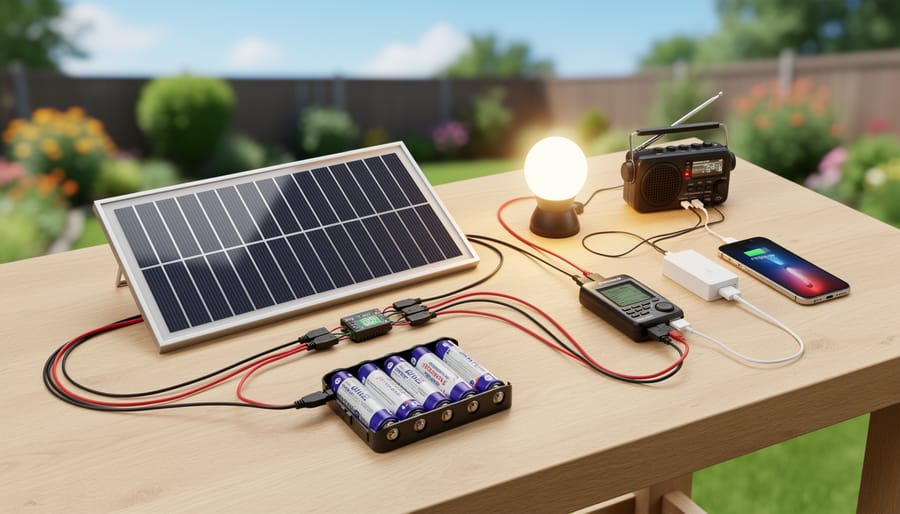
Building a simple 9V solar setup involves connecting the panel to rechargeable batteries and small electronics for portable power.
Quick Assembly Guide
Getting your 9 volt solar panel up and running is surprisingly straightforward, even if you’ve never worked with electronics before. I remember my first assembly—I was honestly a bit nervous about getting the polarity wrong, but once I understood the basics, everything clicked into place.
Start by gathering your components: your 9V solar panel, a charge controller (essential for battery protection), your battery, and whatever device you’re powering. Before connecting anything, check the solar panel setup basics to familiarize yourself with general safety principles.
The golden rule is polarity matters. Most 9V panels have clearly marked positive (red) and negative (black) wires. If yours doesn’t, use a multimeter in the sunlight to identify which is which. Connect the panel’s positive wire to the charge controller’s solar input positive terminal, then negative to negative. From there, connect your battery to the battery terminals on the controller, again matching positive to positive and negative to negative.
Here’s a mistake I made early on: I once skipped the charge controller thinking it wasn’t necessary for such a small setup. Wrong. Even small panels can overcharge batteries, potentially causing damage or safety issues. Always use one.
Double-check all connections are secure before exposing your panel to direct sunlight. Loose connections create resistance, which wastes energy and generates heat. I like to give each wire a gentle tug to ensure it’s firmly attached.
Once everything’s connected, position your panel in direct sunlight and watch your charge controller’s indicator light confirm it’s working. That little green light never gets old—it means you’re officially harnessing the sun’s energy.
9V Panels for Camping and Outdoor Adventures
Lightweight Emergency Power
When I first started exploring solar energy, I thought 9V panels were too small to be truly useful. I was wrong. These compact powerhouses have saved countless camping trips and become essential in my emergency preparedness kit.
The beauty of 9V solar panels lies in their portability. Weighing just a few ounces and fitting easily into a backpack side pocket, they’re perfect for scouts, hikers, and anyone who values preparedness without bulk. I’ve integrated mine into my emergency kit alongside a small battery bank and USB adapter, creating a reliable backup charging station that takes up less space than a paperback book.
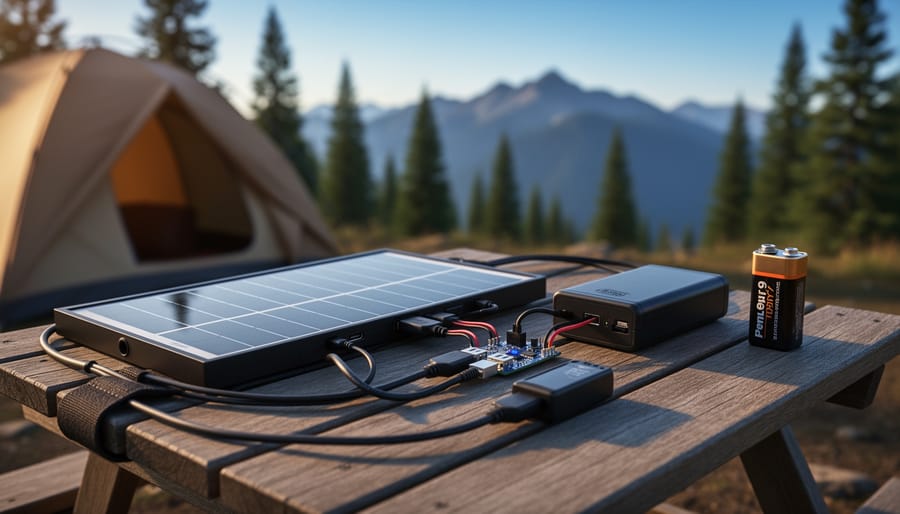
For emergency kits, pair your 9V panel with a rechargeable battery holder and keep spare AA or AAA batteries nearby. This setup ensures you can charge essential devices like flashlights, weather radios, or small GPS units during power outages. The panel can trickle-charge batteries throughout the day, providing consistent power when traditional sources fail.
Backpackers appreciate how these panels clip onto pack straps or tent surfaces, quietly gathering energy while you hike or set up camp. While they won’t rapidly charge smartphones, they excel at maintaining power for headlamps, emergency beacons, and compact electronics. For more robust outdoor needs, consider exploring full portable solar power systems that complement these smaller panels perfectly.
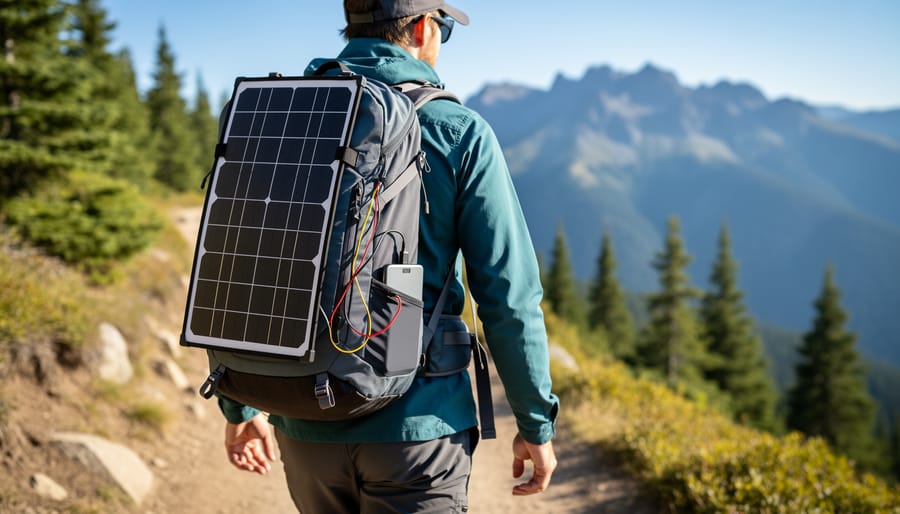
Lightweight 9V solar panels can be easily attached to backpacks for trickle charging during multi-day hiking and camping trips.
Pairing with Battery Banks
One of my favorite camping discoveries was using a 9V solar panel to keep a small battery bank topped up during a week-long backpacking trip. It’s a game-changer when you need reliable power beyond what a single charge can provide.
The key is choosing the right battery bank. Look for rechargeable power banks designed for solar trickle charging, typically ranging from 5,000 to 20,000 mAh capacity. Make sure your battery bank accepts a stable input that matches your panel’s output, usually around 9V or can step down from it. Many portable battery banks have built-in charge controllers, which protect against overcharging during those long sunny days at the campsite.
Here’s the practical setup: Connect your 9V panel to the battery bank’s input port in the morning, position it facing the sun, and let it charge throughout the day while you explore. Even on partly cloudy days, you’ll capture enough energy to extend your phone, GPS, or headlamp usage significantly. I’ve found that a 9V panel can add roughly 20-40% charge to a 10,000 mAh battery bank during a full sunny day.
Pro tip from the trail: Bring a simple voltage meter to monitor charging efficiency. It helps you adjust panel positioning and confirms everything’s working properly, giving you peace of mind miles from the nearest outlet.
Choosing the Right 9V Solar Panel for Your Needs
Key Specifications to Check
When you’re shopping for a 9 volt solar panel, there are a few key specifications that’ll help you pick the right one for your project. I learned this the hard way when I grabbed my first panel without checking the details, and let me tell you, it was a learning experience!
First up is actual wattage output. You’ll see numbers like 1W, 2W, or 5W on most small panels. This tells you how much power the panel can generate in ideal conditions. For charging small batteries or running LED lights, even a 1-2W panel works great.
Next, look at the efficiency rating, usually shown as a percentage. Higher efficiency (around 20-23%) means the panel converts more sunlight into electricity, which matters when space is limited. Don’t stress too much about this for hobby projects though – even 15% efficiency panels work fine.
Weather resistance is crucial if you’re taking your panel outdoors. Look for terms like “water-resistant” or an IP rating (IP65 or higher is solid). This protects your investment from rain and dust.
Finally, check what type of connector comes with the panel. Some have bare wires, others use USB ports or barrel connectors. Make sure it matches what you’re planning to connect, or grab the right adapter ahead of time. Trust me, having the wrong connector on a camping trip is no fun!
Quality vs. Price Considerations
Here’s my honest take from years of tinkering with small solar setups: for simple projects like charging batteries for LED lights or running low-power sensors, budget-friendly 9 volt panels work perfectly fine. I’ve used inexpensive models in garden projects that have lasted several seasons without issues. However, if you’re building something you’ll rely on regularly, like a portable emergency charging station or an outdoor monitoring system, investing in higher-quality panels with better weatherproofing and efficiency ratings pays off in the long run.
Consider your specific needs. Temporary or experimental projects? Go budget. Permanent installations or critical applications? Spend a bit more for panels with solid warranties, better junction boxes, and proven durability. The sweet spot I’ve found is mid-range panels from reputable manufacturers—they offer decent efficiency without breaking the bank. Remember, a slightly more expensive panel that lasts five years beats replacing cheap ones annually. Think about total cost over time, not just the upfront price tag.
Beyond 9V: When to Scale Up Your Portable Solar System
I remember when I first started experimenting with 9V panels, thinking I could power everything from my phone to my laptop. That’s when I learned an important lesson: recognizing when you’ve outgrown your starter setup is just as valuable as building it in the first place.
So how do you know when it’s time to scale up? If you’re constantly combining multiple 9V panels just to get enough juice, or you find yourself wishing you could power devices that need more than a couple watts, you’ve hit the natural ceiling. When charging a single smartphone feels like a major achievement, but you’re dreaming of running LED lights, a small fan, or keeping multiple devices charged, it’s time to graduate.
The good news? Your 9V experience isn’t wasted. Everything you’ve learned about voltage, current, and solar positioning becomes the foundation for bigger projects. Think of 9V panels as your solar training wheels. You’ve proven the concept works, now you’re ready for the real ride.
Your next step typically involves 12V systems, which open up a whole new world of possibilities. From building a solar generator that can power tools and appliances to larger van solar systems for off-grid adventures, the principles remain similar but the capabilities expand dramatically. You’ll work with charge controllers, battery banks, and inverters, but don’t let that intimidate you. If you’ve successfully wired up a 9V panel, you absolutely have what it takes to tackle these bigger challenges.
If there’s one thing I’ve learned from years of tinkering with solar panels, it’s that the best way to understand solar energy is to start small and get your hands dirty. Nine-volt solar panels are perfect entry points into the world of renewable energy. They’re affordable, forgiving when you make mistakes, and incredibly satisfying when you see them power up your first small project.
These compact panels might not run your refrigerator, but they excel as specialized tools for portable applications, educational experiments, and hobby electronics. Whether you’re charging small batteries for a camping trip, powering sensors in a remote location, or simply teaching yourself the fundamentals of solar technology, 9V panels deliver practical value without overwhelming complexity.
My advice? Pick up a panel or two, grab some basic components, and start experimenting. Build that simple phone charger. Power a small LED display. Test different angles and lighting conditions. Each small success builds both your confidence and your understanding of how solar systems work at any scale.
Remember, the Spheral Solar community is here to support your solar journey. You’ll find helpful calculators, project guides, and fellow enthusiasts ready to share their experiences. Start small today, and who knows where your solar adventures will take you tomorrow.
How useful was this post?
Click on a star to rate it!
Average rating 0 / 5. Vote count: 0
No votes so far! Be the first to rate this post.
We are sorry that this post was not useful for you!
Let us improve this post!
Tell us how we can improve this post?
charlesnoble
Here at Spheral Solar, I’m a hands-on solar power enthusiast, constantly exploring and experimenting with DIY solutions. I’m dedicated to sharing my discoveries, insights, and even the bumps I hit along the way, all in the pursuit of a more sustainable future.
Why 9 Volt Solar Panels Are Perfect for Your… by Charlesnoble March 9, 2026 Understand that 9 volt solar panels aren’t actually standardized products delivering exactly 9V—most small panels marketed this way produce anywhere from 6V to 12V depending on sunlight conditions, making them surprisingly versatile for charging batteries, running small electronics, or powering Arduino projects. Match your panel’s actual output voltage to your…
DIY Solar Generator – Complete Guide With Diagrams by Paul July 17, 2021 Building a weatherproof DIY solar generator involves mounting and wiring a battery, charge controller, inverter, trickle charger, and fusing inside a weatherproof case. Then all the relevant input and output sockets are wired and mounted on the outside of the case where they are easily accessible. What Exactly Are Solar…
How I Built a 48V Ebike Solar Charger That Works Anywhere by Charlesnoble January 14, 2026 Calculate your ebike’s battery capacity in watt-hours by multiplying 48 volts by your amp-hour rating—this determines the minimum solar panel wattage you’ll need. A standard 48V 14Ah ebike battery holds 672Wh, requiring at least a 200-watt solar panel for a full day’s charge in optimal sunlight conditions. Match your solar…
How to Choose a J1772 Solar Charger for Your Ebike:… by Charlesnoble July 14, 2026 A J1772 solar charger combines a standard J1772 charging connector (the same Type 1 plug used by most North American EVs and electric bikes) with solar panels and battery components to create an off-grid or grid-supplemented charging system. You’ll need three core elements: solar panels (typically 400-800 watts for practical…
How Does a Solar-Powered Drip Irrigation System Work by Paul September 13, 2021 Heads up: some links here are affiliate links, and purchases through them support the site. As an Amazon Associate I earn from qualifying purchases. Solar-powered drip irrigation can be installed in most gardens using a small solar system, readily available irrigation materials, and minimal tools. If you already have a…
3 Ways to Power an Arduino With Solar Power by Charlesnoble April 24, 2023 To power an Arduino board using solar power, you need a solar panel to generate solar power, a rechargeable battery to store and supply power to your Arduino, and a method to regulate the voltage from the solar panel and prevent overcharging. You can select a solar charge controller with…
Subscribe for handpicked DIY projects, exclusive tips, and giveaways.
Building a solar powered outdoor table takes about 8 to 12 hours and requires basic woodworking skills plus some familiarity with electrical connections. You’ll mount solar panels directly onto a custom-built or modified outdoor table, wire them to a charge controller and battery system housed underneath, and add USB ports or AC outlets for charging… Read more: How to Build a Solar Powered Outdoor Table for Your Camping Setup
Charging a battery bank with a 3-phase inverter requires connecting your inverter’s AC output to a compatible battery charger or hybrid inverter system that can convert the 3-phase power back to DC for storage. Most DIY solar setups achieve this by using a hybrid inverter that handles both solar input and battery charging simultaneously, or… Read more: How to Wire and Configure a Battery Inverter 3 Phase System for Off-Grid Solar
Wiring a 7-pin RV plug correctly connects your tow vehicle to your trailer’s lights, brakes, and auxiliary power in about 45 minutes with basic hand tools and careful attention to the color-coded wire standard. The diagram follows a specific layout mandated by the RV Industry Association: each pin controls a distinct function, from left turn… Read more: How to Wire a 7-Way RV Plug: Step-by-Step Diagram and Setup Guide