Why Your DIY Solar Project Needs a Commercial-Grade Inverter
Updated:
Compare your power needs against inverter capacity ratings before choosing between string, central, or micro-inverter configurations—commercial systems typically handle 10kW to 500kW, far exceeding residential 3-10kW units. Calculate your total panel wattage, then add 25% overhead to account for startup surges and future expansion. A 50kW system, for instance, performs best with a 60-65kW rated inverter.
Evaluate whether commercial-grade equipment makes financial sense for your DIY project by dividing the total system cost by your expected annual energy savings. Commercial inverters cost $0.10-$0.30 per watt compared to residential models at $0.15-$0.40 per watt, but installation complexity and permitting requirements often offset these savings for smaller installations under 25kW.
Check compatibility between your chosen inverter’s input voltage range and your solar panel configuration. Most commercial string inverters operate between 300-1000V DC, requiring series panel connections that create serious safety considerations for DIY installers. Central inverters demand even higher voltages but offer the lowest per-watt cost for systems exceeding 100kW.
Verify local utility interconnection requirements before purchasing, as many jurisdictions mandate specific certifications, remote monitoring capabilities, and rapid shutdown features that vary by equipment type. Your utility may require IEEE 1547 compliance, UL 1741 certification, or specific anti-islanding protections.
I learned this lesson after purchasing a fantastic commercial inverter at auction, only to discover my local utility wouldn’t approve the interconnection without $3,000 worth of additional monitoring equipment. Commercial solar inverters offer incredible value for ambitious DIY projects, but success depends on matching the right technology to your specific situation, understanding the permitting landscape, and honestly assessing whether the complexity suits your skill level and budget constraints.
What Makes a Commercial Solar Inverter Different
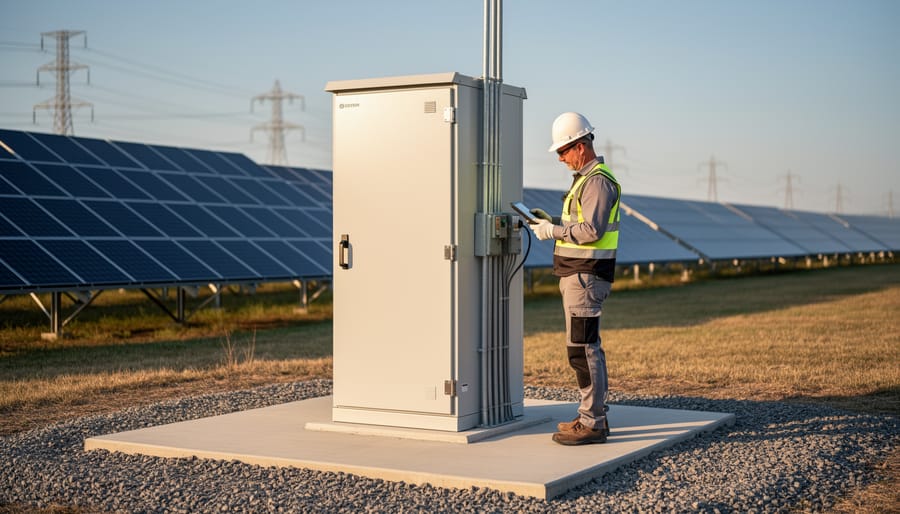
Commercial-grade solar inverters feature robust weatherproof construction designed for continuous outdoor operation in harsh environments.
Power Capacity and Scalability
Commercial solar inverters are built for serious power output, typically starting at 25kW and ranging up to several hundred kilowatts or even megawatts for industrial applications. To put that in perspective, a residential setup might use a 5-10kW inverter, while a commercial unit could power an entire warehouse or small factory.
What makes these inverters particularly interesting for ambitious DIY projects is their modular design. Think of them like building blocks: you can start with one unit and add more as your energy needs grow or your budget allows. I remember talking with a friend who started with a single 30kW inverter for his workshop and later added two more units when he expanded his operations. The inverters communicated seamlessly, effectively creating a 90kW system without replacing the original equipment.
This scalability means you’re not locked into your initial investment. Many commercial inverters use string configurations or master-slave setups, where multiple units work together as a coordinated system. If you’re planning a large barn conversion, community space, or small business, this flexibility lets you phase your installation over time rather than financing everything upfront. The trade-off is complexity in the initial setup and ensuring proper system communication between units.
Durability and Weather Resistance
Commercial solar inverters are built like tanks, and there’s a good reason for that. Unlike residential units that might sit comfortably in your garage or basement, commercial inverters often live outdoors 24/7, facing whatever Mother Nature throws at them.
When I first helped install a commercial-grade inverter at a community solar project, I was amazed by the heavy-duty casing. These units typically feature IP65 or IP66 ratings, which means they’re completely dust-tight and can handle powerful water jets from any direction. Think heavy rain, snow, dust storms, and scorching sun, all year round.
The construction usually involves corrosion-resistant aluminum or stainless steel enclosures with specialized coatings. Ventilation systems use advanced thermal management to prevent overheating during peak summer operation. Many commercial inverters can operate in temperature ranges from -13°F to 140°F, far exceeding what residential units handle.
This rugged build quality isn’t just about weatherproofing. Commercial inverters are designed for continuous operation, sometimes running at full capacity for 25+ years. The internal components, from capacitors to circuit boards, use industrial-grade materials that can withstand constant electrical stress.
For DIY enthusiasts considering commercial equipment, remember that this durability comes at a price premium, but it’s worth it if you’re planning a large-scale installation that truly needs commercial-grade reliability.
Advanced Monitoring and Control Features
Here’s where commercial solar inverters really shine—and honestly, it’s something I wish I’d understood earlier in my solar journey. These units come with monitoring capabilities that would make a tech enthusiast’s heart skip a beat.
Most commercial inverters include built-in internet connectivity, allowing you to track every kilowatt-hour from your smartphone or computer. The software dashboards display real-time production data, system health alerts, and even historical performance graphs. I remember checking my friend’s commercial setup remotely while he was on vacation—we spotted a minor efficiency dip and scheduled maintenance before it became a problem.
The remote diagnostics feature is particularly valuable for DIY installations. Instead of climbing on your roof with a multimeter, the system can pinpoint exactly which string is underperforming or if a connection needs attention. Many manufacturers offer smartphone apps that send push notifications if anything goes awry.
For those interested in grid interaction, these inverters support advanced features like frequency regulation and voltage support. They can automatically adjust power output based on grid conditions, essentially helping stabilize your local electrical network. Some models even enable demand response programs, where your utility might compensate you for allowing them to slightly adjust your system during peak demand periods.
The data logging alone makes troubleshooting infinitely easier compared to residential units.
When DIYers Should Consider Commercial Inverters
Large Home Systems and Multi-Building Setups
If you’re managing a homestead with multiple buildings, a workshop separate from your house, or a small farm operation, commercial solar inverters might be exactly what you need. I remember visiting a friend’s property where he’d set up a 30kW system to power his home, metal fabrication shop, and guest cottage. Instead of installing three separate residential systems, he centralized everything with a single commercial inverter setup, which simplified maintenance and reduced overall costs.
The beauty of this approach is efficiency at scale. Commercial inverters handle higher voltages and currents, meaning you can run longer cable distances between buildings without significant power loss. This matters when your barn sits 200 feet from your solar array. You’ll also appreciate having one monitoring system instead of juggling multiple apps for different inverters.
When planning a multi-building setup, calculate your total peak load across all structures, then add at least 20 percent headroom for future expansion. Many DIYers underestimate how quickly power needs grow once you add that woodworking shop or start an electric vehicle charging station.
One practical tip: consider installing a commercial inverter even if you’re starting with just your home. The scalability means you can easily add circuits for future buildings without replacing your entire system. It’s the difference between planning ahead and paying twice.
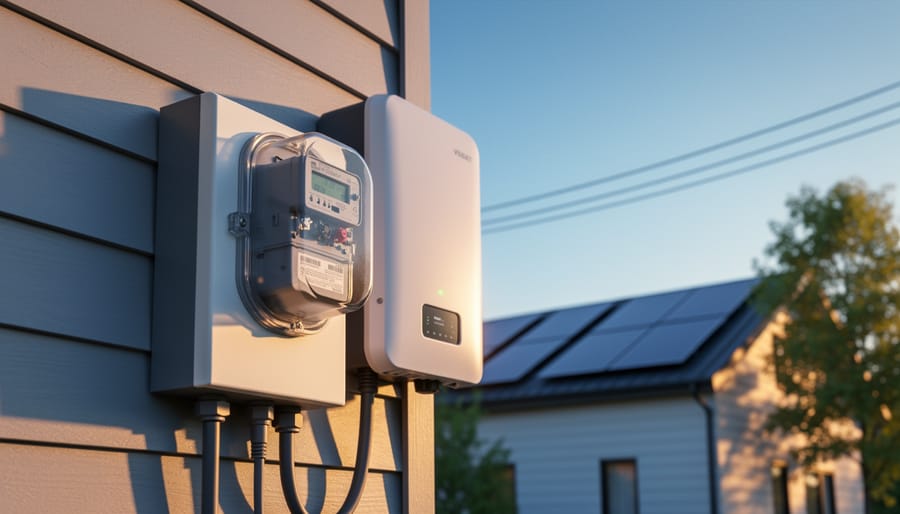
Large-scale residential solar installations with multiple buildings often benefit from commercial-grade inverter capacity and reliability.
Off-Grid Camping Facilities and Community Projects
Commercial solar inverters are finding exciting new applications in off-grid camping facilities and community solar projects. I remember visiting a scout camp last summer that had installed a 15kW commercial inverter to power their entire main lodge and kitchen facilities. The camp director told me it completely transformed their summer programs, allowing them to run refrigeration units and modern cooking equipment without noisy generators disturbing the wilderness experience.
For campgrounds and retreat centers, commercial inverters paired with battery backup systems provide reliable power for communal buildings, water pumping stations, and basic amenities. The key advantage is scalability. You can start with a smaller array and expand as your community grows or seasonal demands increase.
Rural communities are also discovering that commercial inverters make shared solar installations more practical. A group of five neighboring farms in Montana pooled resources to install a 25kW system with a central commercial inverter, distributing power through a simple microgrid. The investment split among multiple families made commercial-grade equipment surprisingly affordable.
When planning these projects, focus on choosing inverters with robust monitoring capabilities so everyone can track system performance. Look for units rated for harsh outdoor conditions and extended warranties, since professional service calls to remote locations can be expensive.
When Future Expansion is in Your Plans
Planning to expand your solar setup over the next few years? Starting with commercial equipment might actually save you money in the long run. I learned this the hard way when I outgrew my residential inverter just two years into my solar journey and had to replace the entire system.
Commercial inverters offer built-in scalability that residential models simply can’t match. They’re designed to handle additional panel arrays without requiring a complete equipment overhaul. While the upfront cost runs 30-50% higher than residential options, you’ll avoid the expensive replacement cycle that catches many DIY enthusiasts off guard.
Think of it like buying a truck when you know you’ll eventually need to haul heavy loads. Sure, a sedan costs less today, but you’ll spend more replacing it later. If your solar roadmap includes doubling your array within five years, commercial equipment becomes the economical choice, even for home installations.
The Three Main Types of Commercial Solar Inverters
Commercial String Inverters
Commercial string inverters are the workhorses of larger solar installations, and understanding how they operate can help you determine if they’re right for your ambitious DIY project. Think of them as the industrial cousins of residential string inverters, designed to handle significantly more power and panels.
Here’s how they work: multiple solar panels connect in series to form strings, and these strings feed into a single commercial-grade inverter. I remember visiting a friend’s small business where he’d installed a 50kW system himself. The simplicity amazed me—twenty panels per string, three strings total, all managed by one robust inverter. When comparing string inverters vs microinverters, commercial string units excel in large-scale applications.
Commercial string inverters typically range from 20kW to over 100kW, making them ideal for warehouses, farms, or community projects. Their main advantages include lower per-watt costs, centralized monitoring, and simpler installation compared to managing hundreds of microinverters. You’re essentially converting DC power from entire arrays at one central location rather than at each panel.
The downside? If one panel underperforms due to shading, it affects the entire string’s output. However, modern units include maximum power point tracking for each string input, which helps minimize these losses. For DIYers tackling commercial-scale projects, these inverters offer professional-grade performance without overwhelming complexity.
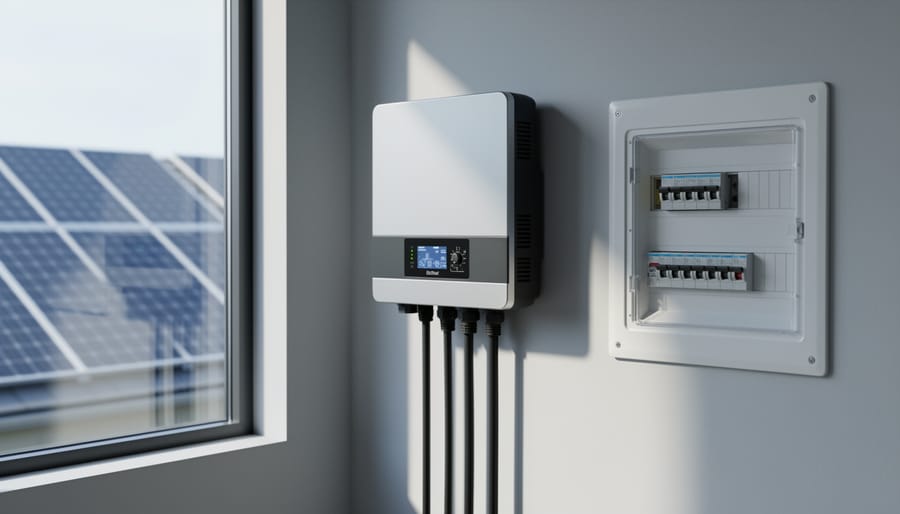
Commercial string inverters handle high-voltage connections from multiple solar panel strings through robust industrial-grade terminals.
Central Inverters for Massive Arrays
Central inverters are the giants of the solar world—massive units designed for utility-scale installations like solar farms covering acres of land. We’re talking systems handling hundreds of kilowatts to several megawatts of power, far beyond what most DIY projects will ever need.
I’ll be honest with you: when I first encountered a central inverter at a commercial solar farm, I was genuinely intimidated. These units are roughly the size of a garden shed, require professional installation teams, and come with price tags that could buy a nice car. They make sense for large businesses, industrial facilities, or commercial developments where economies of scale justify the investment.
Here’s why central inverters work for massive operations: they consolidate all your power conversion in one location, reducing equipment costs per watt and simplifying monitoring. However, they create a single point of failure—if the central inverter goes down, your entire array stops producing power until it’s repaired.
For DIYers tackling even ambitious home or small business projects, string inverters or microinverters remain the practical choice. Understanding central inverters helps you appreciate the full spectrum of solar technology and might inform future conversations with contractors or business partners, but chances are excellent you won’t need one yourself.
Commercial-Grade Microinverters
When I first explored commercial-grade microinverters for a community solar project, I was pleasantly surprised by how approachable they’ve become for DIY enthusiasts. Unlike residential models that typically handle 250-350 watts, commercial microinverters are built to manage higher-capacity panels ranging from 400-600 watts, making them ideal for larger installations without the complexity of string inverters.
The real beauty of commercial microinverters lies in their modularity. Each panel operates independently, so if one underperforms due to shading or a technical issue, the rest of your system keeps humming along. This is a game-changer for hobbyists tackling ambitious projects where consistent output matters. Plus, expansion becomes incredibly straightforward – just add more panels and their paired microinverters without reconfiguring your entire system.
Installation is notably DIYer-friendly, though you’ll still want to check local electrical codes and permit requirements. The plug-and-play nature means you’re connecting individual units rather than wrestling with complex string configurations. I’ve found that many manufacturers now offer monitoring apps that let you track each panel’s performance from your phone, turning troubleshooting into an educational experience rather than a frustrating guessing game.
Just remember: commercial-grade doesn’t necessarily mean commercial-only. These robust units are increasingly accessible for serious DIY projects, though they do carry a premium price tag compared to residential options.
Key Features to Look for in Commercial Solar Inverters
Efficiency Ratings That Actually Matter
When I first started comparing commercial inverters, I got caught up in peak efficiency numbers—those impressive 98% figures manufacturers love to highlight. Here’s what I learned the hard way: peak efficiency only tells you how the inverter performs under ideal conditions, which happens maybe an hour or two per day.
What really matters is weighted efficiency, sometimes called California Energy Commission (CEC) efficiency. This metric accounts for performance across varying sunlight conditions throughout the day—from dawn to dusk, cloudy skies to high noon. A commercial inverter with 97% weighted efficiency will harvest significantly more energy annually than one with 98% peak but only 95% weighted efficiency.
For commercial-grade inverters, look for weighted efficiency ratings above 96%. The best models hit 97-98% weighted efficiency. That 2-3% difference might seem small, but over 25 years, it translates to thousands of dollars in energy production. Think of it this way: a higher weighted efficiency means your system works smarter across all conditions, not just during perfect sunshine. This becomes especially important for larger DIY installations where every percentage point affects your return on investment.
Grid-Tie vs. Off-Grid Capabilities
When I first explored commercial solar setups, understanding the difference between grid-tie and off-grid systems felt like choosing between two completely different philosophies. Grid-tie inverters connect directly to your utility power grid, allowing you to send excess solar energy back for credits while drawing power when your panels aren’t producing enough. Think of it as a partnership with your power company. Off-grid inverters, on the other hand, operate independently with battery storage, giving you complete energy autonomy but requiring careful capacity planning.
For most DIY projects, grid-tie systems offer the simplest entry point since they don’t require expensive battery banks and complicated charge controllers. You’re essentially using the grid as your backup battery. Off-grid setups shine in remote locations without utility access or for folks committed to total energy independence.
Here’s the exciting part: hybrid inverters combine both capabilities, letting you stay grid-connected while maintaining battery backup for outages. These versatile units cost more upfront but provide flexibility as your needs evolve. For ambitious DIYers tackling commercial-grade projects, hybrid systems represent the sweet spot between reliability and independence.
Warranty Length and Service Accessibility
When investing in a commercial solar inverter, you’re looking at warranty periods ranging from 10 to 25 years, which reflects the robust build quality of these units. I remember when my neighbor upgraded to a commercial inverter for his workshop, the 15-year warranty gave him tremendous peace of mind compared to his previous residential unit’s 5-year coverage.
Here’s what matters beyond the warranty length: Can you actually access service when needed? Commercial inverters often require specialized technicians, so check if the manufacturer has local service centers or authorized repair partners within reasonable distance. Some companies offer remote diagnostics and troubleshooting, which can save you time and travel costs.
The DIY serviceability question is important for our community. While basic maintenance like cleaning and visual inspections are straightforward, internal repairs typically aren’t DIY-friendly due to high voltages and complex electronics. That said, many commercial inverters feature modular designs that allow technicians to swap components quickly, reducing downtime. Before purchasing, ask manufacturers about parts availability, typical repair turnaround times, and whether extended warranty options make financial sense for your project.
User-Friendly Monitoring Systems
Modern commercial inverters come with monitoring systems that put real-time data right at your fingertips. Most manufacturers offer smartphone apps that let you track energy production, consumption patterns, and system health from anywhere. I remember checking my system’s performance from a coffee shop and catching a minor efficiency dip before it became a real problem.
Look for inverters with intuitive dashboards that display key metrics without requiring an engineering degree to interpret. The best systems offer historical data logging, helping you identify seasonal patterns and optimize panel angles or energy usage. Many platforms also send alerts for maintenance needs or performance issues, giving you peace of mind and preventing costly downtime in your solar setup.
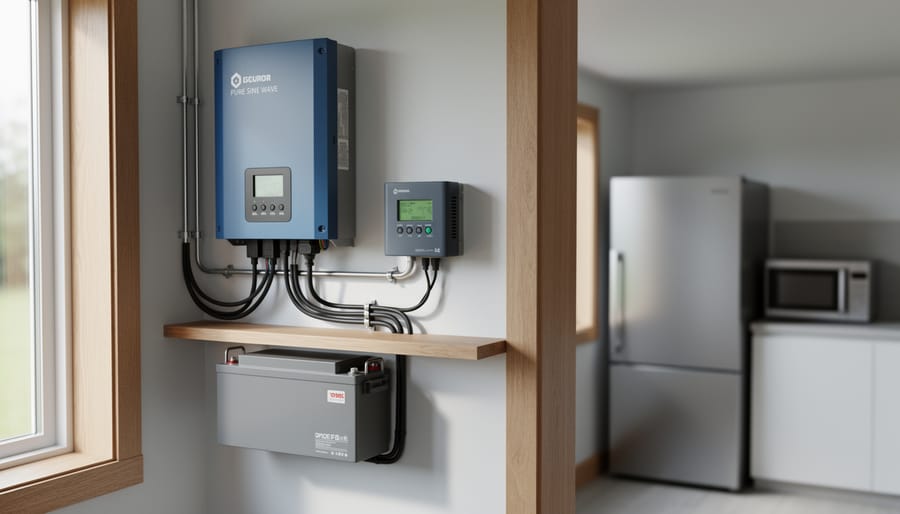
Modern commercial inverters offer intuitive smartphone monitoring that makes system management accessible to DIY solar enthusiasts.
The Real Cost of Commercial Solar Inverters
Price Ranges and What You Get
Commercial solar inverters represent a significant investment, and understanding the pricing landscape helps you make informed decisions. Let’s break down what you can expect to pay and what you’re getting for your money.
String inverters for commercial applications typically start around $0.15 to $0.30 per watt. For a 50kW system, you’re looking at roughly $7,500 to $15,000. These entry-level options work great for straightforward installations without shading issues.
Central inverters, designed for larger operations, range from $0.12 to $0.25 per watt. A 100kW central inverter might cost between $12,000 and $25,000. The economies of scale kick in here, making them cost-effective for bigger projects.
Microinverters and power optimizers sit at the higher end, around $0.30 to $0.50 per watt, but remember you’re paying for individual unit control and better performance in challenging conditions.
When I helped a community center evaluate their solar options, we discovered that spending an extra $3,000 on better inverters saved them thousands in long-term maintenance and efficiency gains. The cost-per-watt perspective matters, but don’t forget to factor in warranty coverage, efficiency ratings, and monitoring capabilities when comparing options.
Hidden Costs and Installation Considerations
Before you get too excited about powering your workshop with a commercial solar inverter, let’s talk about what doesn’t appear on the price tag. I learned this the hard way during my community solar project—that shiny inverter was just the beginning.
First, you’ll need substantial additional equipment. Commercial inverters require heavy-duty mounting hardware, specialized disconnects, and often commercial-grade monitoring systems that can add $500-$2,000 to your budget. The electrical panel upgrades alone might cost another $1,000-$3,000, especially if your current setup wasn’t designed for this level of power.
Installation complexity is where things get serious. Unlike residential units, commercial inverters often weigh over 100 pounds and need precise positioning for optimal cooling and accessibility. You’ll likely need help—both the human kind and potentially equipment rentals like lifts.
Permitting deserves its own conversation with your local building department. Commercial equipment typically triggers commercial permit requirements, even for residential properties, meaning longer approval times and potentially higher fees.
Can you DIY this? Honestly, partial DIY is your best approach. Handle the planning, equipment selection, and maybe the mounting prep, but bring in a licensed electrician for the actual connections. Most jurisdictions require professional certification for final inspection anyway, and your insurance company will thank you.
Top Commercial Solar Inverter Brands Worth Considering
SMA and Fronius: European Engineering
When I first started exploring commercial-grade equipment, SMA and Fronius kept appearing in professional solar forums, and for good reason. These European manufacturers have built reputations on precision engineering that frankly puts them in a different league.
SMA, the German powerhouse, produces inverters that commercial installers swear by for their legendary reliability. Their Sunny Tripower series handles everything from small commercial setups to massive solar farms, with monitoring systems so detailed you’ll know exactly what’s happening with every panel. I’ve talked with DIYers who invested in SMA units and haven’t experienced a single issue in over a decade.
Fronius, hailing from Austria, brings similarly impressive build quality with some of the most intuitive interfaces I’ve encountered. Their SnapINverter mounting system makes installation surprisingly straightforward, even for ambitious home projects. The Fronius Symo and Eco models offer exceptional efficiency ratings often exceeding 98%.
The catch? These premium brands command premium prices, typically 20-30% more than competitors. However, their extended warranties (often 10+ years standard) and lower failure rates make them worthwhile investments for serious DIY solar enthusiasts planning large-scale installations. Think of them as the engineering-focused choice when reliability absolutely matters.
SolarEdge and Enphase: Smart Technology Leaders
SolarEdge and Enphase have revolutionized how we think about solar power efficiency, and I’ve seen firsthand how their monitoring capabilities can transform a solar installation from mysterious to completely transparent.
SolarEdge specializes in power optimizers paired with their string inverters. Each panel gets its own optimizer, which means if one panel is shaded or underperforming, it won’t drag down your entire array’s output. The monitoring platform is incredibly detailed, showing you production down to the individual panel level. I remember installing my first SolarEdge system and being amazed at how quickly I spotted a poorly performing panel that had a manufacturing defect.
Enphase takes a different approach with true microinverters, placing a small inverter on each panel. This offers similar benefits with even more modularity since each panel operates completely independently. Their Enlighten monitoring app is user-friendly enough that even your less tech-savvy neighbors could understand their system’s performance.
Both brands offer professional-grade monitoring that helps you optimize performance and quickly identify issues, making them excellent choices for ambitious DIY projects where ongoing system management matters.
Budget-Friendly Commercial Options
You don’t need to break the bank for commercial-grade performance. Brands like Fronius, SMA, and GoodWe offer mid-range inverters that pack essential commercial features at friendlier price points. I’ve worked with several community solar projects that relied on these manufacturers, and they consistently delivered solid performance without the enterprise-level costs. These units typically include robust monitoring capabilities, scalable designs, and warranties that match pricier competitors. For ambitious DIYers tackling larger installations, these budget-conscious options provide the reliability and expandability you need while keeping your project financially viable.
Charles’s Experience: Installing a Commercial Inverter on the Homestead
When I decided to upgrade my off-grid homestead last spring, I thought I’d researched everything. I’d been running a standard residential inverter for three years, but as we added a workshop with power tools and my wife started her pottery studio with electric kilns, our energy demands skyrocketed. That’s when I started eyeing commercial-grade inverters.
The decision wasn’t easy. Commercial inverters cost significantly more than residential models, and honestly, I second-guessed myself constantly. But after calculating our peak loads and future expansion plans, I realized we needed something robust that could handle 15-20 kW continuously. I settled on a three-phase commercial inverter rated for 25 kW.
The installation was humbling. I’ve tackled plenty of DIY solar projects, but this was different. The unit weighed nearly 200 pounds, requiring two friends and a small crane to mount. The wiring was far more complex than anything I’d done before, with multiple input strings and a sophisticated monitoring system. I spent an entire weekend just reading the manual and watching installation videos.
My biggest challenge came during commissioning. The inverter kept throwing fault codes, and I spent hours troubleshooting solar inverter issues before discovering my ground fault protection settings were incorrectly configured. A quick call to tech support solved it, but it reminded me that commercial equipment assumes a certain level of expertise.
Was it worth it? Absolutely. Six months in, the inverter runs flawlessly, handling our variable loads without breaking a sweat. The efficiency gains alone have increased our usable power by about 8 percent compared to our old setup. The remote monitoring capabilities let me track performance from my phone, catching small issues before they become problems.
My advice: If you’re considering going commercial, be realistic about your technical skills and budget for professional consultation, even if you’re doing the installation yourself. These systems are incredibly capable, but they demand respect and proper setup to perform their best.
Making the Decision: Is a Commercial Inverter Right for Your Project?
So you’ve learned about commercial inverters and their capabilities—now comes the big question: do you actually need one for your project? Let me share a quick story. A friend of mine, eager to power his workshop with solar, almost bought a massive commercial inverter because it seemed more “future-proof.” After we sat down and crunched the numbers, he realized a residential-grade system would save him thousands while perfectly meeting his needs. That conversation inspired me to create this simple decision framework.
Start by asking yourself these key questions. First, what’s your total power requirement? If you’re looking at systems under 10 kW, residential inverters typically offer better value and simpler installation. Commercial inverters really shine when you’re scaling beyond 15-20 kW—think powering entire workshops, small businesses, or community projects.
Next, consider your expansion plans. Are you starting small with hopes to grow significantly? Commercial inverters often handle phased expansion more gracefully, letting you add capacity in modules without replacing your entire system. For single-phase home projects with no major growth planned, stick with residential options.
Here’s a practical checklist to guide you: Do you need three-phase power? That’s commercial territory. Is your project in a harsh environment requiring industrial-grade durability? Point toward commercial. Will you integrate battery storage exceeding 20 kWh? Commercial inverters handle larger battery banks better. Are you comfortable with complex monitoring systems and potentially hiring professionals for setup? If not, residential might be your friend.
Think about your budget realistically. Commercial equipment costs more upfront and often requires professional installation. Factor in maintenance accessibility too—can you easily get support in your area?
Remember, sizing your inverter properly matters more than choosing the fanciest equipment. A well-matched residential inverter beats an oversized commercial unit every time. When in doubt, start with your actual power needs and work backward—not the other way around.
Choosing the right commercial solar inverter for your DIY project doesn’t have to feel overwhelming. Throughout this article, we’ve covered the essential differences between commercial and residential inverters, explored when stepping up to commercial equipment makes sense, and walked through the key features that matter most for ambitious solar installations.
Remember, commercial inverters shine when you’re dealing with larger power requirements, need exceptional reliability, or want advanced monitoring capabilities. But they’re not always the best choice for every project. Take time to honestly assess your actual needs, available budget, and comfort level with more complex equipment. Sometimes a residential-grade inverter does the job perfectly fine.
I’ve been exactly where you are now, standing at the crossroads of deciding whether to invest in commercial-grade equipment. My advice? Start with the numbers. Use the sizing calculators available on Spheral Solar to determine your actual power requirements and system specifications. These interactive tools take the guesswork out of the equation and help you make decisions based on real data rather than assumptions.
Don’t forget that you’re part of a vibrant community of DIY solar enthusiasts who’ve tackled similar challenges. Reach out, ask questions, and share your own experiences as you progress. The collective knowledge in our community is invaluable.
Your DIY solar journey is about more than just saving money or reducing your carbon footprint. It’s about taking control of your energy independence and learning incredible skills along the way. Whether you choose a commercial inverter or stick with residential equipment, you’re making a positive impact. Keep building, keep learning, and enjoy every step of this rewarding adventure.
How useful was this post?
Click on a star to rate it!
Average rating 0 / 5. Vote count: 0
No votes so far! Be the first to rate this post.
We are sorry that this post was not useful for you!
Let us improve this post!
Tell us how we can improve this post?
charlesnoble
Here at Spheral Solar, I’m a hands-on solar power enthusiast, constantly exploring and experimenting with DIY solutions. I’m dedicated to sharing my discoveries, insights, and even the bumps I hit along the way, all in the pursuit of a more sustainable future.
Micro Inverter vs String Inverter: Which Is Better… by Charlesnoble October 23, 2023 In the ever-evolving landscape of solar energy, choosing between micro inverter vs string inverter has become a pivotal decision for residential and commercial solar installations. Microinverters and string inverters are different technologies for converting the DC power generated by solar panels into usable AC power for your home. But which…
Why Grid-Tie Solar Inverters Are Your Gateway to… by Charlesnoble December 4, 2025 Grid-tie solar inverters transform your solar panels’ DC electricity into AC power that feeds directly into your home’s electrical system and the utility grid, eliminating the need for expensive battery banks while letting you earn credits for excess power you generate. When your panels produce more electricity than you’re using,…
Why 3-Phase Solar Inverters Are Game-Changers for… by Charlesnoble January 29, 2026 Check your main electrical panel right now—if you see three thick power cables entering your home instead of two, you already have 3-phase power and might benefit from a 3-phase solar inverter. Most residential homes run on single-phase power, making 3-phase systems unnecessary for typical DIY solar setups, so understanding…
Size Your Off-Grid Solar Inverter Right the First… by Charlesnoble February 10, 2026 Calculate your total daily energy consumption by listing every device you’ll power, multiplying each device’s wattage by hours of daily use, then adding 20% for system losses. This single number becomes your foundation—underestimate it, and you’ll face frustrating power shortages; overestimate significantly, and you’ll waste thousands on oversized equipment. Identify…
Why Your Home Solar System Fails During Power… by Charlesnoble March 8, 2026 Picture this: It’s 2 AM, a storm knocks out power in your neighborhood, and while your neighbors scramble for flashlights, your home stays lit, your refrigerator keeps running, and your family sleeps soundly. That’s the peace of mind a solar battery backup system delivers, and honestly, it’s one of the…
Why Your RV Inverter Keeps Failing (And How to Fix It Fast) by Charlesnoble January 11, 2026 Check your battery connections first—loose or corroded terminals account for nearly 60% of inverter issues I’ve seen in my years working with RV solar systems. Remove both positive and negative cables, clean them with a wire brush and baking soda solution, then reconnect tightly. While you’re at it, use a…
Subscribe for handpicked DIY projects, exclusive tips, and giveaways.
Standard 9V batteries typically deliver 400 to 600 mAh capacity, though the exact number depends on battery chemistry and discharge rate. Alkaline 9V batteries average around 500-565 mAh, while rechargeable NiMH versions offer 200-300 mAh, and lithium variants can reach 1200 mAh under ideal conditions. Understanding these numbers matters when you’re designing a solar backup… Read more: How to Convert 9V Battery Capacity to mAh (And Why It Matters for Your Solar Projects)
In the interest of transparency — we earn a commission on some purchases made through links on this site. After putting half a dozen home backup power stations through real outages and days of load testing, we found the EcoFlow DELTA Pro Ultra delivers the most comprehensive whole-home protection with its 12kWh capacity, true 120/240V… Read more: 7 Best Portable Power Stations for Home Backup of 2026, Tested and Reviewed
Nine times out of ten, an RV generator that won’t start has a stale fuel problem. If your generator hasn’t run in more than 30 days, degraded gasoline is likely gumming up the carburetor and preventing ignition. Before you panic or call for expensive roadside service, try this: turn on the generator’s fuel valve (if… Read more: RV Generator Troubleshooting: Common Problems and How to Fix Them