Why Your Stored Grain Needs to Breathe (And How Solar Makes It Happen)
Updated:
Position your grain bins in locations with maximum sun exposure, ideally south-facing with minimal shade obstruction throughout the day. Solar panels need just 4-6 hours of direct sunlight to power most small-scale aeration systems effectively.
Calculate your power requirements by measuring your grain storage volume in cubic feet and multiplying by 0.1 CFM (cubic feet per minute) to determine the airflow your fan needs to deliver. A typical 100-cubic-foot storage bin requires a 10 CFM fan, which a modest 50-watt solar panel can easily power during peak hours.
Install perforated ducts or aeration tubes at the bottom of your storage containers before filling them with grain, creating channels that distribute airflow evenly throughout the entire mass. Without proper distribution, you’ll create pockets where moisture accumulates and mold develops, defeating the entire purpose of your system.
Run your solar-powered fans during the coolest parts of the day when outside temperature drops below the grain temperature, typically early morning or evening hours. I learned this the hard way after my first harvest when I ran fans during midday heat and actually increased moisture problems instead of solving them.
Monitor grain temperature with simple probe thermometers placed at different depths, checking weekly during the first month of storage and monthly thereafter. Temperature spikes of 10-15 degrees Fahrenheit indicate moisture migration or insect activity that requires immediate attention.
Understanding grain aeration fundamentals transforms how you approach food storage and energy independence. Whether you’re preserving a backyard harvest or managing commercial quantities, combining proven agricultural practices with accessible solar technology puts professional-grade preservation within reach of any motivated DIYer willing to invest a weekend and modest budget into building a reliable system.
What Is Grain Aeration and Why It Matters
The Science Behind Grain Spoilage
Think of grain storage like keeping leftovers in your fridge. When you leave food in a warm, damp environment without proper airflow, things go south pretty quickly. The same principle applies to your stored grain, just on a larger scale.
Grain spoilage happens when three troublemakers team up: moisture, temperature, and stagnant air. When grain moisture levels climb above 14-15%, you’ve basically rolled out the welcome mat for mold and fungi. Add warmth into the mix, and these unwanted guests multiply rapidly. I learned this the hard way during my first harvest season when I stored wheat at around 16% moisture. Within weeks, I noticed that musty smell, a clear sign mold had moved in.
Temperature plays a huge role too. Grain stored above 60°F becomes an ideal breeding ground for insects like weevils and grain beetles. These pests don’t just eat your grain, they also generate heat and moisture through their metabolism, creating a vicious cycle that accelerates spoilage.
Here’s where it gets interesting: without proper airflow, hot spots develop inside your grain bin. Picture a compost pile generating heat as organic matter breaks down. Stored grain does something similar when moisture pockets form. These hot spots can raise temperatures by 10-20 degrees, turning small problem areas into major losses.
The good news? Consistent aeration breaks this cycle by moving air through your grain, controlling both moisture and temperature. It’s like opening windows in a stuffy room, except your grain depends on it for long-term survival.
Without proper aeration, stored grain develops moisture problems and mold growth that can destroy entire harvests.
When to Aerate Your Grain
Knowing when to run your aeration system is just as important as having one in the first place. I learned this the hard way during my first harvest season when I ran my fans constantly and wondered why my solar setup couldn’t keep up. The truth is, strategic timing makes all the difference.
The golden rule for grain aeration is simple: run your system when outside air temperature is at least 10 to 15 degrees Fahrenheit cooler than your stored grain temperature. This temperature differential creates efficient cooling without wasting energy. I check my grain temperature probe every evening during late summer and fall, looking for those perfect cool nights when the differential hits that sweet spot.
Seasonal timing matters tremendously. In most regions, the best aeration windows occur during spring and fall when nighttime temperatures drop significantly. During hot summer months, you’ll want to aerate during the coolest parts of the night, typically between midnight and early morning. Your solar battery bank becomes essential here, storing daytime energy for these overnight cooling sessions.
Moisture content is your other critical trigger. If your grain moisture rises above safe storage levels, typically 13 to 15 percent depending on the grain type, you need to aerate immediately regardless of temperature considerations. High moisture combined with warm temperatures creates the perfect storm for spoilage.
I keep a simple notebook by my grain bins with daily temperature readings and moisture checks. This old-school approach helps me spot trends and make smart decisions about when to let my solar-powered fans do their work.
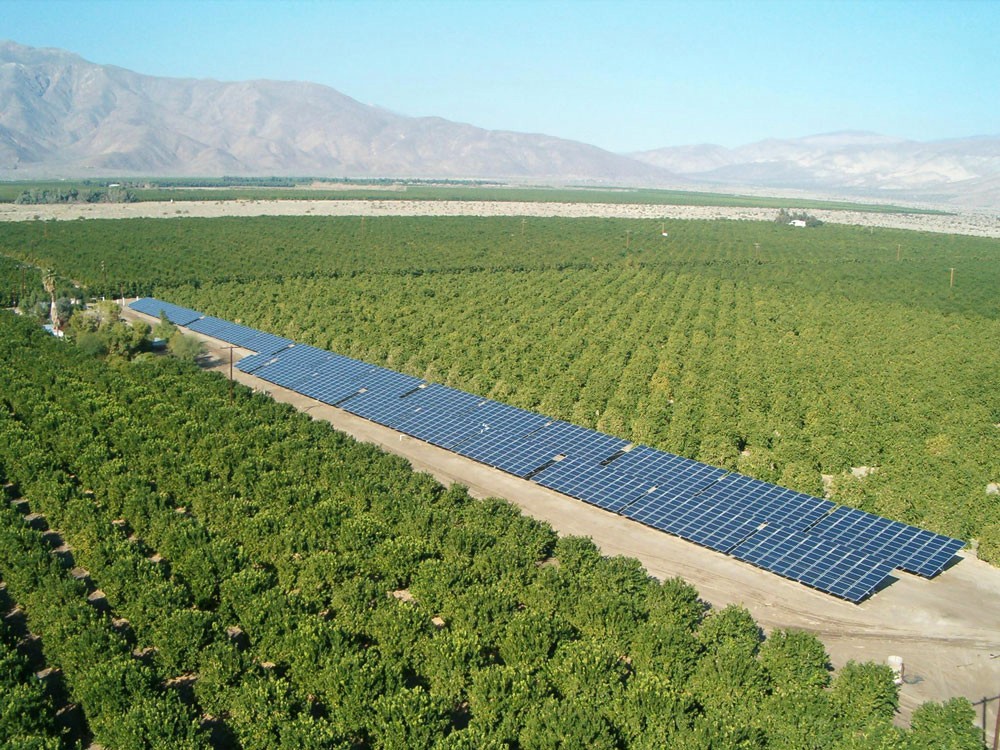
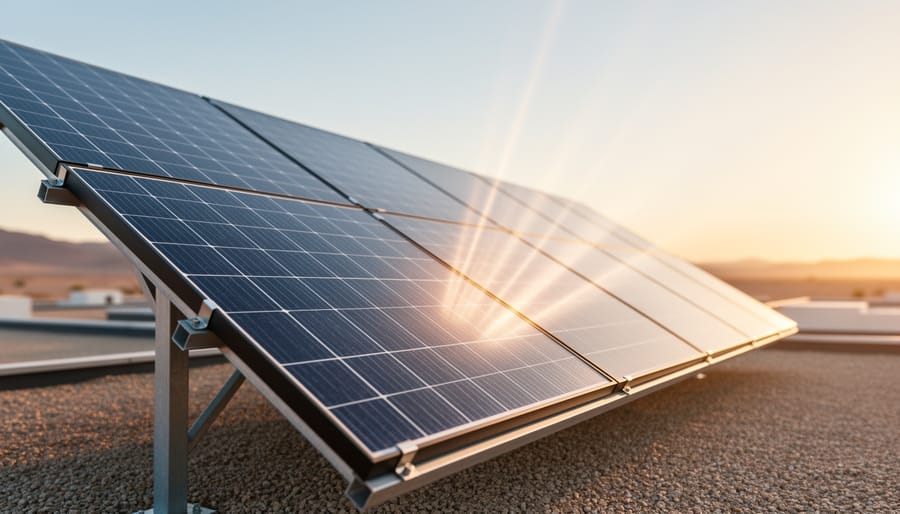
Solar panels paired with grain storage bins create an energy-independent aeration system perfect for remote farm locations.
Why Solar Power Is Perfect for Grain Aeration
The Math That Makes Solar Worth It
Let me break down the numbers in a way that actually makes sense for your grain storage setup. When I first looked into this for my friend’s small-scale operation, I was surprised at how manageable the energy requirements really are.
Most aeration fans for small grain bins run between 0.5 to 1.5 horsepower. That translates to roughly 375 to 1,120 watts when running. Here’s the thing though: these fans don’t run continuously. Depending on your climate and grain moisture levels, you might run them anywhere from 2 to 12 hours per day during critical periods, often less during optimal conditions.
Let’s work with a practical example. Say you have a 1-horsepower fan (about 750 watts) that you run 6 hours daily during your busiest aeration season. That’s 4.5 kilowatt-hours per day. To power this with solar, you’d need approximately 3 to 4 standard 300-watt panels, accounting for sunlight availability and system efficiency losses. Include a battery bank to store energy for running the fan during evening hours when temperatures drop, and you’re looking at a complete system.
The cost comparison gets interesting. Grid electricity at the national average of 14 cents per kilowatt-hour would cost you about 63 cents daily, or roughly $115 for a six-month storage season. A basic solar setup might run $2,000 to $3,500 upfront but pays for itself within a few years while giving you energy independence.
To help you crunch numbers specific to your situation, I’ve created an interactive calculator tool that factors in your bin size, local electricity rates, and sun hours. It’ll give you personalized estimates for panel requirements and payback periods, making your planning much more straightforward.
Building Your Own Solar-Powered Grain Aeration System
Essential Components You’ll Need
Setting up a solar-powered grain aeration system is more straightforward than you might think. Let me walk you through the essential components you’ll need to get started. I remember helping a neighbor set up his first system a few years back, and seeing his relief when he realized he didn’t need a massive investment to protect his harvest was priceless.
First up are your solar panels. For a small grain bin storing around 1,000 to 3,000 bushels, you’ll typically need 100 to 200 watts of solar capacity. This powers aeration fans that run intermittently throughout the day. The beauty of solar-powered systems is that they work hardest when you need them most, during sunny days when grain temperatures can spike.
Next, you’ll need a charge controller. This device prevents your batteries from overcharging and manages power flow. A 10 to 20 amp PWM or MPPT controller works well for most small-scale setups. Think of it as the brain that keeps everything running smoothly.
Your battery bank stores energy for nighttime or cloudy-day operation. Here’s where you make a choice: some folks opt for direct-power systems that only run when the sun shines, which works fine in many climates and saves on battery costs. Others prefer 12-volt deep cycle batteries, typically 100 to 200 amp-hours, to ensure consistent aeration.
The heart of your system is the aeration fan. Look for DC fans rated at 12 volts drawing 3 to 8 amps. These small, efficient fans move enough air to prevent moisture buildup without draining your power supply.
Finally, you’ll need ductwork or perforated flooring to distribute air evenly through your grain, plus basic wiring with appropriate gauge wire, typically 10 to 14 AWG depending on your setup. Don’t skimp on proper connections and fusing for safety.
Sizing Your Solar Array for Grain Storage
Getting your solar array right starts with understanding your specific power requirements. Let’s walk through a real-world example that’ll help you size your own system.
First, check your aeration fan’s wattage. Most small grain bin fans range from 250 to 750 watts, depending on bin size. For this example, let’s say you’re aerating a 1,500-bushel bin with a half-horsepower fan that draws 400 watts when running.
Next, determine your daily runtime. During critical cooling periods, you might run your fan 8-12 hours daily. We’ll use 10 hours as our baseline. That gives us 4,000 watt-hours (400 watts times 10 hours) of daily energy consumption.
Here’s where Charles learned a valuable lesson the hard way: always add a buffer. He initially sized his first grain bin system without accounting for cloudy days and ended up scrambling to add panels mid-season. A 25-30% buffer is smart planning.
So our adjusted daily need becomes 5,200 watt-hours. Dividing this by your location’s average peak sun hours (let’s use 5 hours) gives you the minimum solar array size: roughly 1,040 watts of panels. The principles of sizing solar panels for grain aeration follow the same logic as other agricultural applications.
In practical terms, that means four 300-watt panels would cover your needs. You’ll also need a battery bank to store energy for evening operation, typically 400-600 amp-hours at 12 volts for this setup.
Want precise calculations for your specific situation? Our solar calculator tool takes your bin size, fan specifications, and location data to generate custom recommendations. Just plug in your numbers and get a shopping list tailored to your operation.
Battery or No Battery? Choosing Your Setup
Here’s the key decision you’ll face: should your grain aeration system run only when the sun shines, or invest in batteries for round-the-clock operation?
Direct solar setups are beautifully simple. Your fan runs during daylight hours when your panels generate power. No batteries means lower upfront costs, fewer components to maintain, and no battery replacements down the road. I’ve found this approach works great for many grain storage situations, especially if you’re aerating during warmer months when daylight hours are plentiful. The grain doesn’t mind if airflow pauses at night—what matters is consistent daily circulation.
However, battery-backed solar systems offer significant advantages for serious grain management. If you’re storing high-moisture grain or dealing with humidity spikes that happen after sunset, continuous operation becomes important. Batteries also let you run fans during cooler nighttime hours, which actually improves efficiency since you’re moving cooler air through your grain.
The math is straightforward: batteries roughly double your initial investment but provide operational flexibility that direct systems can’t match. For small-scale hobbyists storing well-dried grain in moderate climates, direct solar often suffices. But if you’re managing larger quantities, dealing with challenging weather conditions, or need precise moisture control, batteries become essential insurance against spoilage.
Consider your climate, grain volumes, and how hands-on you want to be. There’s no wrong choice—just the right fit for your situation.
Installation Tips from the Field
Positioning Your Fans and Ductwork
Getting your fan placement right makes all the difference between grain that stays fresh for months and grain that spoils before winter ends. I learned this the hard way when I first started experimenting with grain storage on my small homestead—placing a fan on the side of my bin created dead zones where moisture built up and ruined nearly a third of my harvest.
The golden rule is to position your aeration fan at the bottom center of your storage bin. This creates a natural upward airflow pattern that pushes air evenly through the entire grain mass. For round bins, a centrally-mounted perforated duct running vertically works beautifully. If you’re working with a rectangular storage container, you’ll want to create a plenum—basically a false floor with holes that distributes air across the entire base.
For DIY retrofitting of existing bins, here’s what works: drill a small hole near the bottom, insert PVC pipe with drilled ventilation holes wrapped in screen mesh to prevent grain from blocking airflow, and mount your solar-powered fan to push air through this pipe. The screen mesh is crucial—I once skipped this step and spent an afternoon clearing a clogged duct.
Think of air distribution like watering a garden. You wouldn’t pour all the water in one spot and expect the whole bed to stay moist. Same principle applies here. Space multiple smaller ducts if you’re aerating more than 100 bushels, ensuring no grain sits more than 4-5 feet from an airflow source. This prevents those moisture pockets that invite mold and pests to set up camp in your carefully stored harvest.
Aeration fans and ductwork form the foundation of any grain storage system, moving air through stored crops to prevent spoilage.
Weatherproofing Your Solar Components
Agricultural environments can be tough on electronics, but protecting your solar setup doesn’t have to be complicated. I learned this the hard way when moisture crept into my first controller setup during a humid summer—not fun! Here’s what I wish I’d known from the start.
Your solar panels need secure mounting that can handle wind, rain, and temperature swings. Use corrosion-resistant hardware and angle panels slightly (around 15-30 degrees) to prevent water pooling. Just like with solar greenhouse systems, proper drainage makes all the difference.
For electronics like charge controllers and inverters, invest in weatherproof enclosures rated at least IP65. These boxes keep out dust and moisture while allowing necessary ventilation to prevent overheating. Mount them in shaded locations when possible, or under eaves near your grain bin.
Check connections quarterly—corrosion loves farm environments. Apply dielectric grease to terminals and inspect wire insulation for rodent damage (trust me, mice love warm solar setups). Keep a simple maintenance log noting voltage readings and any weather events. This simple habit has saved me from several potential failures and keeps my aeration system running smoothly year-round, even during our wettest seasons.
Monitoring and Automation Options
One of the most exciting aspects of setting up a grain aeration system is deciding how hands-on or automated you want to be. I remember when I first started, I kept a simple thermometer cable in my grain bin and checked it manually twice a day. It worked, but let me tell you, waking up at 5 AM to take temperature readings gets old fast!
For those just starting out, temperature cables are your best friend. These are affordable probes you can insert into your grain at different depths, giving you instant readings without digging around. You can find basic models for under $50, and they’ll tell you exactly when it’s time to run your aeration fans. I still use this setup on one of my smaller bins because it’s reliable and requires no power beyond my solar setup.
Moving up the ladder, you can add simple humidity sensors to monitor moisture levels. This is where things get interesting for DIY enthusiasts. Arduino-based systems have become incredibly popular in the homesteading community. For around $100-150 in components, you can build a monitoring system that logs temperature and humidity data, which you can check from your phone. There are tons of open-source designs online, and the community support is fantastic.
If you want to go fully automated, digital controllers can trigger your aeration fans when conditions hit certain thresholds. These units connect directly to your solar charge controller and battery bank, running the system only when needed. While commercial versions can cost several hundred dollars, clever DIYers have created alternatives using programmable thermostats and relay switches for a fraction of the price. The beauty of solar power is that once these systems are set up, they run independently without adding to your electric bill.
Monitoring grain moisture levels helps farmers determine the optimal timing for running aeration systems.
Real-World Performance: What to Expect
Let me be honest with you about what solar-powered grain aeration looks like in the real world. I’ve helped dozens of homesteaders set up these systems, and while they’re incredibly effective, they work differently depending on where you live and when you use them.
In sunny climates like Arizona or Southern California, you’ll get peak performance nearly year-round. Your fans will run strong during those critical late-summer months when you’re storing freshly harvested grain. But here in the Pacific Northwest where I live, we face more challenges. Cloudy days mean reduced airflow, which is why I always recommend oversizing your solar panel array by about 25-30% if you’re in a similar climate.
Seasonal variations matter more than most people realize. During harvest season in late summer and fall, you’ll typically have plenty of sunlight to run your aeration fans when you need them most. Winter aeration, however, becomes trickier in northern regions where daylight hours shrink and snow might cover your panels.
Here’s my practical advice for maximizing efficiency: Position your panels to catch maximum sun during your primary grain storage months, typically August through October. Install a quality battery bank to extend aeration into evening hours when outside temperatures drop, creating ideal cooling conditions. I learned this the hard way when my first system could only run during peak sun, missing those crucial cool nighttime hours.
Monitor your grain temperature regularly with simple probes. If your solar system isn’t keeping up, supplement with grid power during critical periods. There’s no shame in hybrid approaches when protecting your harvest.
Taking control of your grain storage with solar-powered aeration isn’t just practical—it’s genuinely empowering. I’ve seen firsthand how rewarding it is to know your harvest is protected by a system you built yourself, powered entirely by the sun. Whether you’re storing a few bins of wheat or managing a modest homestead operation, this project puts energy independence literally in your hands.
The beauty of solar grain aeration is that it’s achievable. You don’t need an engineering degree or thousands of dollars in equipment. With the right planning, some basic tools, and the step-by-step guidance we’ve covered, even motivated beginners can successfully implement these systems. Start small if you’re uncertain—a single bin makes an excellent learning project.
I’d love to hear how your project turns out. What worked well? What challenges did you encounter? The DIY solar community thrives when we share our experiences and learn from each other’s successes and setbacks.
Ready to get started? Explore our site’s solar calculators and planning tools to size your system properly. Your grain—and your energy bills—will thank you. Let’s keep building a more sustainable future together, one solar panel at a time.
How useful was this post?
Click on a star to rate it!
Average rating 0 / 5. Vote count: 0
No votes so far! Be the first to rate this post.
We are sorry that this post was not useful for you!
Let us improve this post!
Tell us how we can improve this post?
charlesnoble
Here at Spheral Solar, I’m a hands-on solar power enthusiast, constantly exploring and experimenting with DIY solutions. I’m dedicated to sharing my discoveries, insights, and even the bumps I hit along the way, all in the pursuit of a more sustainable future.
How Does a Solar-Powered Drip Irrigation System Work by Paul September 13, 2021 Heads up: some links here are affiliate links, and purchases through them support the site. As an Amazon Associate I earn from qualifying purchases. Solar-powered drip irrigation can be installed in most gardens using a small solar system, readily available irrigation materials, and minimal tools. If you already have a…
How Solar-Powered Greenhouses Slash Your Growing… by Charlesnoble November 13, 2025 Picture this: It’s mid-July, your tomatoes are thriving, but your electricity bill just jumped $80 because your greenhouse exhaust fans have been running nonstop. I’ve been there. Three summers ago, I watched my monthly power costs climb while knowing the sun beating down on my 12×16 greenhouse could be doing…
Why Your Next Outdoor Water Pump Should Run on Sunshine by Charlesnoble March 12, 2026 Picture this: You’re standing in your garden on a sunny afternoon, watching crystal-clear water flow effortlessly from your well to your vegetable beds—no extension cords snaking across the lawn, no monthly electricity bills, and no guilt about your carbon footprint. That’s the promise of solar powered outdoor water pumps, and…
Solar Water Pumps That Bring Your Garden Features to… by Charlesnoble January 13, 2026 Match your pump’s wattage to your solar panel capacity by calculating total daily runtime hours multiplied by pump watts, then add 30% for cloudy days and battery charging losses. A typical 10-watt fountain pump running 8 hours daily needs a minimum 20-watt panel and 12-volt, 7-amp-hour battery to maintain consistent…
5 Best Solar Powered Water Pump for Irrigation in… by Adeyomola June 18, 2021 A high-capacity solar panel is not all that defines the best solar water pumps. Factors like flow rate, head lift, pump efficiency, and power source flexibility add to the total quality a solar-powered water pump for irrigation will offer. Then the ease of maintenance and resistance to corrosion will determine…
Set Your Garden Watering on Autopilot (Even When the… by Charlesnoble February 23, 2026 Picture this: You’re enjoying a relaxing weekend morning when you suddenly remember—you forgot to water the garden yesterday. Again. That sinking feeling is all too familiar for busy homeowners and gardening enthusiasts alike. But what if your irrigation system could run itself, powered entirely by the sun, without trenching for…
Subscribe for handpicked DIY projects, exclusive tips, and giveaways.
After testing dozens of solar chargers across camping trips, power outages, and backyard experiments, we found the X-Dragon 20W delivers the most reliable charging performance for phones and tablets, while the Goal Zero Nomad 50W steps up when you need to power larger devices or handle extended emergencies. If you’re planning weekend hikes, assembling an… Read more: 7 Best Solar Powered USB Chargers of 2026, Tested and Reviewed
There is something special about a mature tree. Decades of growth, shade that actually cools the house, branches that the kids climbed, a root system that has quietly held the yard together through every storm. So when circumstances force a move, whether it is a home renovation, a new driveway, or a construction project that… Read more: How to Move a Mature Tree Without Killing It: The Complete Relocation Guide
A mass energy conversion calculator lets you determine how much energy is locked inside any amount of matter using Einstein’s famous equation E=mc². Whether you’re working on a physics assignment or simply curious about the enormous energy potential in everyday objects, the calculation itself takes just seconds once you understand the formula’s three components: energy… Read more: How to Use a Mass Energy Conversion Calculator (Step-by-Step Guide)