How UMN Students Built a Solar Car That Changed Everything
Updated:
The University of Minnesota Solar Vehicle Project represents one of collegiate engineering’s most ambitious renewable energy challenges, where student teams design, build, and race solar-powered cars across thousands of miles. Since 1990, UMN’s solar racing team has competed in events like the American Solar Challenge and Formula Sun Grand Prix, transforming theoretical engineering concepts into functioning vehicles that travel at highway speeds using nothing but sunshine. Their innovations in photovoltaic efficiency, battery management, and aerodynamic design offer surprising lessons for anyone interested in harnessing solar power, whether you’re planning a professional career or simply want to power your weekend projects with clean energy.
What makes UMN’s solar vehicle project particularly relevant for DIY enthusiasts is how the team’s core challenges mirror the questions everyday solar adopters face: How do you maximize energy capture from limited panel space? What’s the most efficient way to store solar power for later use? How can you reduce energy consumption to match your generation capacity? The students tackle these problems at racing speeds, but the underlying principles apply whether you’re powering a competition vehicle or designing a solar charging station for your garage workshop.
I’ve followed collegiate solar racing for years, and what consistently impresses me isn’t just the engineering excellence, but the resourcefulness these teams demonstrate when working within tight budgets and space constraints. They’ve developed creative solutions for mounting solar panels at optimal angles, weatherproofing electrical systems, and monitoring energy flow in real-time using affordable components. These same strategies can dramatically improve your own solar installations, turning professional-grade concepts into accessible weekend projects that genuinely reduce your carbon footprint while saving money on electricity bills.
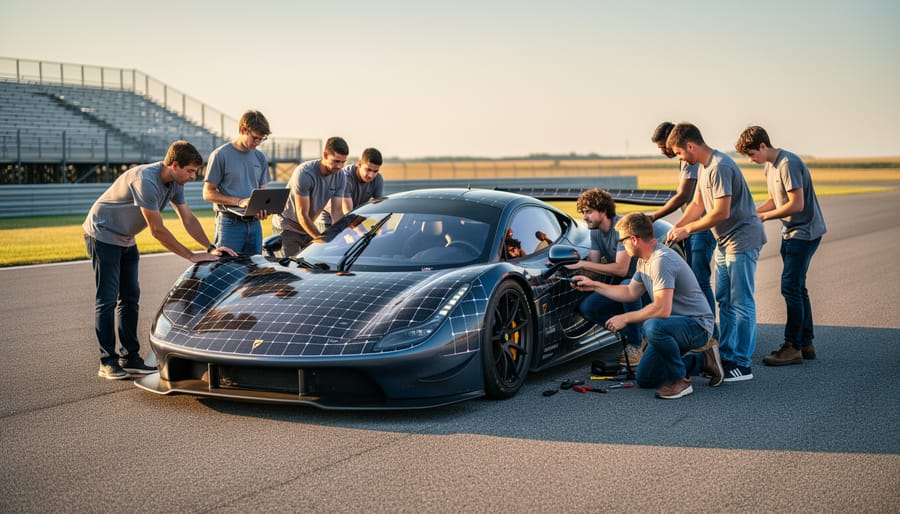
UMN’s solar racing vehicle demonstrates advanced aerodynamic design and optimized solar panel integration for competitive racing.
What Makes the UMN Solar Vehicle Project Stand Out
A Brief History of UMN’s Solar Racing Team
The University of Minnesota’s solar racing team, officially known as the UMN Solar Vehicle Project, has been turning heads since its founding in 1990. What started as a small group of engineering students with a big dream has evolved into one of the most respected collegiate solar racing programs in North America.
The team’s journey really took off when they competed in their first American Solar Challenge in 2001, finishing respectably in the middle of the pack. But here’s where it gets exciting: by 2005, they’d climbed to a top-ten finish, proving that persistence and innovation pay off. I remember hearing from Charles about how inspired he felt watching collegiate teams push the boundaries of what’s possible with solar technology, sparking ideas for his own backyard projects.
The program hit major milestones throughout the 2010s, consistently placing in competitions and earning recognition for both performance and technical innovation. Their vehicles became testbeds for cutting-edge photovoltaic systems, aerodynamic design, and energy management strategies. In 2016, the team achieved a particularly proud moment with a top-five finish at the American Solar Challenge, showcasing years of refinement and dedication.
What makes UMN’s story especially relevant for DIY enthusiasts is their open approach to sharing knowledge. The team regularly publishes technical papers and hosts workshops, making professional-level solar racing insights accessible to anyone interested in renewable energy applications. Their evolution from ambitious beginners to competitive innovators mirrors the journey many hobbyists take when diving into solar projects, proving that with commitment and community support, remarkable achievements are within reach.
The Engineering Philosophy Behind Their Success
What makes UMN’s solar vehicles stand out isn’t just cutting-edge technology, it’s their practical, problem-solving mindset. The team focuses on three core principles that any DIY solar enthusiast can appreciate: efficiency, adaptability, and real-world testing.
First, they obsess over energy efficiency. Every component, from the motor controller to the body panels, gets evaluated for its power-to-weight ratio. Think of it like optimizing your home solar setup, you want maximum output with minimum waste. The team uses lightweight materials like carbon fiber and designs aerodynamic shells that slice through air resistance. This same thinking applies when you’re planning a solar project: prioritize components that deliver the best bang for your buck.
Second, adaptability drives their innovation. UMN engineers design modular systems that can be adjusted based on race conditions, weather patterns, or unexpected challenges. I remember Charles telling me about a solar installation he worked on where the original plan had to change mid-project due to shading issues. Just like UMN’s team, he adapted by repositioning panels and recalculating angles, a reminder that flexibility often matters more than perfection.
Finally, rigorous testing separates dreamers from doers. The team doesn’t just build, they validate everything through countless test runs, data analysis, and refinements. They track metrics obsessively, measuring battery performance, solar charging rates, and energy consumption patterns. This data-driven approach is something you can mirror in your own projects by monitoring your system’s performance and making incremental improvements over time.
Inside Their Solar Car Design: What DIYers Can Learn
Solar Panel Configuration and Energy Capture
The UMN solar car team takes a meticulous approach to solar panel placement that offers valuable lessons for any DIY enthusiast. Their vehicles feature sleek, aerodynamic designs where every square inch of surface area is carefully evaluated for energy potential. The team uses high-efficiency monocrystalline silicon cells, arranged in series to maximize voltage output while maintaining a compact footprint.
What really strikes me about their configuration is the attention to angle optimization. Unlike stationary home installations, solar vehicles face constantly changing sun positions. The UMN team compensates by using maximum power point tracking (MPPT) controllers—essentially smart devices that continuously adjust to extract the most energy possible from their panels. This same technology is available for DIY projects and can boost your energy harvest by 20-30 percent compared to basic charge controllers.
I remember working on my first small solar setup and making the rookie mistake of mounting panels flat. The UMN project taught me that even slight angle adjustments matter tremendously. Their engineers calculate optimal tilt angles based on geographic location and time of year, principles you can apply when learning about solar panel configuration basics for your own projects.
The team also emphasizes keeping panels cool, since heat reduces efficiency. They incorporate ventilation gaps beneath panels—a simple technique you can replicate by mounting panels slightly above your roof or vehicle surface. This passive cooling can improve performance by several percentage points during hot summer months, making your investment work harder for you.
High-efficiency solar cells configured for maximum energy capture demonstrate the precision engineering behind competitive solar vehicles.
Battery Systems and Energy Storage Solutions
The UMN solar vehicle team relies on cutting-edge lithium-ion battery packs to store energy collected from their solar arrays, typically using cells similar to those found in electric vehicles. Their energy management system is the real magic though, constantly balancing power between solar input, battery storage, and motor demand to maximize efficiency during races.
What’s exciting for DIYers is that you can apply these same principles on a smaller scale. I remember when I first started experimenting with solar vehicle conversions, I thought you needed thousands of dollars in specialized equipment. Turns out, the fundamentals are surprisingly accessible.
For RV or van conversions, the key is matching your battery capacity to your actual energy needs. The UMN team uses sophisticated battery management systems (BMS) to monitor individual cell voltages and temperatures, preventing damage and ensuring longevity. You can purchase similar BMS units for a few hundred dollars that’ll protect your investment and give you real-time data through smartphone apps.
Here’s a practical tip: start with calculating your daily energy consumption in watt-hours, then size your battery bank to provide at least two days of autonomy. The UMN approach of thermal management is crucial too. Keep batteries in temperature-controlled spaces when possible, as extreme heat or cold dramatically reduces performance.
For smaller projects like portable solar charging systems, you might opt for LiFePO4 batteries instead of standard lithium-ion. They’re safer, last longer, and handle temperature variations better, even if they’re slightly heavier. The energy management principles remain the same: capture what you can, store it efficiently, and use it wisely.
Efficiency Tricks Worth Stealing for Your Project
UMN’s solar racing team has perfected some brilliant efficiency techniques that you can absolutely borrow for your own projects. Let me share what I’ve learned from studying their approach, and trust me, these tricks made a huge difference when I built my solar-powered garden cart last summer.
First up: aerodynamics matters more than you’d think. The UMN team obsesses over smooth surfaces and reducing drag. For your projects, this means covering exposed wiring, rounding off sharp edges, and minimizing anything that sticks out into the wind. Even on slower vehicles like electric bikes or utility carts, cleaning up the airflow can boost your range by 15-20 percent. I used simple foam insulation and duct tape to streamline my cart’s battery box, and it genuinely helped.
Weight reduction is your secret weapon. UMN uses carbon fiber, but you don’t need exotic materials. Start by eliminating unnecessary components and choosing lighter alternatives. Swap steel bolts for aluminum where possible, use plastic junction boxes instead of metal ones, and question whether you really need that heavy-duty frame. Every pound you remove means less energy needed to move.
Power management separates amateur builds from professional ones. Install a simple charge controller to prevent battery damage, and consider adding a basic monitoring system. Even an inexpensive voltmeter helps you understand your energy flow. The UMN team monitors everything, but you can start small with just voltage and current readings to optimize your system’s performance over time.
From Campus to Competition: The Real-World Testing Process
UMN team members conduct real-world performance testing and data collection to optimize their solar vehicle’s efficiency.
Performance Testing and Data Collection
The UMN team takes performance testing seriously, using sophisticated data loggers to track voltage, current, and energy consumption during both practice runs and race events. They monitor battery state of charge, solar panel efficiency under varying light conditions, and overall system performance to identify areas for improvement.
Here’s the exciting part: you don’t need university-level equipment to gather meaningful data for your own solar projects. I remember when I first started testing my solar setup with nothing more than a basic multimeter and a notebook. Even simple measurements can reveal powerful insights about your system’s performance.
For DIY enthusiasts, start with basic voltage and current measurements at different times of day. A simple multimeter costs around twenty dollars and can tell you how well your panels are performing under morning sun versus midday conditions. Track this data over a week or two, and you’ll start noticing patterns.
Consider creating a simple testing routine: measure your solar panel output at the same times each day, record the weather conditions, and note any changes in performance. This approach mirrors what the professionals do, just at a more accessible scale.
You can also test your battery charging efficiency by measuring voltage before and after charging cycles. Many affordable charge controllers now include basic monitoring features that display real-time data, making performance tracking easier than ever for home projects.
Overcoming Common Solar Vehicle Challenges
Even professional solar racing teams face real-world obstacles, and the UMN team’s experiences offer valuable lessons for DIY enthusiasts. Weather dependency is perhaps the biggest challenge. During cloudy Minnesota days, the team discovered their vehicle’s range could drop by 60% or more. Their solution? Building a robust battery management system that maximizes storage efficiency during sunny periods.
I remember facing similar frustrations with my first backyard solar setup. My panels would sit idle during overcast weeks, and I’d watch my stored power drain away. The key is accepting that solar energy requires a hybrid mindset. The UMN team always plans for worst-case weather scenarios, carrying backup power systems and route alternatives. For your DIY projects, this means sizing your battery bank larger than you think you’ll need and having conventional charging options as backup.
System failures happen to everyone. The UMN team once experienced a complete inverter failure mid-race. Their fix? Modular design with redundant components. Apply this principle to home projects by creating systems with easily swappable parts. Keep spare charge controllers and fuses on hand, and document your wiring thoroughly. Energy limitations force creativity too. When panels can’t generate enough power uphill, the team optimizes aerodynamics and reduces weight. Similarly, your solar golf cart or garden tool setup benefits from efficiency improvements beyond just adding more panels.
Applying UMN’s Innovations to Your DIY Solar Vehicle
Starting Small: Solar Golf Carts and E-Bikes
You don’t need a massive budget or engineering degree to apply UMN’s solar vehicle principles at home. Golf carts and e-bikes make excellent starter projects because they operate at lower speeds and already have electrical systems in place.
I started with a golf cart in my backyard, and honestly, the lessons I learned about energy management were invaluable. The key is understanding your power needs before buying panels. A typical golf cart battery bank holds around 4-6 kWh, while e-bikes need much less, usually 0.5-1 kWh.
For solar golf cart projects, you’ll generally need a 400-600 watt solar array to maintain daily charges, assuming you’re not driving cross-country. Think of it as supplemental charging rather than sole power source, especially when starting out.
With solar e-bike charging, the requirements are more modest. A single 100-200 watt panel can fully recharge most e-bike batteries in a sunny afternoon. Use our solar calculator to match your specific battery capacity with appropriate panel sizing.
The beauty of these projects is their forgiving nature. Unlike UMN’s race車, you’re not chasing milliseconds of efficiency. You’re building practical experience with renewable transportation while keeping expectations realistic.
Solar-equipped golf carts represent an accessible entry point for DIY enthusiasts to apply professional solar vehicle principles.
Mid-Level Projects: Solar RV and Van Conversions
Taking inspiration from UMN’s solar racing innovations, van solar conversions represent an exciting mid-level project that applies professional engineering principles to everyday adventures. Just like the UMN team optimizes every square inch of panel space, your RV or camper van benefits from strategic panel placement on the roof, considering shade from roof vents and air conditioning units.
Here’s where UMN’s power budgeting approach becomes invaluable. Calculate your daily energy needs by listing every device you’ll run – refrigerator, lights, phone chargers, laptops – and their wattage. I learned this lesson the hard way during my first van build when I underestimated my coffee maker’s draw and found myself rationing power by day three of a camping trip.
Start with flexible panels for curved roofs or rigid monocrystalline panels for maximum efficiency on flat surfaces. A basic 400-watt system with a quality charge controller and lithium battery bank can power essential appliances for weekend trips. As you gain confidence, expand your array and storage capacity, just like UMN incrementally improves their solar car designs each racing season.
Resources and Tools to Help You Build
Ready to start your own solar vehicle project? You’re not alone in this journey! When I first explored solar vehicle building, I was overwhelmed by component choices and calculations. Fortunately, there are fantastic resources available to help you get started.
For planning your build, online solar calculators can help you determine the right panel size and battery capacity for your vehicle’s weight and intended use. These tools take the guesswork out of matching components to your specific needs.
When sourcing parts, consider suppliers like Renogy, Sunpower, and AM Solar for quality photovoltaic panels. For motors and controllers, companies like Kelly Controls and Sevcon offer reliable electric vehicle components. Don’t overlook salvage yards and online marketplaces for budget-friendly electric vehicle parts.
The DIY solar community is incredibly supportive. Forums like DIY Electric Car and Endless Sphere host experienced builders eager to share advice. Local makerspaces often have tools and expertise for fabrication work you might need. Solar racing teams, including UMN’s, sometimes host public workshops or share their documentation online.
Remember, every expert builder started exactly where you are now. Take it one step at a time, ask questions freely, and enjoy the learning process. Your solar journey is uniquely yours.
The Community Behind Solar Vehicle Innovation
One of the most inspiring aspects of the University of Minnesota’s solar vehicle project isn’t just the technology—it’s the community that makes it all possible. When I first started exploring solar energy projects, I quickly discovered that the most successful innovations rarely happen in isolation. The UMN team exemplifies this perfectly, bringing together students from engineering, business, design, and communications to tackle complex challenges from multiple angles.
What makes these collaborative communities so powerful is the shared knowledge ecosystem they create. Team members don’t just work on individual components; they cross-pollinate ideas, troubleshoot together, and build on each other’s expertise. A mechanical engineering student might spark an idea that helps an electrical engineering student solve a wiring challenge, while a business major figures out how to source materials more sustainably.
For DIY enthusiasts looking to tap into similar collaborative energy, the good news is that vibrant solar communities exist both online and in your local area. Online forums, Reddit communities like r/solar and r/DIYElectric, and platforms such as Instructables host thousands of makers sharing their successes, failures, and everything in between. I’ve found some of my best project ideas from late-night forum browsing sessions where someone halfway across the world solved exactly the problem I was facing.
Locally, makerspaces and community colleges often host renewable energy groups where you can get hands-on experience and mentorship. Many cities have electric vehicle clubs that welcome solar tinkerers with open arms. The key is to show up, ask questions, and contribute your own learnings back to the community.
Remember, every expert was once a beginner who asked their first question. The UMN team succeeds because they embrace collaboration over competition, and you can apply that same principle to accelerate your own solar journey.
The University of Minnesota’s solar vehicle project shows us that sustainable transportation isn’t just a distant dream—it’s happening right now, built by students with determination and creativity. Whether you’re inspired to build a solar-powered go-kart for weekend fun or simply want to add a solar panel to your bicycle, every journey starts with a single step.
I’ve spent years watching solar technology become more accessible, and I genuinely believe we’re at a tipping point. What once required a university engineering department can now happen in your garage. The same principles powering UMN’s race car can power your next weekend project.
Don’t let the scale of their achievement intimidate you. Start small, learn as you go, and tap into our community for support. Share your progress, ask questions, and remember that every expert was once a beginner tinkering in their driveway.
The future of solar transportation isn’t just in competitions—it’s in backyards, community workshops, and the hands of enthusiasts like you making it real, one project at a time.
How useful was this post?
Click on a star to rate it!
Average rating 0 / 5. Vote count: 0
No votes so far! Be the first to rate this post.
We are sorry that this post was not useful for you!
Let us improve this post!
Tell us how we can improve this post?
charlesnoble
Here at Spheral Solar, I’m a hands-on solar power enthusiast, constantly exploring and experimenting with DIY solutions. I’m dedicated to sharing my discoveries, insights, and even the bumps I hit along the way, all in the pursuit of a more sustainable future.
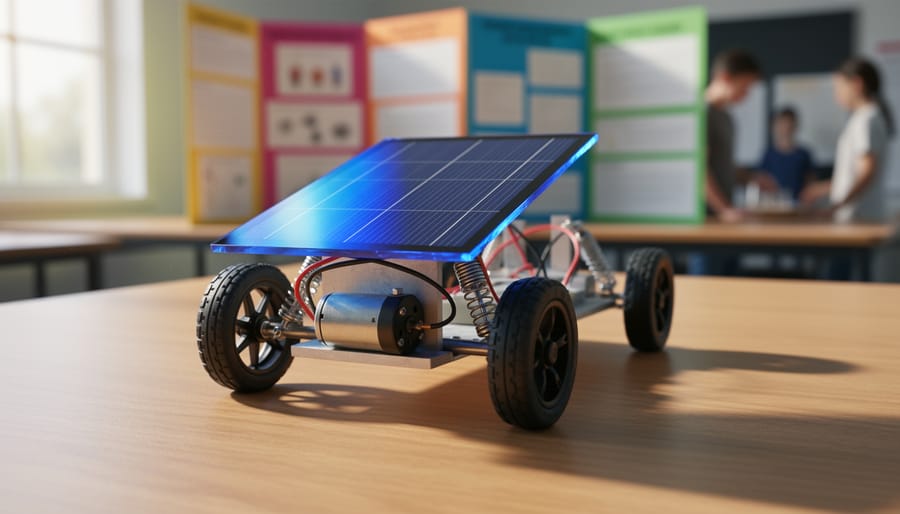
Build a Solar-Powered Car That Actually Wins Your… by Charlesnoble April 5, 2026 Gather a small solar panel (1.5-6 volts), a lightweight toy car chassis or four bottle caps for wheels, a small DC motor, connecting wires, and a hot glue gun to create your science fair winner in an afternoon. Position the solar panel where it catches maximum sunlight—angled slightly toward the…
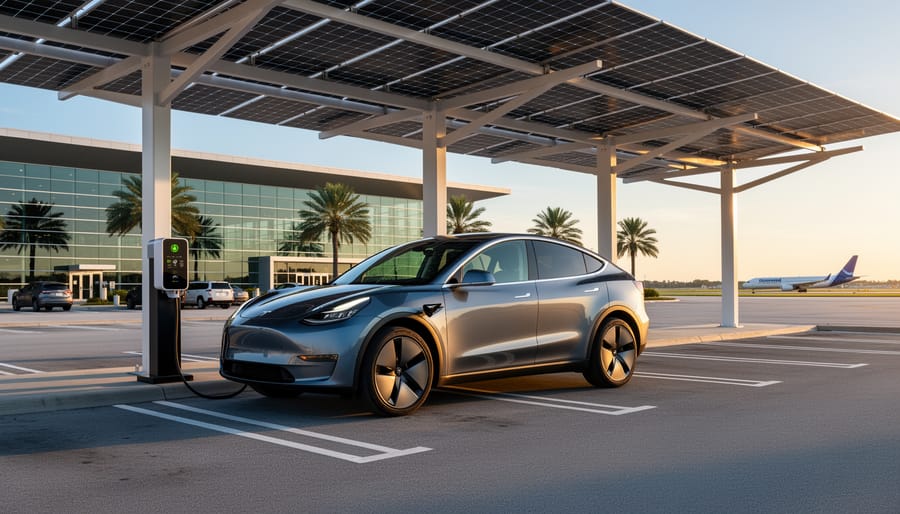
How Orlando Airport’s Solar EV Charging Could… by Charlesnoble April 30, 2026 Picture this: You’ve just landed at Orlando International Airport after a long flight, your electric vehicle waiting in long-term parking with a battery that’s somehow fuller than when you left it. Sound like science fiction? It’s happening right now at MCO, where solar-powered EV charging stations are transforming how travelers…
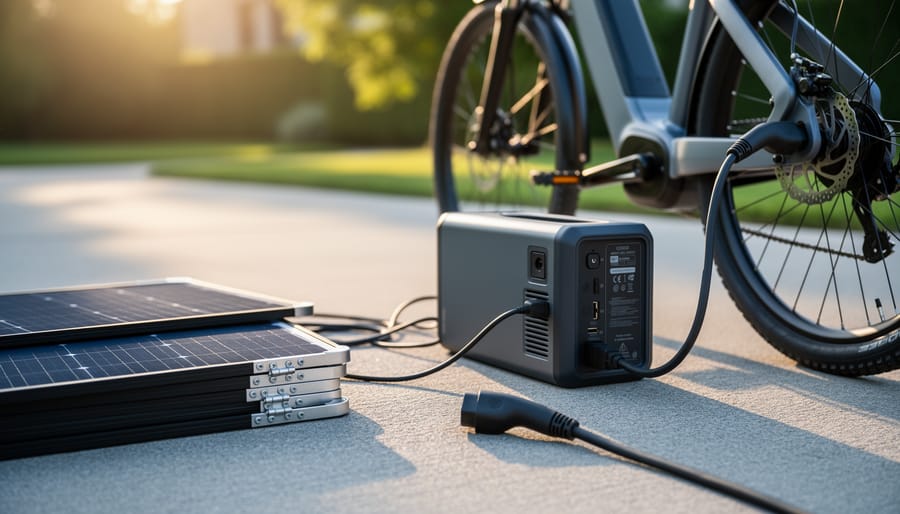
How to Choose a J1772 Solar Charger for Your Ebike:… by Charlesnoble July 14, 2026 A J1772 solar charger combines a standard J1772 charging connector (the same Type 1 plug used by most North American EVs and electric bikes) with solar panels and battery components to create an off-grid or grid-supplemented charging system. You’ll need three core elements: solar panels (typically 400-800 watts for practical…
DIY Solar Generator – Complete Guide With Diagrams by Paul July 17, 2021 Building a weatherproof DIY solar generator involves mounting and wiring a battery, charge controller, inverter, trickle charger, and fusing inside a weatherproof case. Then all the relevant input and output sockets are wired and mounted on the outside of the case where they are easily accessible. What Exactly Are Solar…
Why Your Next Camping Trip Needs a Portable Solar… by Charlesnoble January 24, 2026 Picture yourself camping under a starlit sky, phone at 5%, miles from the nearest outlet. Or imagine a summer storm knocking out power while your refrigerator full of food slowly warms. These moments reveal a simple truth: energy independence isn’t just convenient—it’s essential. Portable solar power systems have evolved far…
30 DIY Solar Light Ideas to Enhance Your Outdoor Décor by Charlesnoble July 24, 2022 Whether it is a garden party, holiday barbeque, or just your family enjoying your outdoor living spaces, solar lights installed in the area can brighten the night and add a flair of festive good cheer to any outdoor space. We managed to find some of the best DIY solar light…
Subscribe for handpicked DIY projects, exclusive tips, and giveaways.
A 5kW solar system occupies between 250 and 350 square feet of roof or ground space and produces roughly 20 to 25 kilowatt-hours of electricity per day in most U.S. locations. That’s enough to power a typical three-bedroom home with moderate energy use, though your exact needs depend on your daily consumption patterns, climate zone,… Read more: How to Size a 5kW Solar System for Your Home or RV
Installing a home solar system yourself takes 2-4 weekends for an average 5kW setup, requires solid electrical knowledge and comfort working at heights, and can save you $5,000-$8,000 in labor costs if you tackle everything except the final utility interconnection. The process breaks down into five main phases: permitting and design, mounting the racking system,… Read more: Solar Power Installation Step by Step: Complete DIY Guide From Start to Finish
After testing dozens of solar chargers across camping trips, power outages, and backyard experiments, we found the X-Dragon 20W delivers the most reliable charging performance for phones and tablets, while the Goal Zero Nomad 50W steps up when you need to power larger devices or handle extended emergencies. If you’re planning weekend hikes, assembling an… Read more: 7 Best Solar Powered USB Chargers of 2026, Tested and Reviewed