Your Portable Power Station Won’t Last as Long as You Think (Here’s Why)
Updated:
A portable power station will typically run your camping devices for anywhere from a few hours to several days on a single charge, depending on what you’re powering and the station’s capacity. As for lifespan, most quality units last between 3 to 10 years before the battery degrades enough to need replacement. The distinction matters because getting caught in the wilderness with a dead battery hits differently than discovering your three-year-old investment won’t hold a charge anymore.
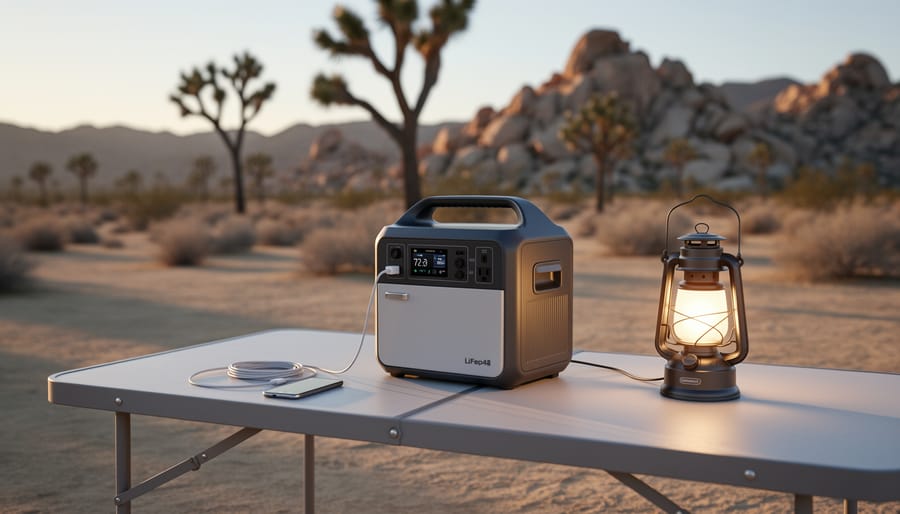
I learned this the hard way on a weekend trip to Joshua Tree back in 2024. My 500Wh power station ran my portable fridge, phone chargers, and LED lights for about 36 hours before tapping out, exactly as the math predicted. But when I pulled that same unit out of storage six months later, it barely held 60% of its original capacity. Turns out I’d made every rookie mistake in the book: storing it fully depleted in a hot garage, never cycling it, ignoring the manufacturer’s maintenance schedule.
The runtime question is straightforward math. Take your power station’s watt-hour (Wh) capacity, divide by your device’s power draw in watts, factor in about 85% efficiency for inverter losses, and you’ve got your answer. A 1000Wh station powering a 100W laptop? Roughly 8.5 hours of use.
The longevity question is trickier because it depends on battery chemistry, charge cycles, storage conditions, and how well you maintain the unit. Lithium iron phosphate (LiFePO4) batteries commonly deliver 3,000 to 5,000 charge cycles before dropping to 80% capacity, while standard lithium-ion versions might give you 500 to 1,000 cycles. Understanding both timelines helps you choose the right capacity for your needs and protect your investment for years of adventures.
What ‘Lasting’ Actually Means for Your Power Station
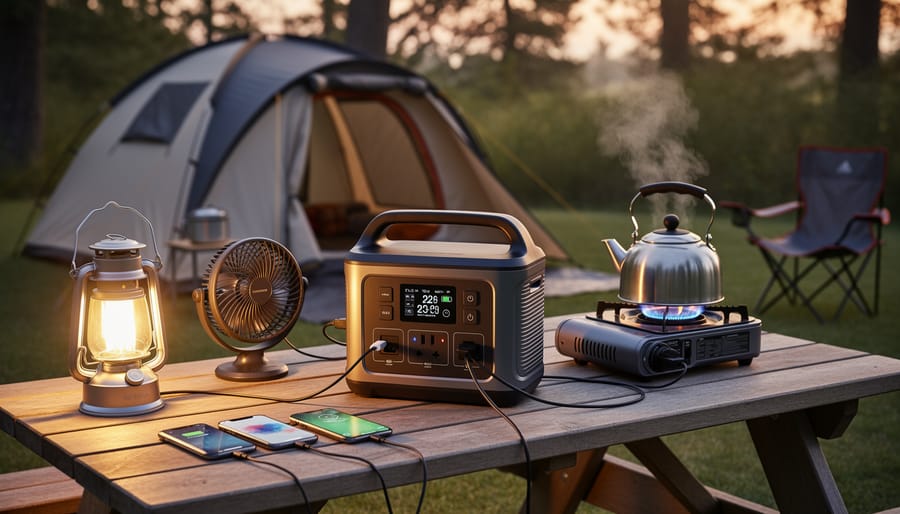
A portable power station powering everyday camping devices helps set the expectation for real usage time.
When someone asks me how long a power station will last, I always ask them back: “What do you mean by ‘last’?” That question usually gets a puzzled look, but it’s the most important one to answer before you buy or pack any portable power solution for your camping trip.
The confusion is completely understandable. Most people assume “how long will it last” means one thing, but there are actually three entirely different measurements at play. Mixing them up leads to disappointment in the field when your power station doesn’t perform as expected, or frustration years down the road when you’re shopping for a replacement sooner than you thought.
Here’s what you’re actually asking about:
Runtime (per charge)
How many hours your power station will run your devices on a single charge before it’s depleted. This is what most campers care about for their weekend trips.
Cycle Life
The total number of charge-discharge cycles your power station can handle before the battery capacity degrades significantly, typically measured to 80% of original capacity. This determines how many years you’ll own the unit.
Depth of Discharge (DoD)
The percentage of the battery you actually use during each cycle. Draining to 50% versus 100% dramatically affects how many total cycles you’ll get.
Watt-Hours (Wh)
The total energy capacity of your power station, similar to the size of a gas tank. A 500Wh unit stores 500 watt-hours of electricity.
Shelf Life
How long your power station can sit unused in storage and still hold a charge. Quality units maintain 80-90% charge after several months of sitting idle.
The reason people get these mixed up is that manufacturers love highlighting whichever number looks most impressive. You’ll see “3000+ cycles!” plastered on the box, while the runtime for your specific camping needs might be disappointingly short. Or they’ll advertise massive watt-hour capacity without mentioning that the battery chemistry only delivers 500 cycles before significant degradation.
Each of these measurements tells you something different about your investment. Runtime determines if you’ll make it through the weekend without recharging. Cycle life tells you whether you’re buying a tool that lasts three years or ten. Shelf life matters if you’re a seasonal camper who stores gear between trips.
Understanding all three means you can match the right power station to your actual camping patterns and budget, rather than gambling on marketing claims.
How Long Will It Run on a Single Charge?
The Simple Math Behind Runtime
The first thing to understand is that figuring out runtime isn’t complicated at all. You just need two numbers: your power station’s capacity (measured in watt-hours, or Wh) and the wattage your device pulls.
The formula is dead simple: capacity (Wh) ÷ device wattage (W) = runtime (hours).
Let’s say you have a 500Wh power station and you’re running a 50W electric blanket. Divide 500 by 50, and you get 10 hours of cozy warmth. That’s it.
Here’s where it gets practical for camping. Most LED string lights pull about 5-10 watts, so that same 500Wh station could keep your campsite lit for 50-100 hours straight. Charging your phone (which draws roughly 10-20 watts while actively charging) would give you 25-50 full charges from empty to full.
A CPAP machine typically runs at 30-60 watts depending on your pressure settings and whether you’re using the humidifier. At 40 watts, you’d get 12.5 hours from a 500Wh unit, enough for two nights of sleep with a bit of margin.
Now, mini fridge power use gets trickier because compressor fridges cycle on and off. A typical 12V camping fridge might be rated at 45 watts but only run 30-40% of the time in moderate weather. So instead of lasting 11 hours (500 ÷ 45), it might actually last 27-36 hours in real conditions.
The key is checking your device’s actual wattage, not just guessing. Most electronics have a label listing watts or amps. If you only see amps, multiply that number by the voltage (usually 120V for AC devices) to get watts. Once you know that, you can calculate your exact runtime before you even leave the driveway.
Real-World Runtime Examples
Let’s see how these numbers play out in actual camping situations. I’ve tested various setups over the years, and the difference between a 300Wh unit and a 2000Wh station is dramatic when you’re trying to keep essentials running through the weekend.
Capacity
Typical Camping Load
Estimated Runtime
300Wh
Phone charging (10W) + LED lights (15W)
10-12 hours continuous use
500Wh
Above + laptop (50W) + small fan (20W)
5-6 hours mixed use
1000Wh
Full electronics + 12V fridge (60W average)
12-15 hours with fridge cycling
2000Wh
Everything above + CPAP (40W) overnight
24+ hours for weekend trip
A 300Wh station works for ultralight trips where you’re just keeping phones charged and running a couple of LED camp lights. Last spring, I brought one on a solo overnight hike and it handled my phone, headlamp charging, and a small Bluetooth speaker without breaking a sweat. But try running anything with a motor or heating element and you’ll drain it within an hour.
The 500Wh range is the sweet spot for car camping couples. You can comfortably run phones, a tablet for the kids, USB fans, and still have juice for morning coffee if you’ve got a small 12V kettle. One friend powers his entire two-night setup with a 500Wh unit and never worries, but he’s not running refrigeration.
Once you jump to 1000Wh, you’re in serious camping territory. I ran a 12V compressor fridge for an entire weekend last summer, plus all our usual devices, and still had 30% capacity left Sunday evening. The fridge cycled on and off rather than running constantly, which is why the math works out better than you’d expect from the raw numbers.
The 2000Wh stations are overkill for most people, but if you need medical equipment like a CPAP or want to run a proper electric cooler for extended trips, that extra capacity buys real peace of mind.
What Drains Your Battery Faster Than Expected
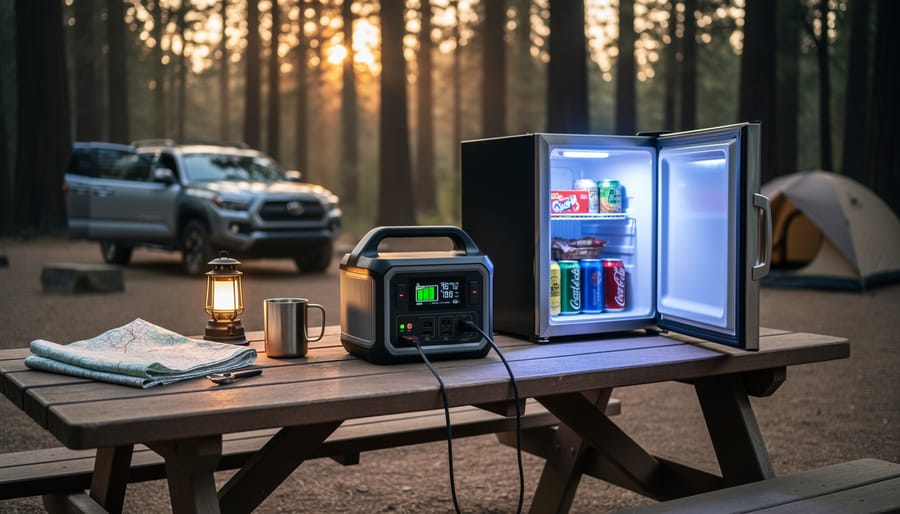
High-draw appliances like mini-fridges can drain a power station faster than expected during camping.
You’d think a 500Wh power station would deliver exactly what the label promises, but most campers find their battery drains 20-30% faster than expected. The culprit isn’t your device, it’s inefficiencies you never see coming.
Your inverter wastes 10-15% of stored energy just converting DC to AC power. Cheaper units can lose up to 20%. Even when nothing’s plugged in, many inverters continue drawing power, this inverter phantom drain can consume 5-20 watts constantly. Leave it on overnight and you’ve burned through 60-240Wh before breakfast.
Temperature hammers capacity too. At freezing, lithium batteries deliver only 70-80% of their rated capacity. Above 95°F, internal resistance increases and runtime drops. I learned this the hard way on a summer desert trip when my power station died hours early despite careful calculations.
Electric coolers are notorious runtime killers. That 45W-rated cooler actually spikes to 90W when the compressor starts, then cycles on and off unpredictably. What should run 11 hours on paper barely makes it through 7. Same goes for anything with a compressor or heating element.
USB ports and LCD displays seem innocent but constantly draw 2-5W combined. Small, yes, but over a three-day camping trip, that’s 144-360Wh vanished into nothing.
The fix? Turn off inverters when not actively needed, account for 85% usable capacity in your planning, and expect real-world performance to fall short of specifications.
The Long-Term Lifespan: Charge Cycles and Battery Degradation
Wear from real camping conditions is a visual reminder that long-term performance depends on careful usage and storage.
Understanding Battery Cycle Life
A charge cycle isn’t just plugging in your power station once. It’s using 100% of the battery’s capacity, whether that happens in one go or spread across multiple uses. If you drain your 1000Wh unit halfway on Friday night, recharge it, then use the other half on Saturday, that counts as one full cycle. Use 25% four times? Same thing, one cycle total.
This matters because every battery has a finite number of cycles before it starts losing capacity. Most standard lithium-ion power stations (the NMC chemistry you’ll find in mid-range models) are rated for 500 to 1000 cycles. LiFePO4 batteries, which I’ve switched to for my own camping setup, typically last 2000 to 4000 cycles, with some quality units pushing even further.
Here’s what those numbers actually mean for your camping life. Let’s say you have a 500-cycle lithium-ion power station and you do one full cycle per camping trip. If you camp twice a month, that’s roughly 24 cycles per year, giving you about 20 years of use. Sounds great, right? But there’s a catch.
Manufacturers rate cycle life to 80% capacity retention. After 500 cycles, your power station won’t suddenly die. It’ll still work, but it will only hold about 80% of its original charge. That 1000Wh unit becomes an 800Wh unit. For weekend camping, you might not notice. But if you’re running a CPAP machine or counting on specific runtime for medical devices, that 20% loss matters.
The math changes dramatically with LiFePO4. At 3000 cycles with the same camping frequency, you’re looking at 125 years of use before hitting that 80% threshold, essentially a lifetime investment.
Which Battery Chemistry Lasts Longer
When you’re shopping for a portable power station, the battery chemistry might seem like technical jargon. But it directly determines whether you’ll be replacing your unit in two years or ten.
Most portable power stations use one of two battery types: lithium-ion (specifically NMC, or nickel-manganese-cobalt) or LiFePO4 (lithium iron phosphate, sometimes called LFP). The difference between them isn’t subtle, it’s the difference between 500 charge cycles and 3,000.
LiFePO4 batteries are the long-distance runners of the power station world. They typically deliver 2,000 to 4,000 charge cycles before dropping to 80% capacity, compared to 500 to 1,000 cycles for standard lithium-ion. If you camp every other weekend and fully cycle your battery each trip, that’s the difference between three years and potentially a decade of use.
LiFePO4 Pros
Lasts 3-6 times longer with 2,000-4,000 charge cycles
Much safer chemistry with virtually no fire risk
Performs better in hot conditions common during summer camping
Maintains capacity better over years of storage between trips
LiFePO4 Cons
Costs 20-40% more upfront than lithium-ion models
Slightly heavier for the same capacity
Lower energy density means bulkier units
The safety advantage matters more than most campers realize. LiFePO4 batteries are inherently stable and won’t enter thermal runaway, the chemical chain reaction that causes lithium-ion fires. When you’re sleeping in a tent with your power station running a CPAP machine all night, that peace of mind is worth something.
For occasional campers who use their power station maybe ten times a year, a cheaper lithium-ion unit might serve you fine for five or six years. But if you’re a regular weekend warrior or planning to rely on your station for extended off-grid trips, LiFePO4 pays for itself through longevity alone. Do the math on cost per cycle, and LiFePO4 almost always wins.
How to Make Your Power Station Last Longer
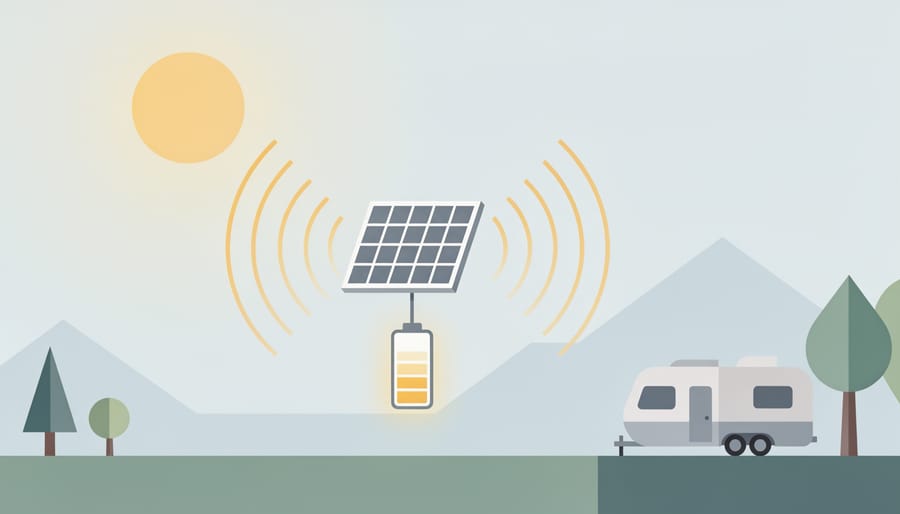
Solar charging can extend your time off-grid by replenishing energy day after day.
Smart Charging Habits That Add Years
I learned this the hard way during my second year of camping with a portable power station. I’d charge it to 100% before each trip and keep it plugged in at full charge between outings. Within eighteen months, my 500Wh unit was only holding about 60% of its original capacity. A camping buddy using the same model still had nearly full capacity after three years. The difference? His charging habits.
Keeping your power station at 100% charge constantly accelerates battery degradation. Lithium batteries experience the most stress at maximum voltage. If you won’t be camping for a few weeks, charge to 50-70% instead and top it off a day or two before your trip. This optimal charge voltage sweet spot can literally double your battery’s lifespan.
The same principle applies after camping. When you get home, resist the urge to immediately charge back to 100% if the unit won’t be used soon. Let it sit at 40-60% for storage. Only charge fully right before heading out.
Pass-through charging, using your power station while it’s plugged in, works fine occasionally, but don’t make it your default setup. The constant charge-discharge cycling while at high voltage generates extra heat and stress. Use it when you genuinely need AC power at your campsite with shore hookup, not as a permanent arrangement.
Solar charging is gentler than wall charging because it happens gradually at lower wattage. The slower charge rate produces less heat and stress. I now do most of my recharging via solar panels during camping trips, only using wall charging when I need a quick top-up before departure.
Temperature and Storage Tips
Extreme temperatures are silent killers for power station batteries. Heat accelerates chemical degradation inside lithium cells, cutting years off your unit’s life. Cold doesn’t cause permanent damage like heat does, but it temporarily reduces capacity and can prevent charging altogether if the battery drops below freezing.
Store your power station somewhere between 50°F and 77°F when you’re not camping. A climate-controlled garage, basement, or spare closet works perfectly. Avoid attics where summer heat builds up, and skip unheated sheds in winter unless you live somewhere temperate. Keep the charge level around 50-60% for long-term storage, not fully charged. Charles stores his units on a basement shelf and checks them every six weeks, topping up if they’ve dropped below 40%.
Before winter camping or storage, bring your power station indoors overnight to warm up before charging. Charging a cold battery stresses it and reduces lifespan. If you’re camping in cold weather, keep the unit insulated inside your tent or vehicle rather than leaving it outside. Some campers wrap their silent power setup in a sleeping bag at night to maintain temperature.
After summer trips in hot climates, let your power station cool down before recharging. Don’t leave it in a closed car trunk where temperatures can hit 140°F or higher. These simple temperature habits can double your power station’s usable years.
Pairing Solar Panels: Extending Your Off-Grid Time Indefinitely
Sizing Your Solar Setup for Camping
The most common sizing mistake campers make is buying panels that are too small to meaningfully offset their daily usage. Here’s a simple rule that works for most weekend trips: your solar panel wattage should equal or exceed your daily watt-hour consumption. If you’re using 500Wh per day running lights, phones, and a small fridge, aim for at least 500W of solar panels to break even under good sun conditions.
But reality isn’t that clean. Solar panels rarely produce their rated wattage for more than a few peak hours daily. A 100W panel might average 400-500Wh per day in summer with clear skies, but drop to 200-300Wh in spring or fall. I learned this the hard way on a cloudy April camping trip when my single 100W panel barely kept up with my CPAP machine alone.
For a typical weekend camping setup drawing 30-50W continuously (LED string lights, phone charging, occasional laptop use, 12V fridge cycling), you’ll consume roughly 720-1200Wh daily. To stay self-sufficient without draining your power station, pair a 1000Wh unit with 200-300W of solar panels. This gives you enough buffer for less-than-ideal weather and ensures you can fully recharge between dawn and dusk.
The solar vs generators decision becomes easier when you realize 200W of portable panels costs less than constantly refilling a generator and runs silently while you sleep.
The Reality of Solar Recharging Times
Getting 100% power from the sun sounds great on paper, but here’s what actually happens when you’re camping: your solar panels rarely hit their rated output.
That 100W panel? In perfect midday sun, you might see 80W. Under scattered clouds, it drops to 30-40W. Overcast skies cut it to 10-15W. I learned this the hard way on a trip to Olympic National Forest, what should’ve been a 5-hour recharge turned into an all-day affair because clouds rolled in.
Temperature matters too. Summer heat actually reduces panel efficiency by 10-20%, while crisp fall mornings can boost output. Winter sun sits lower in the sky, reducing effective charging time even on clear days. A panel that fills your 500Wh station in 6 summer hours might need 9-10 hours in December.
Partial shade is sneaky. Even a small shadow across one corner can slash total output by 50% or more, depending on how your panel’s cells connect internally.
For reliable camping power, plan solar recharging at 60-70% of rated capacity and assume you’ll need most of the daylight hours. Pack enough battery capacity to cover cloudy days, or you’ll be rationing power when the weather doesn’t cooperate.
When to Expect Replacement: Lifespan Red Flags
Your power station won’t give you a clear expiration date, but it will drop hints when it’s reaching the end of its useful life.
The most obvious sign is reduced capacity. If your unit used to run your camping fridge for 12 hours but now barely makes it to 8, that’s battery degradation in action. Most power stations won’t suddenly die, they’ll gradually lose their punch over hundreds of charge cycles. When you’re consistently getting 60% or less of the original runtime, replacement becomes worth considering.
Longer charge times are another red flag. A power station that normally recharges in 4 hours but now takes 7 or 8 might have cell imbalance or failing battery management electronics. Pair this with the unit running warmer than usual during charging, and you’re looking at internal problems.
Error messages or flashing indicators that appear during normal use signal trouble. Check your manual first, but persistent fault codes often point to battery management system failures that aren’t worth repairing on consumer units.
Physical swelling is non-negotiable: stop using the power station immediately. Bulging sides or a warped case mean dangerous internal pressure buildup. This applies to any lithium battery device, and continuing to use a swollen unit risks fire or rupture.
The repair-versus-replace math is usually straightforward. Most manufacturers don’t sell replacement battery packs separately, and third-party battery swaps often cost 70-80% of a new unit. Unless you have a premium model with warranty coverage or replaceable modules, a degraded power station means shopping for its successor.
Understanding how long your portable power station will last isn’t about trusting spec sheets, it’s about running the numbers for your actual camping setup. Whether you’re planning a weekend trip or extended off-grid adventures, the math we’ve covered gives you real answers instead of marketing promises.
Your power station’s lifespan depends on three interconnected factors: the runtime you’ll get per charge (driven by your watt-hour capacity and device loads), the total cycle life before capacity degradation (where LiFePO4 chemistry wins hands down), and how you treat the battery between trips. A 500Wh unit might power your essentials for two days or barely make it through one night, depending entirely on what you’re running and how efficiently you manage loads.
I’ve watched too many campers buy undersized stations based on vague marketing claims, then struggle with dead batteries by day two. Don’t be that person. Take 15 minutes to list your devices, add up their wattages, and calculate your actual daily consumption. Then size your power station, and ideally your solar panels, to match reality, not wishful thinking.
The community here at Spheral Solar has helped countless DIYers dial in their camping power systems. Share your setup in the comments, ask questions about sizing, or tell us how you’ve extended your off-grid time. Real-world experience beats manufacturer specs every time, and we’re all learning together.
How useful was this post?
Click on a star to rate it!
Average rating 0 / 5. Vote count: 0
No votes so far! Be the first to rate this post.
We are sorry that this post was not useful for you!
Let us improve this post!
Tell us how we can improve this post?
charlesnoble
Here at Spheral Solar, I’m a hands-on solar power enthusiast, constantly exploring and experimenting with DIY solutions. I’m dedicated to sharing my discoveries, insights, and even the bumps I hit along the way, all in the pursuit of a more sustainable future.
AGM vs. Lead Acid Batteries: Which Is Better for… by Charlesnoble July 23, 2026 AGM batteries outperform traditional flooded lead acid batteries in nearly every practical measure that matters for solar installations, but whether that performance justifies their 50-100% higher upfront cost depends entirely on how hands-off you want your system to be and how often you’ll cycle the battery deeply. After running both…
Why Two Solar Panels Beat One Every Time (Parallel… by Charlesnoble June 22, 2026 Connect your panels to a charge controller or battery system by running positive terminals to positive and negative to negative. This parallel configuration doubles your available current (amperage) while keeping voltage the same, which is exactly what you need when your system demands more power than a single panel can…
6 Best Solar Spot Lights of 2026, Tested and Reviewed by Charlesnoble August 8, 2026 After testing dozens of solar spotlights in real-world conditions throughout 2026, the AloftSun Solar Motion Sensor Outdoor Lights emerged as the top overall choice for most homeowners, thanks to its reliable performance and versatility across different landscape lighting scenarios. But picking the right solar spotlight depends entirely on what you’re…
5 Sources of Electrical Energy Every Solar DIYer… by Charlesnoble July 1, 2026 Electricity powers our homes from five main sources: solar panels, wind turbines, hydroelectric generators, fossil fuel generators, and battery storage systems. If you’re building a reliable off-grid setup or backing up your solar array, understanding how these sources work together transforms a single-point-of-failure system into resilient, year-round power. I learned…
How to Install a Whole House Ventilation System… by Charlesnoble July 12, 2026 Installing a whole house ventilation system powered by solar takes about 6 to 8 hours for a moderately skilled DIYer and delivers continuous fresh air circulation without touching your electric bill. The core method involves mounting a solar panel on your roof to power an intake or exhaust fan, routing…
Why Is My Defiant Solar Motion Security Light Not… by Charlesnoble September 5, 2026 Most Defiant solar motion lights fail because the battery no longer holds a charge or the solar panel has accumulated enough grime to choke off charging completely. Before you assume your light is dead and start shopping for a replacement, pull off the panel cover and check the battery terminals…
Subscribe for handpicked DIY projects, exclusive tips, and giveaways.
Building a solar powered outdoor table takes about 8 to 12 hours and requires basic woodworking skills plus some familiarity with electrical connections. You’ll mount solar panels directly onto a custom-built or modified outdoor table, wire them to a charge controller and battery system housed underneath, and add USB ports or AC outlets for charging… Read more: How to Build a Solar Powered Outdoor Table for Your Camping Setup
Charging a battery bank with a 3-phase inverter requires connecting your inverter’s AC output to a compatible battery charger or hybrid inverter system that can convert the 3-phase power back to DC for storage. Most DIY solar setups achieve this by using a hybrid inverter that handles both solar input and battery charging simultaneously, or… Read more: How to Wire and Configure a Battery Inverter 3 Phase System for Off-Grid Solar
Wiring a 7-pin RV plug correctly connects your tow vehicle to your trailer’s lights, brakes, and auxiliary power in about 45 minutes with basic hand tools and careful attention to the color-coded wire standard. The diagram follows a specific layout mandated by the RV Industry Association: each pin controls a distinct function, from left turn… Read more: How to Wire a 7-Way RV Plug: Step-by-Step Diagram and Setup Guide