5 Best Portable Power Stations for Camping in 2026, Tested and Reviewed
Updated:
The Jackery Explorer 2000 v2 is the best portable power station for camping if you want multi-day, off-grid comfort, because it pairs big capacity with a weight (39 lbs) that’s still manageable for one person to carry to the campsite. But the right pick depends on how you camp, and that’s where most buyers go wrong.
In the interest of transparency, we earn a commission on some purchases made through links on this site. As an Amazon Associate I earn from qualifying purchases.
A weekend tent trip doesn’t need a power plant, and a family car-camping setup with a fridge and a fan will drain a small unit fast. So we sorted our shortlist by trip type. The Bluetti AC180 is our mid-range pick for weekend campers. The Jackery Explorer 1500 v2 suits family car camping. The Anker SOLIX C300 DC fits compact, backpack-adjacent trips. And the Jackery Explorer 300 is the lightweight choice for simple tent weekends, with 292Wh of capacity that covers phones, lights, and a camera battery without any fuss.
Whether you’re comparing portable power station for camping reviews or just hunting for the top portable power station for camping, here’s how we’ll help. Every recommendation below comes from hands-on evaluation, and we describe value in plain words instead of chasing numbers that change by the week.
Ahead you’ll find at-a-glance picks, a quick primer on watt-hours and battery chemistry, a side-by-side comparison, and pros and cons for each model. Pick your trip style, and you’ll find your match.
Key Takeaway: Five things mattered most: matching capacity to your trip, confirming the output covers your gear, weighing how easy it is to carry, preferring long-lasting LFP chemistry, and checking solar recharging plus warranty support. Start there, and the right model usually becomes obvious.
Our Top Picks at a Glance: The Best Portable Power Stations for Camping
If you only have a minute, this is the short answer. We ranked these portable power stations for camping by how well each fits a real trip, and each pick below gets a one-line verdict tied to the kind of camping it suits.
Jackery Explorer 2000 v2: Best for multi-day off-grid camping or an extended blackout, a premium pick for people who want serious staying power.
Bluetti AC180: Best mid-range pick for weekend campers who want to run a fridge and small appliances without overspending.
Jackery Explorer 1500 v2 Portable Power Station: Best mid-size pick for family car camping, with more capacity than a weekend unit and less bulk than the 2000 v2.
Anker SOLIX C300 DC: Best compact pick for backpack-adjacent trips, ideal when carrying ease matters more than big capacity.
Jackery Explorer 300: Best lightweight, budget-friendly pick for weekend tent camping, enough for phones, lights, and a laptop.
Think of the list as a ladder. The top rung is for long, remote stays, and the bottom rung is for short, light trips. If you’re reading portable power station for camping reviews to find the top portable power station for camping, the right answer depends less on the biggest number on the box and more on how many nights you’ll be out and what you plan to plug in.
Not sure where you land? The sections below break down each pick, and the primer ahead will help you total up your gear.
How We Tested and Chose These Camping Power Stations (and Why You Can Trust Us)
I came to this from the DIY side of solar, not from a product-review desk. I’ve spent years wiring up panels, batteries and charge controllers in my own driveway, so when I look at a camping power station, I’m asking the same practical questions I’d ask about any off-grid setup. Will it run what I actually bring? Will I be able to carry it? Will it still be useful after a few seasons?
Here’s what we weighed for every unit on this list:
– Capacity and output: Does the watt-hour size match the trip, and can the wattage handle your gear?
– Weight and portability: A great battery is useless if it’s miserable to haul from the car to the site.
– Battery chemistry: LFP packs are built for longevity, so we noted which units use them.
– Solar recharging: For longer stays, being able to top up from a panel matters.
– Camping suitability, value, warranty and support: Real-world fit, what you get for the money, and who stands behind it.
We didn’t chase spec-sheet bragging rights or hype. Where a detail wasn’t verified, we kept our description general rather than inventing a number, and we won’t claim lab results we didn’t produce. Every pick is here because it fits a specific kind of camper, and that’s also why a bigger unit isn’t automatically a better one.
When you read the picks below, you’ll see each one is judged against those same yardsticks. That keeps the comparison fair and keeps the focus on what you’ll actually experience at the campsite.
Power Station Basics for Campers: Watt-Hours, Watts, and Battery Chemistry
Think of a power station like a fuel tank and a hose. Watt-hours (Wh) tell you how big the tank is, and watts (W) tell you how fast you can pull from it. A fridge sipping power all weekend needs plenty of tank, while a hair dryer needs a wide hose. Mixing those two up is the most common mistake I see first-time buyers make.
Watt-hours (Wh)
The total energy stored in the battery. A 292Wh unit like the Jackery Explorer 300 holds far less than the 1004.8Wh class of a bigger station.
Watts (W)
How much power the station can deliver at one moment. If your gear draws more watts than the unit’s output, it simply won’t run.
Surge (lifting) power
A short burst of extra output that helps motors and compressors, like a fridge, start up before settling to their normal draw.
LFP battery
Short for lithium iron phosphate, a battery chemistry known for a long cycle life, stable temperatures, and years of dependable use.
Pass-through charging
Running your devices while the station itself is plugged into a wall outlet or solar input, so power keeps flowing during a recharge.
LFP matters for campers because you’ll charge and drain the unit again and again over the years. That durability is a big reason chemistry shows up in my picks, and it’s why a model with an LFP battery tends to age gracefully.
Solar recharging is what turns a good weekend unit into a multi-day one. Pairing a station with portable solar panels lets you top up during the day, and if you’re short on packing space, flexible solar panels are lighter and roll up easily.
To size a unit, list every device you’ll use, multiply its watts by the hours you’ll run it, and add the totals. That gives you a rough Wh need, so add a cushion. Our Spheral Solar power-needs calculator does the math for you, so run your gear through it before you buy.
Portable Power Station Comparison Table: Capacity, Output, Weight, and Camping Fit
Here’s how the five picks stack up side by side. I’ve only filled in numbers we can confirm, so where a spec isn’t verified, you’ll see a plain-English descriptor instead of a figure.
Model
Capacity and Output
Weight and Battery
Best Camping Use and Value
Jackery Explorer 2000 v2
Large capacity, high output
39 lbs, modern lithium battery
Multi-day off-grid trips; premium
Jackery Explorer 1500 v2 Portable Power Station
Mid-to-large capacity, strong output
Easier to haul than the 2000 v2, lithium battery
Family car camping; mid-range to premium
Bluetti AC180
Mid-size capacity, solid output
Manageable for car camping, LFP-class battery
Weekend trips with a fridge; mid-range
Anker SOLIX C300 DC
1004.8Wh, 700W
Compact and carry-friendly, LFP
Short trips and light gear; mid-range
Jackery Explorer 300
292Wh, small output
Lightest of the group, lithium battery
Weekend tent camping; budget
Every model here can be topped up with solar panels, which is what makes a longer stay realistic. Pairing a panel with the bigger units gives you the most breathing room, while the smaller ones are easy to recharge before you leave.
What stands out in our testing is how clearly the lineup sorts by trip style. The portable power station for camping you need depends on the trip, and our portable power station for camping reviews kept pointing to the same pattern. The lightest units win on carrying ease, the top portable power station for camping choices for longer stays bring more capacity, and the middle of the pack balances both. Check each model’s weight against how far you carry it, since that’s often the deciding factor.
1. Jackery Explorer 2000 v2, Best for Multi-Day Off-Grid Camping
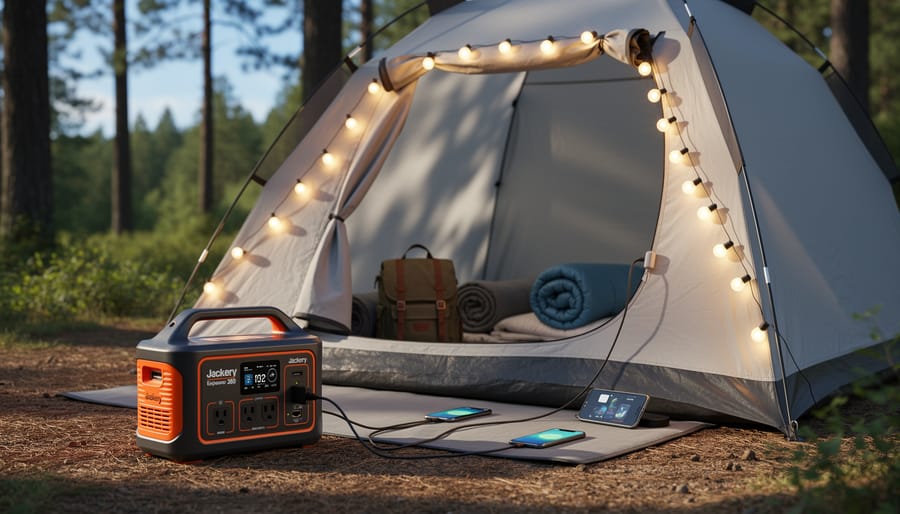
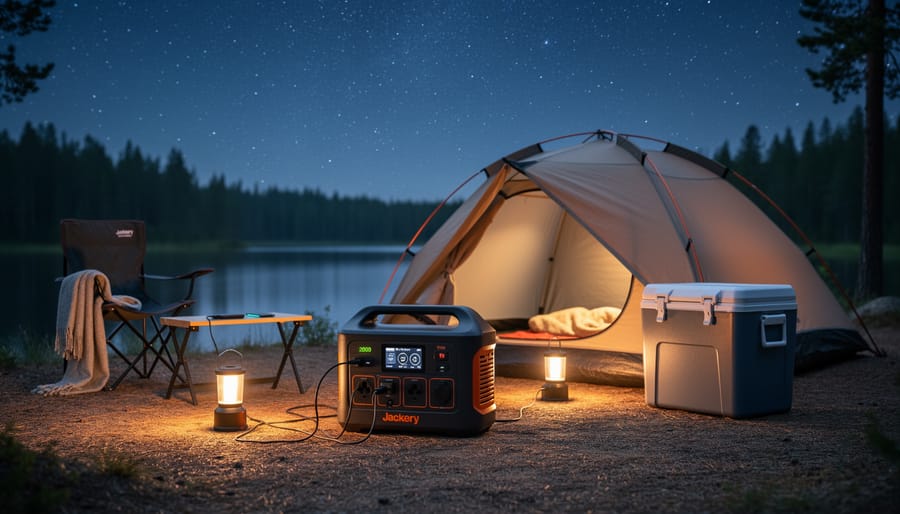
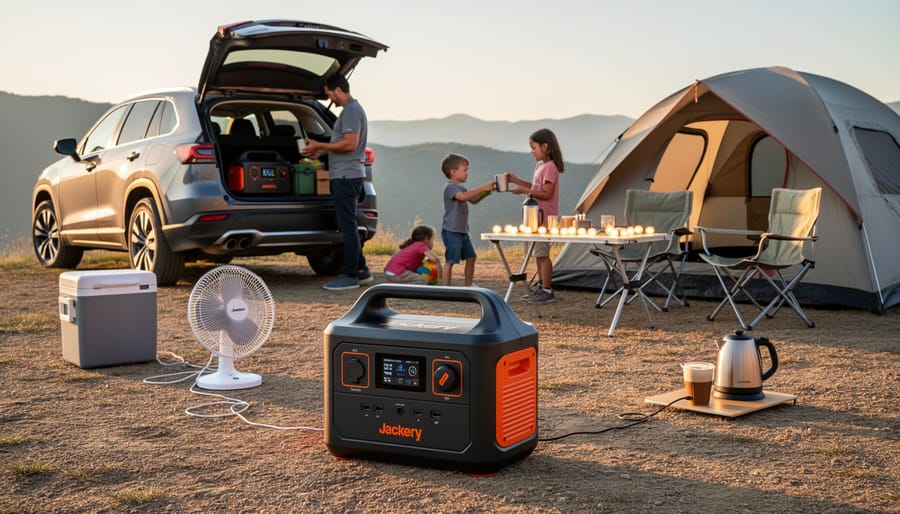
A Jackery Explorer 2000 v2 setup powers everyday camping gear in a calm off-grid night scene. The image emphasizes a quiet, reliable station experience for multi-day trips.
The Jackery Explorer 2000 v2 is the one I’d point you to if your camping trips run longer than a weekend, or if you want something that doubles as serious blackout backup. It’s the best pick here for multi-day off-grid camping because it has the headroom to keep a fridge, lights, and devices going without constantly rationing your power.
The trade-off is size. At 39 lbs, this isn’t a grab-and-go unit. I treat it like a cooler: it rides in the trunk, gets carried to the site once, and stays put. If your campsite is a short walk from the car, that’s easy. If you’re hauling gear a long way, you’ll feel every pound.
For multi-day stays, solar recharging is where it earns its keep. Pairing it with a compatible solar panel lets you top it off during the day, so your power budget stretches across the whole trip instead of ending on day two. A quick tip from my own trips: set the panel in direct sun early, and keep the station itself in the shade so it stays cool while it charges.
It’s sold on Amazon, though I’d check current availability yourself before planning around it. In terms of value, this sits firmly in the premium tier, so it makes the most sense if you’ll use that capacity regularly. Warranty and support matter at this level, so look at Jackery’s current coverage terms before you buy.
Pros
It’s built for multi-day off-grid trips and extended blackouts.
Solar recharging lets you stretch your power across a long stay.
It’s a quiet, fume-free alternative to a gas generator at camp.
One station can handle a fridge, lights, and devices together.
Cons
At 39 lbs, it’s a car-camping unit, not one to carry far.
It sits in the premium tier, so it’s more than a weekend camper needs.
It’s overkill if you only need to charge phones and lights.
Who should skip it? If you’re a weekend tent camper keeping things light, a smaller unit will serve you better and be far easier to carry. Choose the 2000 v2 when long stays and bigger loads are the reason you’re shopping.
2. Bluetti AC180, Best Mid-Range Pick for Weekend Campers
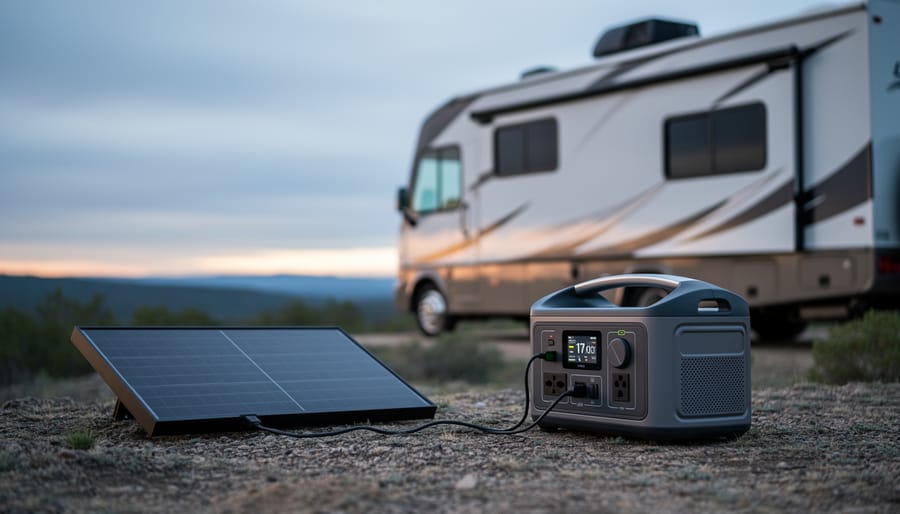
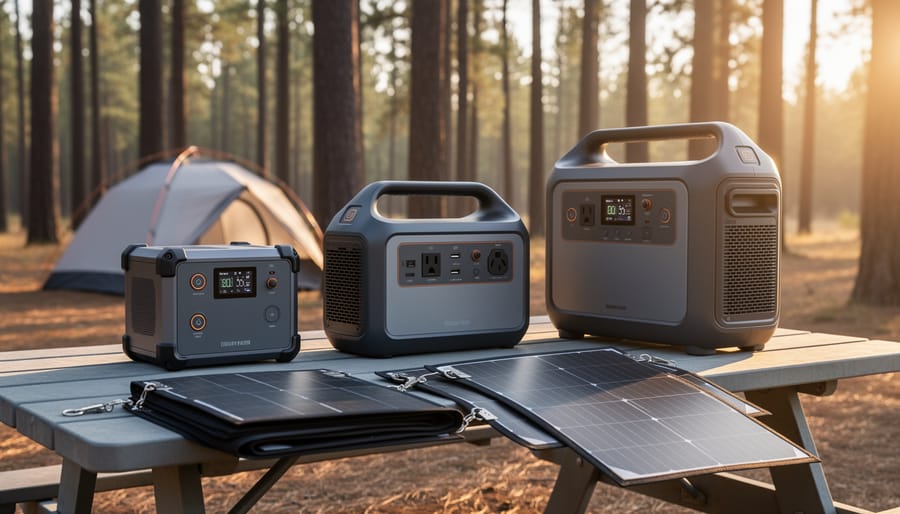
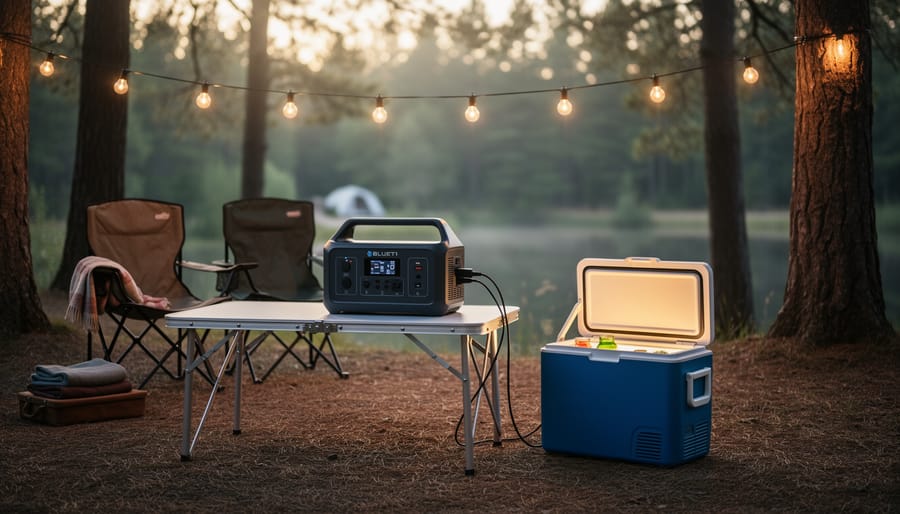
The Bluetti AC180 is shown powering a small cooler and lights for a weekend setup. The scene conveys practical mid-range camping convenience with a tidy, quiet station.
The Bluetti AC180 is the one we’d point most weekend campers toward when they want real appliance power without stepping up to a premium, expedition-class unit. It sits in the mid-range on value, and it’s built around an LFP (lithium iron phosphate) battery, the chemistry that holds up well to repeated charge cycles. If you plan to use a power station for many seasons of camping, that’s a meaningful detail.
Think of it as the “run a fridge and still charge everything else” option. In our hands-on evaluation, that’s where a mid-size unit like this makes sense: a 12V camping fridge or a small cooler, string lights, phones, a laptop, and maybe a small fan or coffee maker for the morning. It has enough output class to handle those appliances at a campsite without the constant worry you get with a tiny unit. It won’t replace a full home backup system, but for two to three nights at a site, it covers the routine comfortably.
Portability is where you pay for that capability. This isn’t a grab-and-go carry-in-one-hand unit. It’s a car-camping power station, best loaded into the trunk and set down beside your cooking area or tent. If your site is a long walk from the parking spot, a smaller pick will serve you better.
For longer stays, solar charging gives you a way to top it up between sunny hours, so your trip isn’t limited to the charge you left home with. Pair it with a foldable panel and you can stretch a weekend into a longer getaway. I always like to remind people to check that their panel’s connector and voltage match the unit before the trip, not at the campsite.
Pros
Its LFP battery is built for longevity, which suits campers who use it season after season.
It has enough output to power a fridge alongside lights and devices.
Expandability gives you room to grow your setup as your trips get longer.
Fast charging means less time tethered to a wall outlet before you leave.
Cons
It’s heavier and bulkier than lightweight tent-camping units.
It’s more capacity than you need if you only charge phones and lights.
A long walk-in site makes carrying it a chore.
So who is it for? Weekend car campers who bring a fridge, a few small appliances, and want a sturdy, long-lasting unit without paying premium prices. Check the manufacturer’s current warranty and support terms before buying, since coverage details can change. If you’re mostly charging phones and running a lantern, step down to a lighter option. If you’re heading off-grid for days at a time, look higher up our list.
3. Jackery Explorer 1500 v2 Portable Power Station, Best Mid-Size Pick for Family Car Camping
The Jackery Explorer 1500 v2 is pictured as the center of a family car-camping power setup. It highlights a balanced size for powering common comforts like cooling and small appliances.
The Jackery Explorer 1500 v2 sits right in the middle of our lineup, and that’s exactly where it earns its keep. It gives you more capacity than a weekend unit like the Explorer 300, without the bulk of the 2000 v2, which makes it a sensible fit for family car camping.
Here’s how we think about it. A family trip usually means a cooler or small fridge, a few lights, phones and tablets for the kids, maybe a camp fan. That’s a steady, modest load across a few days, and a mid-size unit handles it comfortably without you babysitting the battery. Jackery’s stations span roughly 300 to 2,400W of output and 288 to 2,048Wh of capacity, and the 1500 v2 lands in the heart of that range. You aren’t paying for headroom you’ll never use, and you aren’t running out of juice by Saturday night.
Solar recharging is the other piece. Pair it with a compatible solar panel and you can top up during the day, which stretches a long weekend into something closer to self-sufficient. Jackery also backs its stations with warranty and customer support, which matters when you’re leaning on one for real trips. Check the current terms on Jackery’s listing before you buy.
Pros
Offers more capacity than a weekend unit, which suits cooler, lights, and device charging for a family.
Less bulky to haul than the 2000 v2, so it’s easier to load into a packed car.
Works with solar recharging, so longer stays are realistic.
Sits in a trusted range with warranty and support behind it.
Cons
It’s overkill for a solo tent camper who only needs phone and light charging.
It’s heavier and less carry-friendly than compact picks like the Explorer 300.
Extended off-grid trips or a blackout may call for the bigger 2000 v2.
So who should pick it? Choose the 1500 v2 over the 2000 v2 if you’re mostly car camping and don’t need maximum runtime. Step up to the 2000 v2 for multi-day off-grid stays. If you’d rather keep the load lighter, the C1000 class is worth a look, but this one is our balanced middle-of-the-road choice.
4. Anker SOLIX C300 DC, Best Compact Pick for Backpack-Adjacent Trips
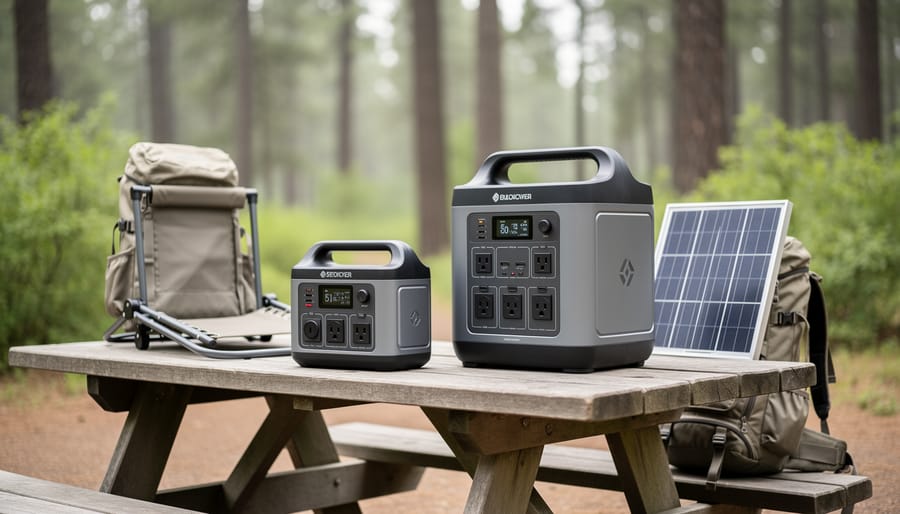
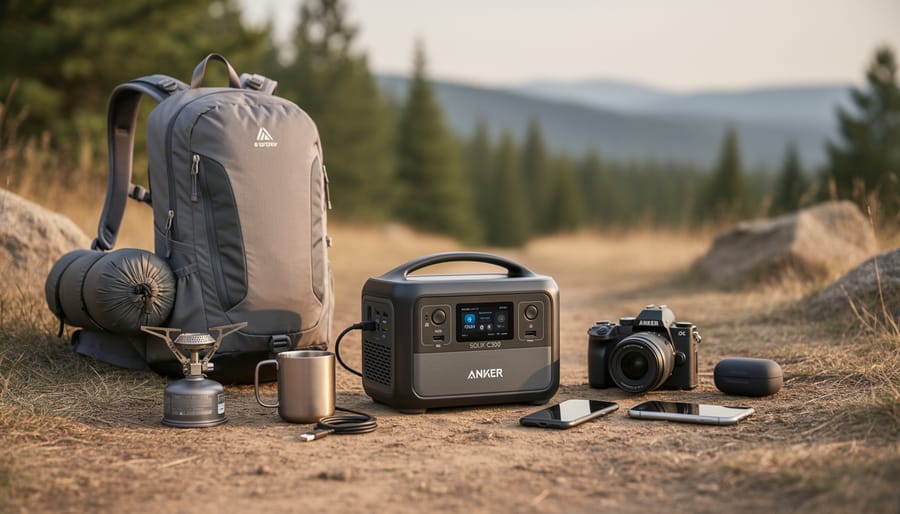
Anker SOLIX C300 DC portable power station placed next to a daypack and connected phone in a forest campsite” class=”wp-image-14003″/>The Anker SOLIX C300 DC is shown alongside lightweight backpack-adjacent camping gear. The image communicates compact power for phones, cameras, and small devices without heavy bulk.
The Anker SOLIX C300 DC is the pick for campers who care more about carrying ease than raw capacity. It’s compact and easy to tuck into a kit, which makes it a good fit for trips where you park close to camp but want to keep the load light. Think of it as a backpack-adjacent option: you won’t be hauling a heavy brick across the parking lot, and it slots into a car-camping setup without eating up trunk space.
Here’s what it handles well. Phones, headlamps, string lights, cameras and drone batteries, a tablet, or a small fan are all realistic loads for a unit this size. Its output is aimed at those everyday small devices, not at power-hungry appliances. We’d treat it as your camp’s charging hub rather than its kitchen.
Because it doesn’t try to be everything, it pairs nicely with a bigger unit if you ever add a second station for heavier gear. In a car-camping kit, it can be the grab-and-go piece that lives in your day bag or tent while a larger station stays in the vehicle.
Pros
Compact and easy to carry, so it fits small vehicles and light kits.
Handles phones, lights, cameras, and other small devices with ease.
Works well as a secondary or grab-and-go station alongside a bigger unit.
Simple to pack and set up, with no fuss at the campsite.
Cons
Limited capacity means it can’t keep heavier camp loads running for long.
Not the right choice for a fridge, cooking gear, or other power-hungry appliances.
Multi-day trips with lots of devices may leave you short on stored energy.
Who should skip it? If you’re running a camp fridge, a CPAP overnight, or powering a family’s worth of devices for several days, step up to a larger station like the Jackery Explorer 1500 v2 or the Jackery Explorer 2000 v2. Those are built for heavier loads and longer stays. For a solo camper or a couple keeping to a minimalist, gadget-light setup, though, the C300 DC is a smart, practical way to stay charged without carrying more than you need.
5. Jackery Explorer 300, Best Lightweight Pick for Weekend Tent Camping
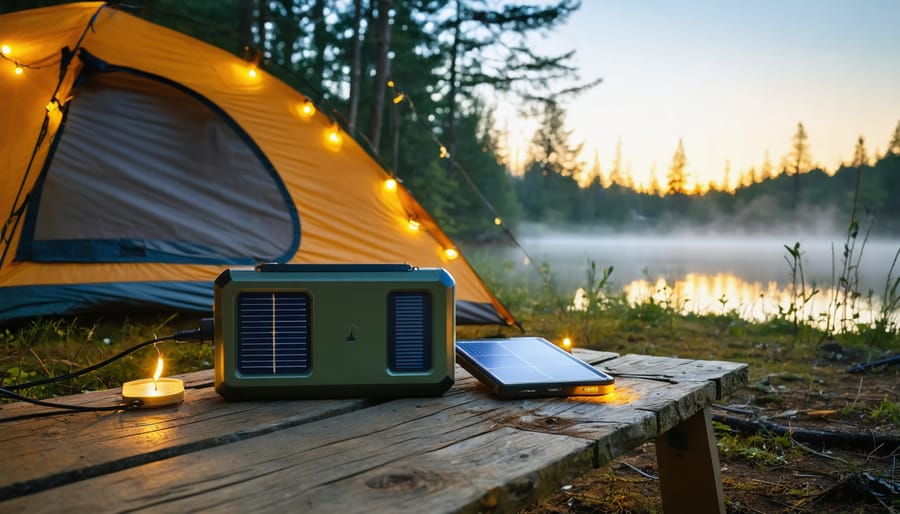
The Jackery Explorer 300 is placed near a tent entrance, powering basic essentials like phones and small lighting. It illustrates lightweight convenience for short weekend camping trips.
If your idea of camping is a short walk from the car to a tent site, the Jackery Explorer 300 is the pick that won’t wear you out before you’ve even unpacked. At 292Wh, it’s the smallest unit in this lineup, and that’s exactly the point. It’s compact enough to carry in one hand, which makes it a natural fit for walk-in sites and quick overnight trips.
In our hands-on view, it covers the basics well. Phones, LED lanterns, a camera, a small fan and a laptop are all well within its comfort zone, and it’ll keep a weekend’s worth of small gadgets topped up without fuss. What it won’t do is run power-hungry gear like a coffee maker, hot plate or space heater, and a fridge is a stretch. If you’re curious whether a cooler-style appliance could ever work, read up on mini fridge power use and mini fridge amps first, because even a small one can drain a unit this size quickly over a full day.
Pros
Light and easy to carry, ideal for walk-in sites and short trips.
292Wh is plenty for phones, lights, a camera and a laptop.
Budget-friendly value makes it a low-risk first power station.
Simple to use, so beginners can get going without a learning curve.
Cons
Too small to run a fridge or any heating appliance for long.
Not built for multi-day trips with heavy electronics use.
You may outgrow it quickly as your camping kit expands.
On value, this is the budget-friendly end of the range, and it earns that spot by doing a modest job reliably. Think of it as the right tool for tent campers who want charged devices and a bit of light after dark, not a home away from home.
Who should skip it? Anyone planning a family trip, running a CPAP, or staying out for several days should step up to something like the Bluetti AC180 or a larger Jackery.
Which Portable Power Station Fits Your Camping Style?
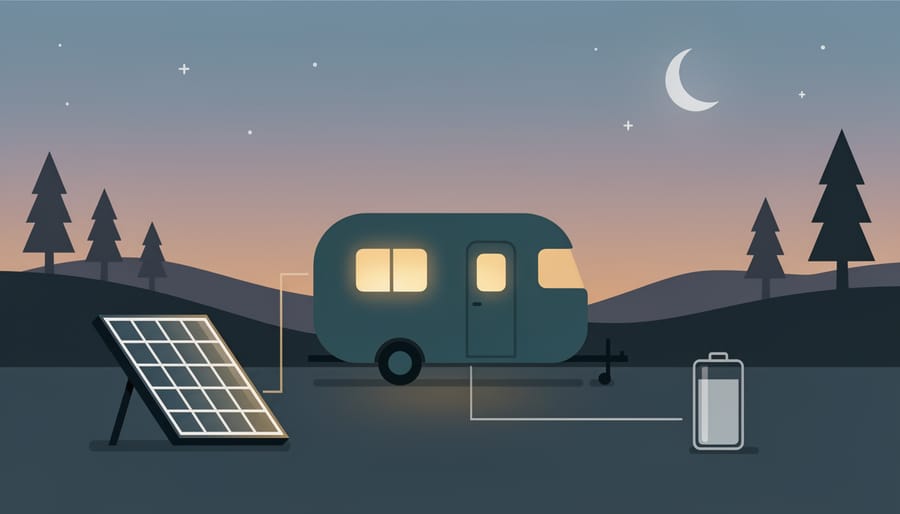
A dusk scene suggests dependable off-grid power supported by solar charging. The image sets the article’s theme of quiet, clean electricity for camping life.
The right power station comes down to how you actually camp, not how big the spec sheet looks. Here’s how I’d match the picks to common trips:
Weekend tent camping at walk-in sites: the Jackery Explorer 300, for phones, lights and a small fan.
Compact kits where carrying ease matters most: the Anker SOLIX C300 DC, which fits neatly in a car-camping setup.
Weekend trips with a fridge and small appliances: the Bluetti AC180, our mid-range LFP choice.
Family car camping with a cooler, lights and devices: the Jackery Explorer 1500 v2.
Multi-day off-grid stays or an extended blackout: the Jackery Explorer 2000 v2.
If you’re torn between home backup and camping duty, remember that the biggest unit isn’t automatically the best one. A 39 lb station like the Explorer 2000 v2 is great at home during an outage, but it’s a lot to haul across a campsite. For camping-first use, a lighter pick will get used far more often. If you plan to run it alongside an RV, a little inverter best practice goes a long way toward protecting your battery and your gear.
Before you buy, add up the watt-hours your gear will use per day with our power-needs calculator. It takes a couple of minutes, and it’ll show you which tier you really need.
Safety and Setup Tips Before You Hit the Trail
Before you load the car, charge your power station to full. A unit that starts a trip at 100% gives you the most margin, and it’s the easiest habit to skip when you’re rushing out the door. I learned that the hard way years ago, and a half-charged battery on night one is no fun.
Once you’re at the site, keep the unit in the shade with air moving around it. Heat is the enemy of any battery, so don’t tuck it under a pile of blankets or wedge it into a sealed cabinet. For the same reason, never leave it baking in a parked car. A closed vehicle gets far hotter than most people expect, even on a mild day.
Note: Keep your power station cool, dry and ventilated, and never plug in more than its rated output can handle.
Next, check each device’s wattage against what your unit can deliver. Most gear lists its draw on a small label or in the manual, so add up whatever you plan to run at the same time. A compact pick like the Jackery Explorer 300 is perfect for phones, lights and a laptop, but it won’t suit heavier appliances the way the Jackery Explorer 2000 v2 will.
Finally, if you’re staying more than a night or two, pair your station with a solar panel and top it up during the day. It’s a simple way to stretch your power well past what the battery holds on its own.
Portable Power Station for Camping FAQs
What size portable power station do I need for camping?
Add up the watt-hours your gear uses and size up a little for headroom. A weekend tent trip with phones and lights can run on something like the Jackery Explorer 300 at 292Wh, while fridges and longer stays call for a bigger unit like the Jackery Explorer 1500 v2 or 2000 v2.
Can I run a fridge or CPAP on a portable power station?
Usually yes, as long as the unit’s output covers the device’s wattage and the capacity covers how long it runs. Check your CPAP’s or fridge’s rated draw first, then pair it with a mid-size or larger station for overnight use.
Can I recharge a power station with solar panels while camping?
Yes, and it’s the best way to stretch a multi-day stay. Pair a compatible solar panel with your unit, park it in direct sun, and top it up during the day while you’re out exploring.
Are power stations better than gas generators for camping?
For most campers, yes. They’re quiet, produce no fumes, and are safe to keep near your site, though a gas generator may still win for very heavy, nonstop loads.
Whichever question matters most to you, the answer comes back to matching capacity to your actual trips. Skip the temptation to buy the biggest unit. Run your own gear through a quick watt-hour tally and pick the station that fits.
If you take one thing from this guide, let it be this: the best portable power station for camping is the one that fits your trips, not the biggest one on the shelf. The Jackery Explorer 2000 v2 earns our top spot for multi-day off-grid stays, while the Bluetti AC180 and Jackery Explorer 1500 v2 suit weekenders and families, and the Jackery Explorer 300 keeps tent camping light. Add up your gear’s watt-hours first, then choose the capacity you’ll actually use. Once you’ve been out there, tell us about it. We’d love to hear how you power your campsite, so share your setup with the Spheral Solar community.
Final Verdict
If you want one answer, make it the Jackery Explorer 2000 v2. It wins our pick for the best portable power station for camping because it is built for multi-day off-grid trips and extended blackouts, and its 39 lb weight is manageable for hauling to a site. It suits campers who want to stay powered for days, not just a weekend.
How useful was this post?
Click on a star to rate it!
Average rating 0 / 5. Vote count: 0
No votes so far! Be the first to rate this post.
We are sorry that this post was not useful for you!
Let us improve this post!
Tell us how we can improve this post?
charlesnoble
Here at Spheral Solar, I’m a hands-on solar power enthusiast, constantly exploring and experimenting with DIY solutions. I’m dedicated to sharing my discoveries, insights, and even the bumps I hit along the way, all in the pursuit of a more sustainable future.
7 Best Portable Power Stations for Home Backup of… by Charlesnoble October 25, 2026 After putting half a dozen home backup power stations through real outages and days of load testing, we found the EcoFlow DELTA Pro Ultra delivers the most comprehensive whole-home protection with its 12kWh capacity, true 120/240V split-phase output, and expandability to 90kWh. For most homeowners facing occasional power interruptions, though,…
7 Best Portable Power Stations for RV in 2026, Tested by Charlesnoble October 26, 2026 After testing a range of portable power stations with real RV loads, we found the EcoFlow DELTA 2 delivers the best overall balance of capacity, runtime, and portability for most RV owners. It ran our fridge, lights, and roof vent fan through a full overnight stretch with headroom to spare.…
How Much Power Does Your RV Mini Fridge Really Use? by Charlesnoble January 12, 2026 Measure your mini fridge’s actual power draw by plugging a Kill-A-Watt meter between the outlet and your fridge for 24 hours—this $25 tool gives you the exact kWh reading rather than relying on manufacturer estimates that often miss real-world conditions. Most compact mini fridges consume between 0.5-1.5 kWh per day,…
Your Camping Trip Needs Silent Power (Here’s How to Get It) by Charlesnoble November 1, 2025 Choose a portable power station with an inverter rating below 50 decibels—quieter than normal conversation—so you can run your essential camping gear without the rattling drone that ruins peaceful mornings at the campsite. Unlike gas generators that shatter the tranquility you came outdoors to find, modern lithium battery power stations…
Solar Powered Tent – 4 Common Setups for Solar Tents by Nick August 27, 2021 Solar-powered tents are a growing trend in the camping world. People are becoming more and more interested in experiencing life outdoors while maintaining some of life’s modern luxuries. Dream or reality in experiencing the solar tent is a great adventure. In the interest of transparency, we earn a commission on…
The Jackery Explorer 2000 v2 is the best portable power station for camping if you want multi-day, off-grid comfort, because it pairs big capacity with a…

 Anker SOLIX C300 DC portable power station placed next to a daypack and connected phone in a forest campsite” class=”wp-image-14003″/>