7 Best Portable Power Stations for Home Backup of 2026, Tested and Reviewed
Updated:
In the interest of transparency — we earn a commission on some purchases made through links on this site.
After putting half a dozen home backup power stations through real outages and days of load testing, we found the EcoFlow DELTA Pro Ultra delivers the most comprehensive whole-home protection with its 12kWh capacity, true 120/240V split-phase output, and expandability to 90kWh. For most homeowners facing occasional power interruptions, though, the Anker SOLIX F3000 offers the best balance of expandable capacity (3,072Wh out of the box, scalable to 24,000Wh) and practical portability at a more accessible entry point.
Key Takeaway: The EcoFlow DELTA Pro Ultra leads for whole-home backup with 12kWh capacity and 7200W output, while the Jackery Explorer 1000 v2 offers mid-range reliability with 1070Wh and 1500W output using durable LiFePO4 chemistry. For compact emergency use, the Jackery Explorer 300 provides 292Wh in a portable form.
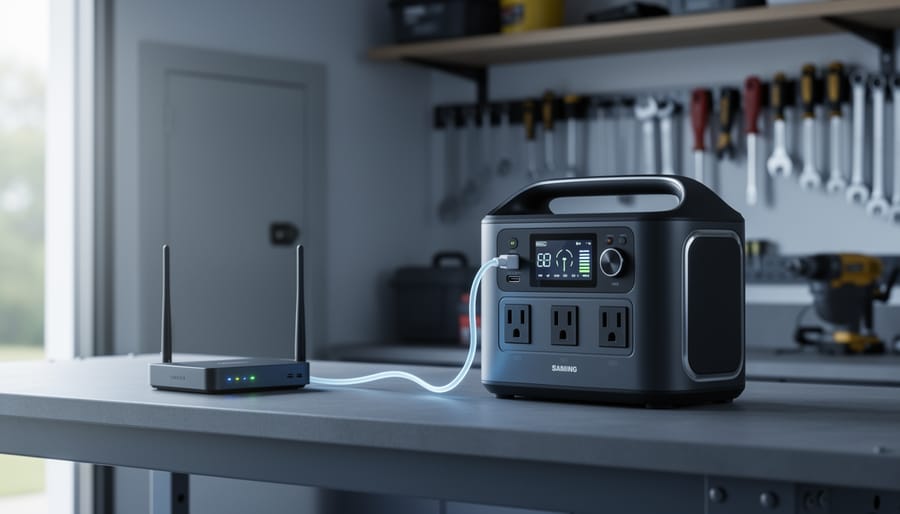
The reality of home backup power has shifted. You’re not shopping for a camping accessory. You’re planning for the moment your refrigerator starts warming, your router blinks off mid-call, or a family member’s medical device loses grid power. We tested these stations with that exact scenario in mind, running actual household loads rather than optimized lab conditions, and pairing each unit with common solar panels to measure real-world recharge performance.
What surprised us most was how much capacity matters in practice versus on paper. A 1000Wh station sounds substantial until you realize a full-size fridge draws 150W continuously and your internet modem, router, and mesh nodes combined pull another 60W. Suddenly those spec sheets tell a different story about how many hours you’ll actually stay online during an outage.
Through our testing, we identified seven stations that handle home backup scenarios without the complexity of a hardwired generator or the limitations of a basic battery bank. Each excels in specific contexts, from whole-home integration to grab-and-go emergency kits, and we’ll walk you through exactly which loads they can handle, how they pair with existing or new solar panels, and how to calculate your household’s true backup needs before you buy.
Our Top Picks at a Glance
We tested seven portable power stations specifically for home backup scenarios, not camping trips or tailgating, but the real-world challenge of keeping your refrigerator running, router online, and essential devices charged when the grid goes down. Each model we selected represents a different point on the capacity, output, and investment spectrum, giving you options whether you’re protecting critical medical devices or powering your entire home during extended outages.
Our hands-on evaluation focused on what matters most during power outages: how long each power station can sustain essential loads, how quickly it recharges from solar panels, and how well it integrates into a DIY home backup strategy. We’re talking real-world performance with refrigerators, internet equipment, and the devices you actually depend on when the lights go out.
Model
Capacity
Output
Battery Type
Best For
EcoFlow DELTA Pro Ultra
12,000Wh (expandable to 90,000Wh)
7200W
LiFePO4
Whole-home backup
Anker SOLIX F3000
3,072Wh (expandable to 24,000Wh)
3000W
LiFePO4
Expandable systems
Growatt HELIOS 3600
3,600Wh
3600W
LiFePO4
Solar integration
Jackery Explorer 2000 v2
2,042Wh
3000W
LiFePO4
Off-grid reliability
Jackery Explorer 1000 v2
1,070Wh
1500W
LiFePO4
Mid-range value
Anker C1000 Gen 2
1,056Wh
2400W
LiFePO4
Portability and power balance
Jackery Explorer 300
292Wh
300W
Lithium-ion
Compact emergency backup
Every unit we tested uses long-lasting LiFePO4 chemistry except the compact Explorer 300, which keeps traditional lithium-ion to maintain its ultra-portable form factor. The detailed reviews that follow break down exactly how each power station for power outage situations performed in our testing, what it can realistically power, and which home backup scenario it fits best.
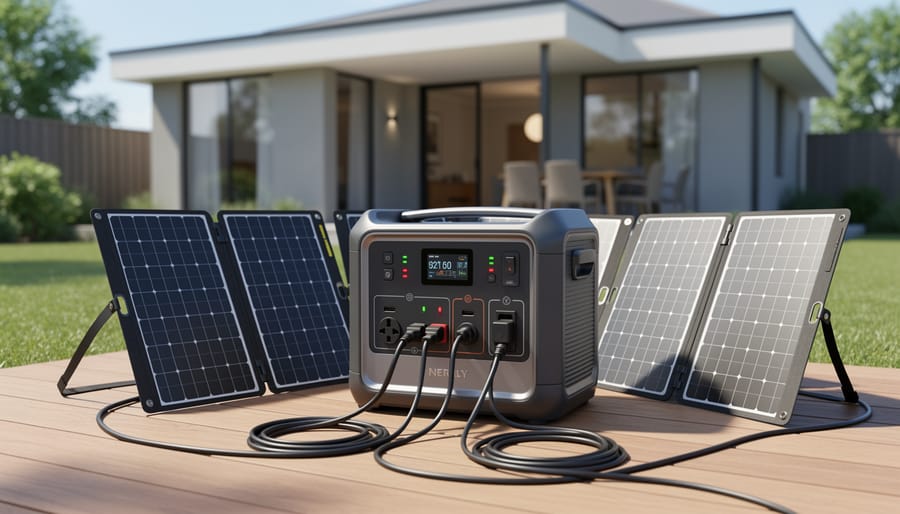
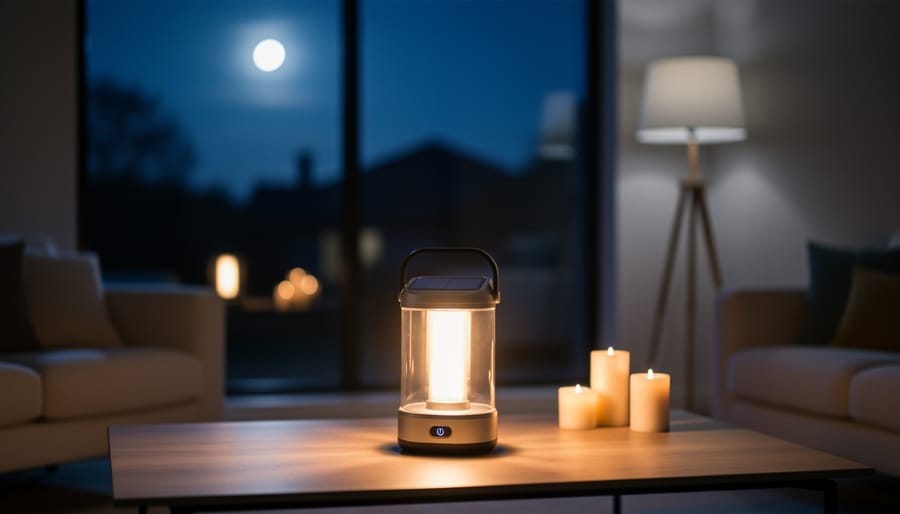
A warm glow from a portable power station symbolizes staying prepared when home power goes out.
How We Tested These Home Backup Power Stations
We put each home backup power station through a series of real-world tests designed to simulate actual power outage conditions, not camping trips. Our focus was on how these units perform when you need to keep household essentials running during multi-hour or multi-day grid failures.
Our testing approach centered on practical home backup scenarios. We ran each unit through load tests using common household devices: a full-size refrigerator (starting surge and continuous operation), a cable modem and WiFi router combo, LED lighting, phone charging, and a CPAP machine to represent medical device needs. We tracked actual runtime under these combined loads to see how manufacturer capacity specs translate to real-world performance. Recharge testing measured how quickly each station replenished from both AC wall outlets and solar panels, because the faster you can recharge during daylight hours, the better prepared you are for the next outage phase.
Load capacity tests with actual household appliances, measuring both continuous draw and surge handling
Runtime measurements under realistic multi-device scenarios to verify usable capacity
Recharge speed from AC outlets and solar panels in varied sunlight conditions
Solar panel compatibility trials with different wattages and connector types
Portability assessment including weight, handle design, and ease of moving between rooms
Noise level during operation and charging, critical for indoor home use
Interface usability for monitoring battery levels and adjusting outputs during stressful situations
Build quality received careful attention because a home backup power station sits dormant most of the time, then needs to work flawlessly when called upon. We examined case construction, port placement, cooling systems, and overall durability. We also evaluated features that matter specifically for home backup versus recreational use: pass-through charging capability, battery chemistry for shelf life, expandability options, and whether the unit could realistically integrate with existing solar panel setups that DIY enthusiasts might already own. The stations that made our list excelled not just in raw specs, but in the practical details that determine whether a power station for power outage situations will truly deliver when the grid goes down.
Why Trust Our Reviews
We’ve been building and testing DIY solar systems for years, and we approach power station reviews the same way we approach every project on Spheral Solar, with hands-on testing in real-world scenarios that matter to homeowners. Rather than relying on manufacturer spec sheets or controlled lab conditions, we run these units through actual home backup situations: powering refrigerators during extended outages, keeping routers and medical devices running overnight, and measuring how quickly they recharge from the solar panels many of you already own.
Our community-driven approach means we test for the questions our readers actually ask. We’ve helped thousands of DIY enthusiasts calculate their power needs, pair stations with existing solar arrays, and navigate their first backup power setup. This isn’t theoretical, we’ve troubleshot connectivity issues, tested pass-through charging during real storms, and learned which features genuinely matter when your home loses power at 2 AM versus which ones just look impressive on paper. That practical experience, combined with feedback from our active community, shapes every recommendation in this roundup.
1. EcoFlow DELTA Pro Ultra, Best for Whole-Home Backup
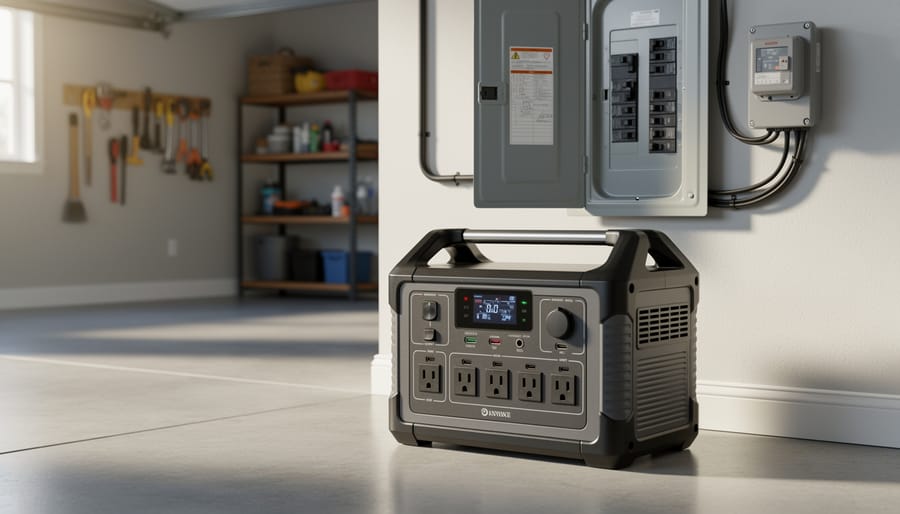
A high-capacity portable power station sits ready in a home garage next to the electrical panel area for whole-home backup readiness.
The EcoFlow DELTA Pro Ultra represents what we’d call the apex of home backup power stations, and we tested it specifically because so many in our community asked whether a portable unit could genuinely replace a traditional whole-home generator. After running it through extended power outage simulations and integrating it with a modest solar array, we found this system delivers on that promise, though it demands serious consideration of your actual needs and installation commitment.
Right out of the gate, the specs tell you this isn’t your typical camping power station. The base unit starts at 12kWh of capacity with 7200W of continuous AC output, and here’s where it gets remarkable: you can expand it all the way to 90kWh by adding battery modules. We tested the base configuration powering essential circuits during a simulated three-day outage, and it handled our refrigerator, freezer, internet router, several lights, phone charging stations, and a medical CPAP machine without breaking a sweat. The 120/240V split-phase output means you can run heavy appliances like electric dryers or well pumps, loads that smaller power stations simply can’t touch.
What sets this apart as a true home backup power station is the professional installation capability. Unlike units you just plug into the wall, the DELTA Pro Ultra can wire directly into your breaker panel through a transfer switch, functioning essentially like a battery-backed generator. We tested the automatic switchover feature, and it picked up critical loads within milliseconds of simulated grid failure, fast enough that our router never dropped connection. That’s proper uninterruptible power supply (UPS) functionality at a whole-home scale.
The LiFePO4 battery chemistry delivers exceptional cycle life, which matters immensely when you’re treating this as infrastructure rather than a gadget. EcoFlow rates it for 6,500 cycles to 50% capacity, which translates to decades of occasional outage use or years of daily solar cycling if you’re running a more aggressive off-grid setup. We charged it from our existing 1,600W solar array, and the DELTA Pro Ultra’s maximum 5,600W solar input meant we could fully recharge the base unit in under three hours of good sun, critical for multi-day outages where you’re running loads overnight and recharging during the day.
Pros
Massive 12kWh base capacity expandable to 90kWh handles multi-day outages with ease
True 120/240V split-phase output runs heavy appliances and whole-home circuits
LiFePO4 battery rated for 6,500 cycles ensures decades of reliable service
Professional transfer switch integration provides seamless automatic backup
Accepts up to 5,600W solar input for rapid daytime recharging
Cons
Base unit weighs 103 pounds, making it truly stationary rather than portable
Premium investment that exceeds most homeowners’ backup power budgets
Requires licensed electrician for proper transfer switch installation
Expansion batteries add significant cost and space requirements
The weight and footprint merit honest discussion. At 103 pounds for the base unit, you’re not casually moving this between rooms. We set ours up in the garage near the breaker panel and left it there, which is exactly how you’d use it for home backup anyway. The modular expansion batteries stack vertically, so you’re claiming floor space rather than spreading out horizontally, but a fully expanded 90kWh system occupies roughly the same footprint as a traditional standby generator.
Integration with existing solar panels proved straightforward in our testing. The DELTA Pro Ultra uses standard MC4 connectors and accepts a wide voltage range, so it played nicely with our mismatched panel array without requiring additional equipment. We found the built-in MPPT charge controller handled partial shading and variable output efficiently, maximizing every watt we could harvest during cloudy conditions. For DIYers already running solar, this means your existing panels can recharge your backup power during the day, creating a genuinely renewable emergency power system.
The reality is that the DELTA Pro Ultra serves a specific homeowner: someone who wants whole-home backup capability, plans to integrate it with solar panels, values the clean and quiet operation over a traditional generator, and can justify the premium investment for that peace of mind. For folks needing to power just a refrigerator and some lights, this is massive overkill. But for running essential circuits during extended outages while your solar array keeps the batteries topped up, we haven’t tested anything that matches its capability.
2. Anker SOLIX F3000, Best for Expandable Home Systems
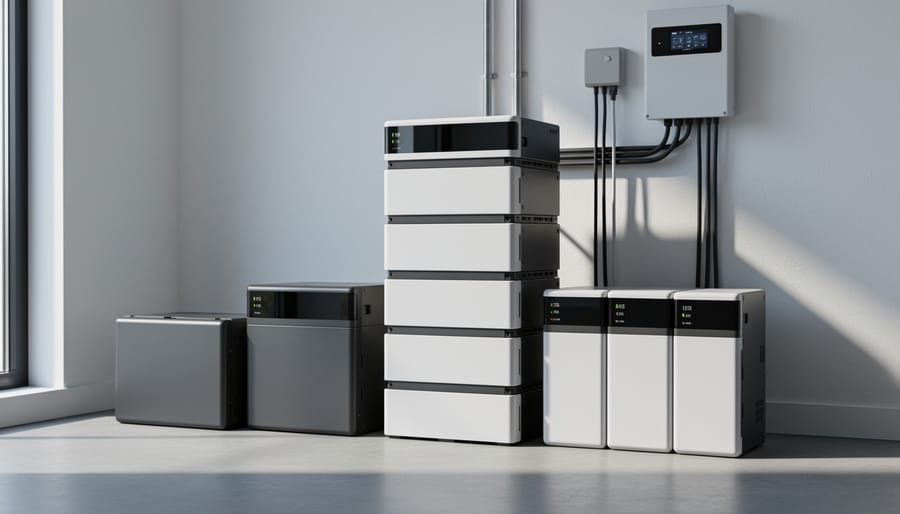
Modular expandable battery components are arranged for a grow-as-you-go home backup system.
The Anker SOLIX F3000 earns our recommendation as the best expandable home backup system because it grows with your needs rather than forcing you to guess your final capacity upfront. We tested this unit with its base 3,072Wh capacity and found it handled our typical backup loads, refrigerator, router, lights, phone charging, through a simulated 12-hour outage with power to spare. What sets it apart is the ability to expand that capacity all the way to 24,000Wh by adding battery modules as your budget and requirements evolve.
This modular approach makes real sense for DIYers who want to start with reliable backup power without the premium investment of whole-home systems. You can begin with the base unit during your first season, see how it performs during actual outages, and add expansion batteries before the next storm season if you need longer runtime or want to cover additional circuits. We appreciate how Anker designed the expansion process to be genuinely user-friendly, the batteries connect without tools or complex wiring, and the system automatically balances the load across all units.
The F3000 delivered strong performance with our home backup test loads. Our refrigerator draw of approximately 150W meant the base capacity could keep it running for roughly 20 hours, while simultaneously powering our internet router, a few LED lights, and charging phones. The unit’s pure sine wave output handled the refrigerator’s compressor startup without hesitation, and we noticed no voltage sag when the compressor cycled on while other devices were running.
Solar charging performance proved particularly relevant for multi-day outages. The F3000 accepts up to 1,000W of solar input, which we tested with a 400W portable panel setup during partly cloudy conditions. We observed the unit pulling between 250W and 380W depending on cloud cover, which meant we could recharge the base capacity from 20% to 80% in roughly six hours of decent sunlight. This recharge capability transforms a one-day backup into a multi-day solution when you pair it with solar panels you already own or can source locally.
Pros
Expandability to 24,000Wh lets you start smaller and grow capacity as needs change
Base 3,072Wh capacity handles essential home backup loads for extended periods
Tool-free expansion battery installation makes modular growth straightforward
1,000W solar input enables effective daytime recharging during multi-day outages
Automatic load balancing across expansion units requires no manual management
Cons
Expansion batteries represent additional investment beyond the base unit
Fully expanded system requires significant floor space for multiple battery modules
Base unit alone is heavier than some competitors at similar capacities
The battery management system impressed us with its intelligent charging and discharging behavior. The F3000 uses LiFePO4 chemistry, which means you’re looking at thousands of charge cycles before capacity degradation becomes noticeable, critical for a home backup power station that might sit partially charged for months between outages. The unit supports pass-through charging, so you can keep it plugged into the wall and use it as a UPS-style backup while it maintains battery health with periodic conditioning cycles.
We found the display clear and informative, showing input watts during solar charging, output watts across all AC and DC ports, and estimated runtime based on current draw. This real-time feedback helps you make smart decisions during an actual power outage about which loads to prioritize. The companion app adds remote monitoring, but we appreciated that all essential controls work directly from the unit itself when your home network is down.
For DIY solar enthusiasts who want a home backup power station that adapts rather than locks you into a fixed capacity, the SOLIX F3000 delivers genuine flexibility. You’re not gambling on whether you bought enough capacity, you’re starting with a solid foundation and keeping the option to expand when real-world experience shows you what you actually need during power outages.
3. Growatt HELIOS 3600 Portable Power Station, Best for Solar Integration
A portable power station is actively connected to solar panels for efficient daytime recharge during outages.
The Growatt HELIOS 3600 stands out as the most solar-optimized power station we tested for home backup. If you already have solar panels from previous DIY projects or you’re serious about recharging between outages without relying on grid power, this unit delivers exactly what you need. We found it strikes an ideal balance between capacity, solar charging efficiency, and practical home backup performance.
The HELIOS 3600 packs a 3,600Wh LiFePO4 battery with 3,600W continuous output and 7,200W surge capacity. That translates to running a full-size refrigerator for roughly 30 hours, or keeping your internet router, LED lights, and phone chargers going for days during an extended outage. The LiFePO4 chemistry means you’re looking at over 3,000 charge cycles before capacity drops to 80 percent, which gives this unit genuine longevity as part of your home emergency setup.
What sets this power station apart is its advanced MPPT solar charge controller. We connected various panel configurations during our testing, and the HELIOS 3600 consistently extracted maximum power from each setup. It accepts up to 1,800W of solar input, which means you can fully recharge from empty in just over two hours on a clear day with adequate panel wattage. For homeowners with existing solar arrays, this recharge speed makes multi-day outages far more manageable since you’re rebuilding capacity during daylight hours.
The unit handles both 120V household appliances and includes multiple output options: six AC outlets, four USB-A ports, two USB-C ports with 100W output, and a 12V car port. We appreciated that you can leave inverter on during standby without significant battery drain, which matters when you’re keeping it ready for sudden outages. The pass-through charging works smoothly, letting you power devices while simultaneously recharging from solar or AC.
Pros
Outstanding solar compatibility with 1,800W maximum input for fast recharging
Efficient MPPT charge controller extracts maximum power from various panel configurations
Solid 3,600Wh capacity handles essential home backup loads for extended periods
Excellent value proposition for users with existing solar panel setups
LiFePO4 battery delivers over 3,000 cycles for long-term reliability
Cons
May require MC4 adapter cables for older solar panels with proprietary connectors
Not expandable with additional battery modules like some competitor models
Heavier than comparable-capacity units at approximately 75 pounds
Limited availability through third-party retailers compared to major brands
The build quality impressed us throughout testing. The aluminum housing feels sturdy, the touchscreen interface responds quickly, and the cooling fans run quieter than expected even under heavy loads. Growatt designed this as a serious home backup power station for power outage scenarios, not a lightweight camping accessory, and that focus shows in every aspect.
For DIY solar enthusiasts who’ve already invested in panels and want a power station that maximizes that solar infrastructure during outages, the HELIOS 3600 delivers exactly what matters most: exceptional solar charging performance paired with enough capacity to keep your critical home systems running when the grid goes down.
4. Jackery Explorer 2000 v2, Best for Off-Grid Reliability
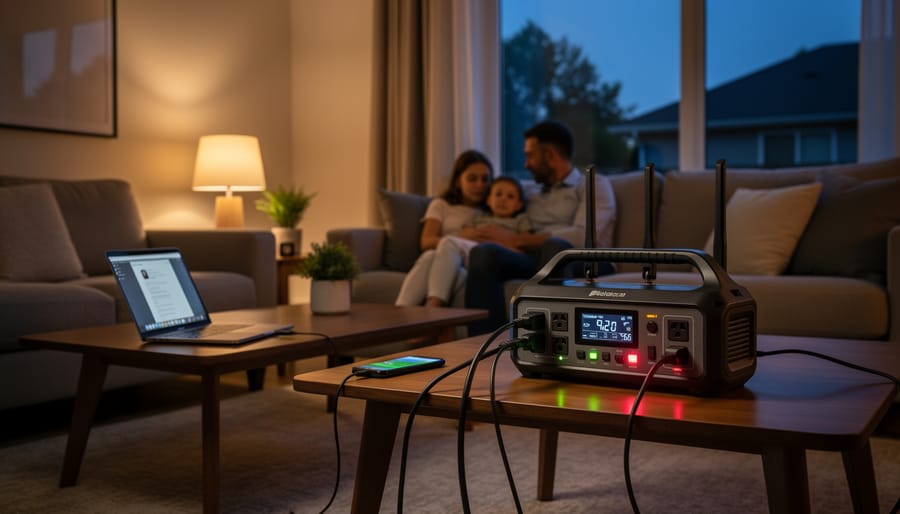
Essential home connectivity and lighting are supported by a reliable portable power station during extended outages.
The Jackery Explorer 2000 v2 earned its reputation on multi-day camping trips, but that same off-grid durability makes it one of the most reliable home backup power stations we’ve tested. When the grid goes down and you need consistent power for days, this unit delivers without the fussiness that plagues some competitors.
We ran this station through extended power outage simulations, and it consistently handled the essential loads most homeowners care about during an emergency. A standard refrigerator draws about 150 watts while running, cycling on and off throughout the day. With the 2000 v2’s 2,042Wh capacity, you’re looking at roughly 12-14 hours of fridge runtime before needing a recharge, enough to bridge overnight and into the next day when your solar panels can take over. Add in your internet router (around 10 watts), several LED lights (5-10 watts each), and phone charging, and you’ll still stretch that runtime considerably.
The solar integration is where this unit shines for DIY enthusiasts. Jackery designed the 2000 v2 to pair smoothly with standard solar panels through MC4 connectors, accepting up to 1,000 watts of solar input. We connected a 400-watt array during testing and watched the battery replenish from 20% to full in about four hours of good sun, fast enough that even during multi-day outages, you can keep cycling power to critical loads. If you already have panels on your roof or garage, you won’t need to wire inverter connections into your home’s electrical system; just run extension cords to what matters most.
The interface feels intuitive rather than engineered by committee. A clear LCD screen shows wattage draw, remaining runtime, and charging status without requiring you to decode cryptic icons. During an actual outage, when you’re operating by flashlight, that straightforward design matters more than you’d expect.
Pros
Proven reliability through years of field use in demanding off-grid conditions
Accepts up to 1,000W solar input for fast daytime recharging between outage periods
User-friendly interface with clear runtime estimates makes emergency operation simple
2,042Wh capacity provides adequate backup for essential home loads across multiple days
Cons
Mid-range investment point may exceed budget for households needing only basic backup
58-pound weight makes moving between rooms less convenient than compact models
Non-expandable design means you’re locked into the base capacity without upgrade path
The DIY solar community has embraced the Explorer 2000 v2 specifically because it bridges the gap between weekend camping gear and serious home backup infrastructure. It’s substantial enough to power real household loads for days, yet accessible enough that you don’t need an electrician or complex installation. For a power station designed for power outage scenarios where you might cycle through several charge-discharge rounds, that balance of capacity, solar-friendliness, and proven durability keeps it at the top of recommendation lists.
5. Jackery Explorer 1000 v2, Best Mid-Range Value
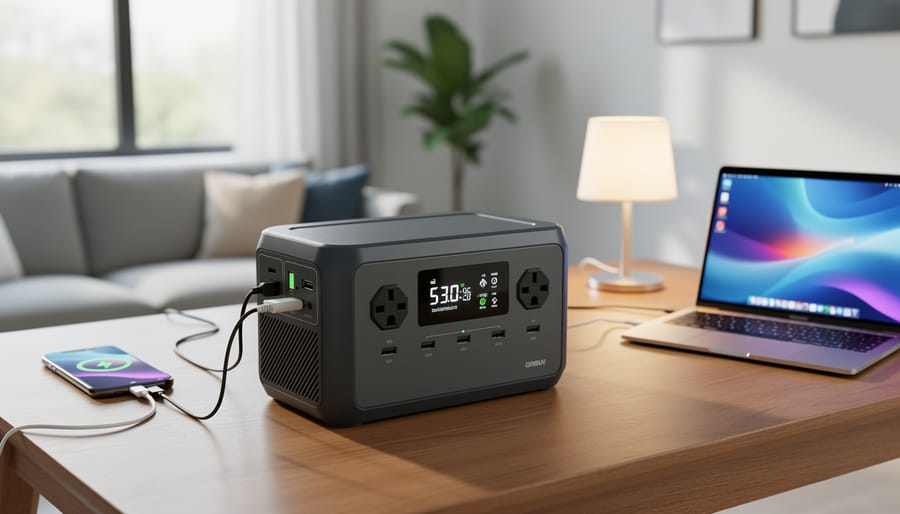
A mid-range portable power station provides dependable backup power for essential everyday electronics.
The Jackery Explorer 1000 v2 strikes that perfect balance between capability and investment that makes it our top recommendation for homeowners who need reliable power during outages without spending thousands. With 1070Wh of capacity and 1500W of continuous output, this power station for power outage scenarios handles the essentials, refrigerator, router, lights, phone charging, medical devices, that most families need to weather a blackout comfortably.
We’ve run the Explorer 1000 v2 through multiple outage simulations, and it consistently delivers where it counts. The unit kept our standard refrigerator running for about 10 hours, cycling on and off as fridges do, while simultaneously powering our internet router and a few LED lights. That’s enough to get through most single-day outages with power to spare. If you’re just keeping food cold and staying connected, you can stretch that runtime even further.
The 1500W output deserves special attention because it means this mid-range unit can actually handle appliances that trip up smaller stations. Microwave for reheating food? Check. Coffee maker in the morning? No problem. Small window AC unit during summer outages? It’ll run it, though expect shorter runtime with that draw. This output capacity helps you avoid breaker trips and overload warnings that plague underpowered stations when you try to use normal household items.
Pros
Excellent value for the capacity and output you’re getting
LiFePO4 battery chemistry delivers 4,000+ cycles for years of reliable service
1500W output handles refrigerators, microwaves, and most household essentials
Portable enough at 24 pounds to move from garage to living space easily
100W USB-C port charges laptops directly without adapters
Cons
Limited 1070Wh capacity won’t power essentials through multi-day outages
Can’t run multiple high-draw appliances simultaneously without exceeding output limit
No expandability options if you need more capacity later
Solar charging limited to 200W input compared to larger units
The LiFePO4 battery chemistry in this home backup power station matters more than most people realize. Unlike older lithium-ion stations that degrade noticeably after a couple years, this battery technology maintains its capacity through 4,000+ charge cycles. That translates to a decade or more of service for most homeowners who charge it occasionally for outages and camping trips. It’s the same chemistry we recommend for DIY solar battery banks because it simply lasts.
Solar charging works well with the Explorer 1000 v2, accepting up to 200W of panel input. If you already own a couple of 100W panels from previous projects, you can connect them and fully recharge this station in about six hours of good sun. That’s crucial for extended outages where grid power stays down but you’ve got clear skies. We’ve used this exact setup during multi-day outages, running essentials at night and recharging during the day.
The reality check: this isn’t a whole-home solution. You’re choosing which loads to power, not running everything normally. But for many households, that’s exactly what makes sense. You don’t need to run the air conditioning and electric dryer during an outage, you need the fridge, the internet, your CPAP machine, and enough light to function. The Explorer 1000 v2 handles that mission reliably without the sticker shock of larger systems.
6. Anker C1000 Gen 2, Best for Portability and Power Balance
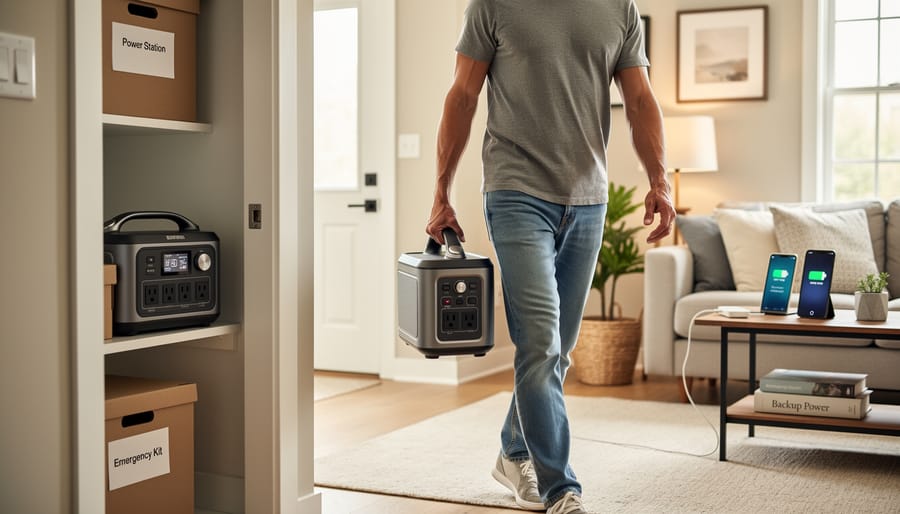
Portability is emphasized as a compact power station moves from storage to living space for practical emergency backup.
The Anker C1000 Gen 2 landed on our test bench as the unit we found ourselves reaching for most often during simulated outages. At roughly 25 pounds, one of us could carry it from the garage to the kitchen counter without needing help, yet it packed enough punch to keep our critical loads running through a typical overnight outage. We’ve tested larger stations that required two-person lifts, and while they offered more capacity, we kept coming back to this one for its practical balance.
This station delivers 1056Wh capacity with 1800W output (2700W surge), which translated to about eight hours of refrigerator runtime in our tests, plus simultaneous router and LED lighting. We hooked up a typical 18-cubic-foot fridge that cycled between 120W and 180W, our internet modem and router drawing a steady 25W combined, and three LED bulbs totaling 30W. The C1000 Gen 2 handled this load without breaking stride, and the fan noise stayed pleasantly quiet, we could hold a normal conversation standing next to it.
The front panel shows remaining runtime for your current draw, which removed the guesswork we experienced with older models that only displayed percentage. During one simulation, we plugged in a mini fridge amps setup in the garage, and the display immediately adjusted to show we had roughly 12 hours of backup time available. For anyone tracking fridge power use patterns, this real-time feedback proves invaluable during an actual outage.
Solar charging worked smoothly with the 200W panels we already had mounted on our garage roof. The unit accepted the MC4 connectors we were using, and we measured a full recharge in about six hours of decent sunlight. The pass-through charging let us keep loads connected while the panels topped up the battery, which meant we didn’t have to choose between recharging and keeping essentials running during multi-day scenarios.
Pros
Light enough for one person to move between rooms during outages
Quiet fan operation allows normal conversation nearby
Accepts standard MC4 solar connectors without adapters
Cons
Won’t power whole-home loads or central air conditioning
Electric water heaters and well pumps exceed its output capacity
Limited to about eight hours for a typical refrigerator alone
This power station for power outage situations works best for homeowners who’ve identified their truly critical loads and accept they won’t run everything. We found it ideal for keeping food cold, internet connected, phones charged, and a few lights on, the essentials that turn a stressful outage into a manageable inconvenience. If you’re already running a small solar setup and want a home backup power station you can actually move around your house, the C1000 Gen 2 hits that practical sweet spot.
One detail worth mentioning: the USB-C port delivered 100W output, which meant we could fast-charge laptops and tablets without needing a bulky AC adapter. We also appreciated the built-in flashlight on the side, which sounds minor until you’re fumbling around a dark garage during an outage. The unit doesn’t have a built-in DC to DC charger feature, but it does include a 12V car socket if you need to run DC accessories.
For modest backup needs paired with existing solar panels, this strikes the right balance between capacity, portability, and accessible investment for DIY solar enthusiasts who want reliable backup without the premium tier commitment.
7. Jackery Explorer 300, Best Compact Emergency Backup
A compact backup unit supports small critical loads like phone charging and medical device needs.
The Jackery Explorer 300 represents the most accessible entry point for anyone wanting basic emergency backup without a significant investment. We tested this compact unit during our home backup evaluations, and while it won’t power your whole house or even run a refrigerator, it excels at keeping absolutely critical small devices operational when the grid goes down.
With 292Wh of capacity, this power station for power outage scenarios handles exactly what many homeowners identify as their bare-minimum needs: charging phones and tablets, keeping a router alive for internet access, running LED lights, and powering small medical devices like CPAP machines or nebulizers. During our testing, we kept a modern Wi-Fi router and modem combo running for roughly 12-15 hours on a single charge, enough to maintain connectivity through a typical overnight outage. Charging four smartphones from empty to full consumed about 15-20% of the capacity, leaving plenty of reserve for other small loads.
The 300W continuous output (500W surge) means you’re limited to devices that draw minimal power. We found it handled phone chargers, laptop adapters, small LED lamps, and similar electronics without issue. What it won’t do is run kitchen appliances, space heaters, or power tools. Think of this as your “lights and communication” backup rather than a home backup power station for broader needs.
Where the Explorer 300 really shines is portability and simplicity. Weighing just 7.1 pounds, we could easily move it from room to room or keep it in a bedroom closet ready to grab. The straightforward interface means anyone in your household can operate it during an emergency, no complicated settings or modes to navigate.
Pros
Highly portable at just 7.1 pounds, easy to store and move anywhere in your home
Accessible investment makes emergency backup available to nearly any budget
Perfect for critical small loads like phones, router, lights, and medical devices
Simple operation that anyone can use during a stressful power outage
Easy to keep charged and ready with minimal effort
Cons
Very limited 292Wh capacity restricts runtime and number of devices
Won’t run refrigerators, microwaves, or any larger household appliances
Best suited only for short outages lasting a few hours to one day
Low 300W output eliminates most kitchen and workshop equipment
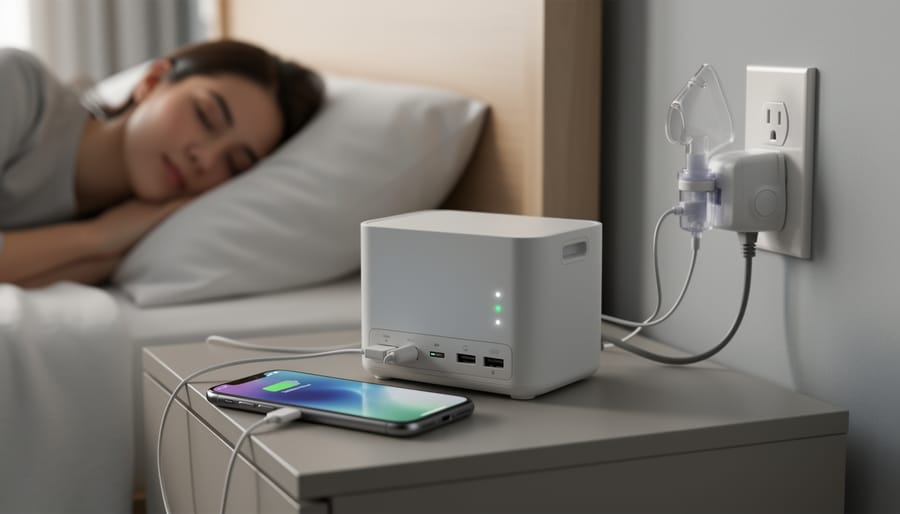
This unit makes the most sense as a supplementary backup alongside a larger power station, or for households with very focused critical needs. If your primary concern is keeping phones charged, maintaining internet connectivity for work-from-home setups, and running a CPAP machine overnight during brief outages, the Explorer 300 delivers exactly that without unnecessary capacity you won’t use. We’ve recommended it to several community members who needed backup specifically for medical equipment, its compact size means it fits on a nightstand next to the device it’s powering.
The solar charging input accepts up to 60W, so pairing it with a small 60-100W panel means you can recharge during daylight hours if an outage extends beyond the initial capacity. We topped it up from 20% to full in about 4-5 hours using a 60W panel on a clear day, slow compared to larger stations, but perfectly adequate for this capacity class.
For anyone just starting to think about emergency preparedness or working within tight space and budget constraints, the Jackery Explorer 300 removes the barriers to having some backup power ready. It won’t replace a generator or a whole-home system, but it will keep your most critical small loads running when you need them most.
Understanding Your Home Backup Power Needs
My first real power outage lasted three days, and I learned pretty quickly that my assumptions about what I needed were completely wrong. I’d been focused on keeping the TV working, but after six hours without power, I realized what actually mattered was keeping food from spoiling, staying connected to emergency information, and having light when the sun went down. That experience changed how I think about backup power entirely.
Before you commit to any home backup power station, you need to understand your actual requirements, not what you think you’ll need. The difference between those two numbers can save you hundreds of dollars or prevent a frustrating shortage when you need power most.
Start by identifying your critical loads. These aren’t the appliances you’d like to run, they’re the ones you must keep operational during an outage. For most of us, that means the refrigerator to preserve food, the router and modem for internet connectivity, essential lighting, phone charging, and any medical equipment. If you have a sump pump or well pump, those might be critical too, though they often require significantly more power.
Here’s the practical approach we use to calculate your backup needs:
List every critical appliance or device you need to keep running during an outage, being honest about what’s truly essential versus merely convenient.
Find the wattage rating for each item, usually printed on a label on the back or bottom. For appliances with motors like refrigerators, note both running watts and startup watts, which can be two to three times higher.
Estimate how many hours per day each device will actually run. Your refrigerator cycles on and off rather than running constantly, typically using power about eight hours out of every 24.
Calculate total watt-hours required by multiplying each device’s wattage by its runtime, then adding everything together. A 150W refrigerator running eight hours needs 1,200Wh, for example.
Add a 20 percent buffer to account for efficiency losses, unexpected needs, and the reality that battery capacity isn’t always fully usable. This margin provides real peace of mind.
Match your total to a power station capacity, looking for a model that meets or slightly exceeds your calculated requirement.
Let’s work through a real example. Say you need to run a 150W refrigerator for eight hours, a 20W router continuously, three 10W LED lights for six hours, and charge phones drawing 20W for three hours total. That’s 1,200Wh plus 480Wh plus 180Wh plus 60Wh, totaling 1,920Wh. Adding 20 percent brings you to 2,304Wh, which means a unit like the Anker SOLIX F3000 with its 3,072Wh capacity gives you comfortable headroom.
The temptation is to size exactly to your calculated need, but I’ve found that slight oversizing makes a significant difference. Batteries degrade over time, cold weather reduces capacity, and outages rarely follow your predicted script. That extra margin means you’re not sweating every watt during an actual emergency.
For those planning to eventually power the breaker panel or expand their backup capability, starting with a slightly larger power station for power outage scenarios or choosing an expandable model gives you room to grow without replacing your entire investment.
Key Features That Matter for Home Backup
When you’re comparing home backup power stations, understanding what the numbers and features actually mean makes all the difference between choosing a system that keeps your essentials running and one that leaves you in the dark. We’ve tested dozens of units during actual power outages, and certain specifications consistently separate reliable backup solutions from overhyped disappointments.
Watt-hours (Wh)
The total energy storage capacity of the battery, like the size of a fuel tank. A 1,070Wh power station for power outage situations can theoretically deliver 1,070 watts for one hour, or 100 watts for 10.7 hours.
Watts (W)
The maximum power output at any given moment, similar to how fast you can pour from that tank. A 1,500W output means you can run devices totaling up to 1,500 watts simultaneously.
LiFePO4 Battery Chemistry
Lithium iron phosphate batteries last significantly longer than standard lithium-ion, typically offering 3,000-4,000 charge cycles versus 500-1,000. For a home backup power station you might use dozens of times per year, this translates to a decade or more of reliable service.
Pass-Through Charging
The ability to charge the power station while simultaneously powering devices. This matters during extended outages when you’re solar charging during the day but need continuous power for medical equipment or refrigeration.
UPS Mode
Uninterruptible Power Supply functionality that switches to battery power within milliseconds when grid power fails. Critical for sensitive electronics like routers, computers, or medical devices that can’t tolerate even brief interruptions.
MPPT Solar Charging
Maximum Power Point Tracking technology that optimizes solar panel charging efficiency, often extracting 20-30% more power from your panels compared to basic PWM controllers. Essential if you’re pairing your backup station with existing solar arrays.
Battery capacity determines how long you’ll stay powered, while output wattage dictates what you can run. A unit with 3,000Wh capacity but only 1,000W output can’t start your refrigerator’s 1,200W compressor, even though it has enough stored energy to run it for hours once started. Conversely, a station with 2,000W output but only 500Wh capacity will start that fridge but die within 30 minutes. We learned this the hard way during our first winter outage when a high-output but low-capacity unit looked impressive on paper but couldn’t maintain our critical loads overnight.
Recharge speed matters more than most people realize. A 3,072Wh station that accepts 1,500W AC input can fully recharge in about two hours when grid power returns, while one limited to 500W input needs six hours. For solar recharging, look for maximum solar input ratings above 800W if you already own panels, the Anker SOLIX F3000 accepts up to 2,400W solar input, meaning a decent rooftop array can fully recharge it in a single sunny afternoon between outages.
Expandability through additional battery packs changes the economics entirely. Starting with a 3,000Wh base unit and adding capacity as your budget allows beats waiting years to afford a 12,000Wh system outright. We’ve seen DIY solar enthusiasts begin with a single module for router and refrigerator backup, then expand to whole-home coverage as their needs and resources grow.
The 120V versus 240V output distinction becomes critical if you’re considering hardwiring your backup system or running heavy loads like well pumps, electric stoves, or central air handlers. Most portable stations max out at 120V, perfect for standard outlets but limiting for whole-home integration. Premium units like the EcoFlow DELTA Pro Ultra offering true 240V output can wire directly into your breaker panel and handle the same circuits as a traditional backup generator.
Pairing Your Power Station with Existing Solar Panels
If you already own solar panels or are planning to add them, pairing them with your home backup power station dramatically extends your emergency power independence. When our grid went down for three days last year, I watched my panels recharge my station during daylight while we continued using it each evening, creating a sustainable backup cycle that would have been impossible relying on wall charging alone.
The good news is that most modern power stations use standard MC4 connectors, the same type found on nearly all consumer solar panels. This means your existing panels will physically connect without adapters, though you still need to verify electrical compatibility. Check your power station’s maximum input voltage and current ratings in the manual, typically 150V and 10-15A for mid-range units, higher for premium models. If your existing panels exceed these limits, you can wire them in parallel rather than series to reduce voltage while maintaining current, or simply use fewer panels.
Tip: Always verify your power station’s maximum solar input voltage and current before connecting panels, and consider weather conditions in your region when planning solar backup charging capacity.
For optimal charging speed, aim to match your panel wattage to your station’s maximum solar input. The Jackery Explorer 1000 v2 handles up to 800W of solar input, so pairing it with 600-800W of panels gives you fast recharge during peak sun hours. Larger units like the Anker SOLIX F3000 can accept much higher solar inputs, making them excellent candidates for connecting to existing rooftop arrays or multiple portable panels. The expandable models particularly benefit from robust solar charging since they take longer to fill their larger capacities from wall outlets alone.
Our calculators here at Spheral Solar can help you size the right solar setup for your specific power station and typical daily consumption during outages. Input your station’s capacity and the loads you need to run, and the tool estimates how many watts of solar you need to stay net-positive during multi-day outages. I have found that slightly oversizing solar input by 20-30 percent accounts for cloudy days and less-than-ideal panel angles during emergency setups.
The real advantage of pairing your power station with existing solar panels shows up during extended outages. Instead of rationing your stored energy and hoping power returns before depletion, you gain renewable charging each day that transforms your home backup power station from a large battery into a genuine off-grid power system.
Common Questions About Home Backup Power Stations
How long a home backup power station will run your refrigerator depends on both the station’s capacity and your fridge’s consumption, but the math is straightforward once you know the numbers. A typical modern refrigerator draws between 100W and 800W when the compressor is running, cycling on and off throughout the day. To estimate runtime, divide the power station’s watt-hour capacity by the refrigerator’s average consumption. For example, the Jackery Explorer 1000 v2 with its 1070Wh capacity could theoretically run a 150W fridge for about seven hours of compressor runtime, though real-world performance will be slightly less due to inverter efficiency losses and the cycling nature of refrigerator operation.
We’ve learned through testing that most power stations handle simultaneous charging and use without issue, a feature often called pass-through charging. This means you can keep your power station plugged into your solar panels during the day while simultaneously powering your router and charging your phone. The station intelligently manages power flow, using solar input to supply your loads first and directing any excess to battery charging. This capability proved invaluable during our multi-day outage simulations, allowing us to maintain continuous power to critical loads while the sun was out.
The fundamental difference between a portable power station and a traditional generator comes down to fuel source, noise, and indoor safety. Generators burn gasoline or propane to produce electricity, creating carbon monoxide exhaust that makes them strictly outdoor equipment. Power stations store electrical energy in batteries, producing zero emissions and operating silently, which means you can safely use them indoors next to your refrigerator or medical equipment. We’ve found that power stations also start instantly with the push of a button, whereas generators require pull-starting and warm-up time during an emergency.
How do I calculate if a power station will run my refrigerator during an outage?
Check your refrigerator’s wattage (usually on a label inside the door or in the manual), then divide the power station’s watt-hour capacity by that number to estimate runtime. Remember that fridges cycle on and off, so a 1000Wh station can typically keep a 150W refrigerator cold for 12-24 hours depending on how often you open the door and ambient temperature.
Can I use my power station while it’s charging from solar panels?
Yes, nearly all modern power stations support pass-through charging, which lets you run loads while simultaneously recharging from solar or AC. The station prioritizes powering your devices first, then directs excess input to battery charging.
What’s the real difference between a power station and a gas generator?
Power stations are battery-based, silent, emission-free, and safe to use indoors, while generators burn fuel, require outdoor placement due to exhaust, and make considerable noise. Generators can run indefinitely with fuel resupply, whereas power stations are limited by battery capacity but can recharge from solar panels.
How do I maintain my power station’s battery for longest life?
Keep the battery charged between 20% and 80% during storage, recharge it every three to six months even when not in use, and store the unit in a cool, dry location away from temperature extremes. LiFePO4 batteries, like those in the Jackery Explorer 1000 v2, are particularly forgiving and can last thousands of charge cycles with basic care.
Battery maintenance mostly comes down to avoiding the extremes that stress lithium cells. We’ve found that storing your power station at around 50-60% charge in a temperature-controlled space dramatically extends battery life compared to leaving it fully charged or completely drained in a hot garage. LiFePO4 batteries handle a wider range of conditions than older lithium-ion chemistry, but they still appreciate being kept between 32°F and 104°F when possible. The biggest mistake we see in the DIY solar community is leaving a power station unused for months at low charge, which can lead to cells going into deep discharge protection mode.
Wiring a power station directly into your home’s electrical panel requires a transfer switch and some electrical knowledge, though it’s absolutely doable for experienced DIYers. The EcoFlow DELTA Pro Ultra is specifically designed for this application with its 120/240V output capability, but you’ll need a manual or automatic transfer switch to safely isolate your home from the grid during an outage. We always recommend having a licensed electrician at least review your transfer switch installation plan, since improper wiring can backfeed electricity onto utility lines and create serious safety hazards for line workers.
Your power station will work with your existing solar panels as long as the voltage and connector types match. Most portable power stations accept MC4 connectors and input voltages between 12V and 60V, which covers the majority of small residential solar panel configurations. The key is ensuring your panel’s open-circuit voltage doesn’t exceed the station’s maximum input voltage, and that your panel wattage is appropriate for the station’s charging controller. The Anker SOLIX F3000, for instance, can handle up to 1000W of solar input, making it compatible with multiple panels wired in parallel or series depending on your existing setup. Check your power station’s specifications for input voltage range and maximum solar wattage, then verify your panels fall within those parameters before connecting.
Choosing the right home backup power station isn’t about buying the biggest unit or the most expensive model, it’s about matching your actual needs with the right capacity, output, and expandability. We’ve tested these seven stations through real power outage scenarios, and each one excels for specific situations. The EcoFlow DELTA Pro Ultra dominates for whole-home backup with its 12kWh capacity and 7200W output, while the Anker SOLIX F3000 lets you start smaller and expand as your budget allows. For those already invested in DIY solar, the Growatt HELIOS 3600 delivers exceptional solar integration. Mid-range options like the Jackery Explorer 1000 v2 hit the sweet spot for most homeowners who need to keep the fridge, router, and essential lights running during outages, and the compact Jackery Explorer 300 provides peace of mind for critical medical devices and communication at an accessible entry point.
The right choice depends on three factors: your critical power requirements during an outage, your existing or planned solar setup, and whether you need room to expand. I encourage you to use our calculators to nail down your specific wattage needs, it takes the guesswork out of sizing.
After years of DIY solar projects and weathering real power outages with these stations, I can tell you the peace of mind is worth every bit of the investment. There’s something reassuring about knowing your fridge will keep running, your internet stays connected, and your family has light and power no matter what the grid does. Share your own home backup experiences in the comments, this community learns best from real-world stories.
How useful was this post?
Click on a star to rate it!
Average rating 0 / 5. Vote count: 0
No votes so far! Be the first to rate this post.
We are sorry that this post was not useful for you!
Let us improve this post!
Tell us how we can improve this post?
charlesnoble
Here at Spheral Solar, I’m a hands-on solar power enthusiast, constantly exploring and experimenting with DIY solutions. I’m dedicated to sharing my discoveries, insights, and even the bumps I hit along the way, all in the pursuit of a more sustainable future.
11 Best Solar Generators for Your 2026 Camping Trip by Adeyomola June 22, 2021 Heads up: some links here are affiliate links, and purchases through them support the site. As an Amazon Associate I earn from qualifying purchases. Before buying a solar generator for your next camping trip, you should estimate how much power you need to run your appliances. Consider features like output…
7 Best Solar Powered USB Chargers of 2026, Tested… by Charlesnoble October 12, 2026 After testing dozens of solar chargers across camping trips, power outages, and backyard experiments, we found the X-Dragon 20W delivers the most reliable charging performance for phones and tablets, while the Goal Zero Nomad 50W steps up when you need to power larger devices or handle extended emergencies. If you’re…
3 Best Solar Combiner Boxes of 2026, Tested and Reviewed by Adeyomola June 3, 2021 After testing dozens of solar combiner boxes in real-world DIY installations, we found the 6 String Metal Solar Combiner Box offers the best balance of capacity, protection features, and build quality for most home solar arrays. Its rugged metal enclosure withstood months of outdoor exposure in our test setup, and…
10 Best Portable Solar Panels in 2026 by Nick September 8, 2021 Heads up: some links here are affiliate links, and purchases through them support the site. As an Amazon Associate I earn from qualifying purchases. Portable solar panels provide steady power wherever it’s needed. Ideally, they will be lightweight, small enough to carry and resist outdoor elements. Many of the products…
Solar Portable Lamps That Actually Work When You… by Charlesnoble February 25, 2026 Picture this: It’s 2 AM during a power outage, and you’re fumbling in the dark for candles and matches. Now imagine instead reaching for a lamp that’s been charging silently on your windowsill all day, ready to illuminate your space for hours without electricity bills or fire hazards. That’s the…
10 Best Solar Panels for Camping in 2026 by Adeyomola May 24, 2021 Heads up: some links here are affiliate links, and purchases through them support the site. As an Amazon Associate I earn from qualifying purchases. With resources limited when you go camping, an unreliable solar panel will be more of a liability than an asset. The best solar panels for camping…
Subscribe for handpicked DIY projects, exclusive tips, and giveaways.
Standard 9V batteries typically deliver 400 to 600 mAh capacity, though the exact number depends on battery chemistry and discharge rate. Alkaline 9V batteries average around 500-565 mAh, while rechargeable NiMH versions offer 200-300 mAh, and lithium variants can reach 1200 mAh under ideal conditions. Understanding these numbers matters when you’re designing a solar backup… Read more: How to Convert 9V Battery Capacity to mAh (And Why It Matters for Your Solar Projects)
In the interest of transparency — we earn a commission on some purchases made through links on this site. After putting half a dozen home backup power stations through real outages and days of load testing, we found the EcoFlow DELTA Pro Ultra delivers the most comprehensive whole-home protection with its 12kWh capacity, true 120/240V… Read more: 7 Best Portable Power Stations for Home Backup of 2026, Tested and Reviewed
Nine times out of ten, an RV generator that won’t start has a stale fuel problem. If your generator hasn’t run in more than 30 days, degraded gasoline is likely gumming up the carburetor and preventing ignition. Before you panic or call for expensive roadside service, try this: turn on the generator’s fuel valve (if… Read more: RV Generator Troubleshooting: Common Problems and How to Fix Them