How to Convert 9V Battery Capacity to mAh (And Why It Matters for Your Solar Projects)
Updated:
Standard 9V batteries typically deliver 400 to 600 mAh capacity, though the exact number depends on battery chemistry and discharge rate. Alkaline 9V batteries average around 500-565 mAh, while rechargeable NiMH versions offer 200-300 mAh, and lithium variants can reach 1200 mAh under ideal conditions.
Understanding these numbers matters when you’re designing a solar backup system or keeping your camping electronics running. I learned this the hard way during a weekend off-grid trip when my smoke detector drained faster than expected because I’d assumed all 9V batteries were created equal. They’re not, and that milliamp-hour rating tells you exactly how long your device will run before needing a replacement or recharge.
The challenge most people face is that manufacturers don’t always list mAh on the packaging. Unlike AA or AAA batteries where capacity specs are readily available, 9V ratings often require digging through spec sheets or performing simple calculations based on the battery’s watt-hour rating. This creates confusion when you’re trying to budget runtime for your multimeter, portable radio, or solar charge controller alarm systems.
This guide walks you through the actual capacity numbers for different 9V battery types, shows you how to convert between watt-hours and milliamp-hours when specs aren’t clearly labeled, and helps you calculate expected runtime for your specific devices. You’ll also learn why discharge rate dramatically affects real-world capacity and how to factor that into your planning, especially for solar applications where reliable backup power isn’t negotiable.
Key Takeaway: Focus on total watt-hours (voltage × capacity in amp-hours), not just voltage or capacity alone, when substituting battery types. A 500 mAh 9V battery equals approximately 4.5 Wh, match that energy total with your replacement configuration, whether it’s six AA cells in series-parallel or two 18650s with a boost converter.
Understanding 9V Battery Capacity: What mAh Really Tells You
When you see “mAh” on a 9V battery package, you’re looking at milliamp-hours, a measurement of how much electrical charge the battery can deliver over time. Think of it like the fuel tank in your car: a battery with 600 mAh can supply 600 milliamps of current for one hour, or 300 milliamps for two hours, or 60 milliamps for ten hours. The relationship between capacity and voltage works differently than many people expect. While AA and AAA batteries operate at 1.5V and often pack 2000-3000 mAh, a 9V battery delivers six times the voltage but typically holds just 400-1200 mAh depending on its chemistry.
Tip: To estimate how long a battery will power your device, divide the battery’s mAh rating by your device’s current draw in milliamps, a 600 mAh battery running a 50 mA device gives you roughly 12 hours of runtime.
This capacity difference exists because 9V batteries are actually six tiny 1.5V cells stacked inside one rectangular case, leaving less room for energy storage compared to a single large cylindrical cell. Understanding this trade-off matters when you’re building solar backup systems or planning camping trips. A smoke detector drawing just 10 milliamps might run for months on a 9V, while a power-hungry guitar pedal pulling 100 milliamps will drain the same battery in hours. This is similar to how Joules vs watts helps you understand energy storage versus power delivery in solar applications. When you’re combining 9V batteries with solar chargers or integrating them into portable power stations, knowing the actual mAh capacity lets you calculate whether your setup will last through a weekend camping trip or keep your emergency radio running during a multi-day power outage.
Tools and Information You’ll Need
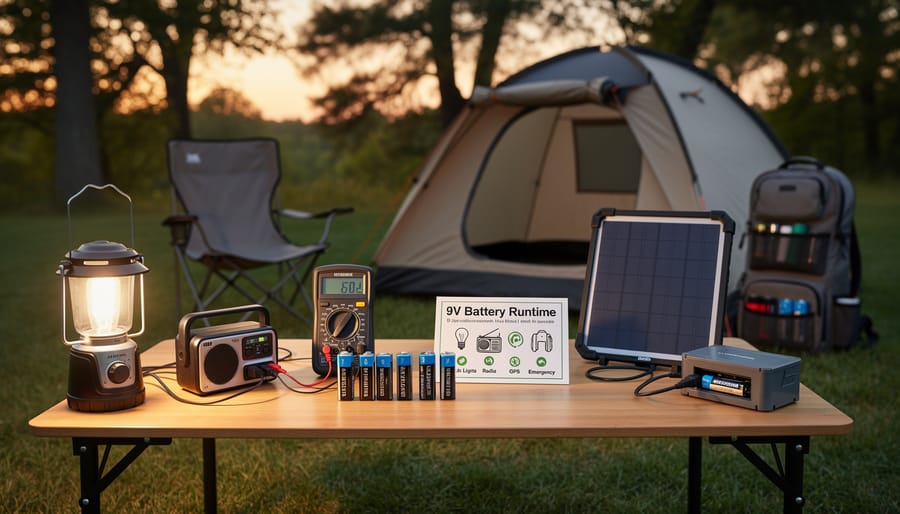
This campsite scene visually connects 9V battery runtime to real outdoor electronics used during solar backup or camping trips.
Good news: you don’t need expensive equipment to convert 9V battery capacity into usable runtime calculations. Most of the work happens with information you can find online or on the battery packaging itself.
Here’s what you’ll want to gather before you start:
Battery datasheet or packaging with mAh rating (check manufacturer websites if the label doesn’t list capacity)
Device specifications showing current draw in milliamps or power consumption in watts
Calculator or smartphone for basic division (or bookmark Charles’s battery capacity calculator for instant results)
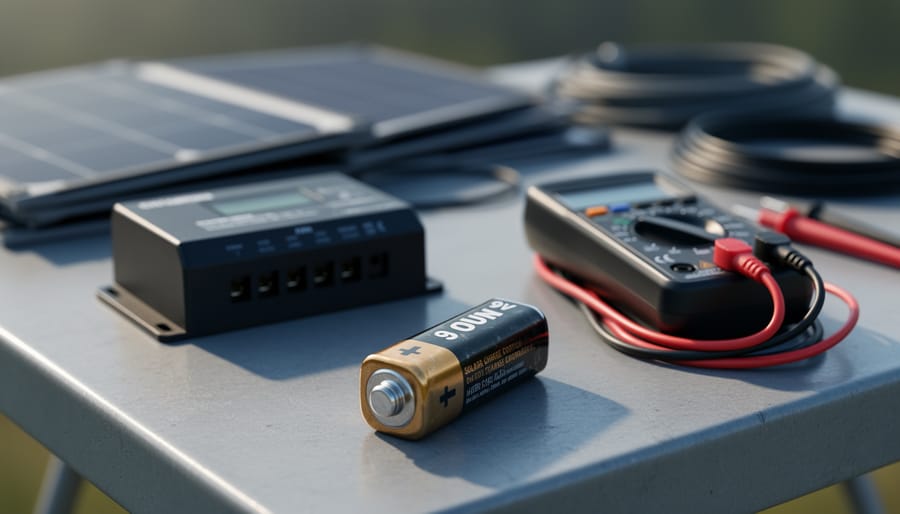
Multimeter with milliamp setting (optional, but helpful for measuring actual device current)
Notepad or spreadsheet to track your calculations for future reference
The multimeter is genuinely optional. I’ve found that manufacturer specs get you close enough for most solar backup planning and camping gear decisions. You’ll only need to measure current directly if you’re working with devices that don’t publish their power specs, or if you want to verify claims from questionable manufacturers.
For devices that only list wattage, you can derive current draw with simple math, which we’ll cover in the step-by-step section. The key is having accurate capacity numbers for your specific battery chemistry, since a lithium 9V performs very differently than an alkaline one.
Safety Precautions When Working with 9V Batteries
Before you start experimenting with capacity calculations, let’s cover some crucial safety points. 9V batteries might seem harmless compared to bigger battery packs, but they have unique risks that catch people off guard.
The biggest danger with 9V batteries is how close those terminals sit on top. Unlike AA or AAA batteries where the positive and negative ends are far apart, both 9V terminals are right next to each other. Drop a 9V in your pocket with keys or loose change, and you’ve created a short circuit. I learned this lesson when a 9V in my camping gear bag got hot enough to melt through a plastic case, thankfully I caught it before anything worse happened.
Warning: Touching both 9V terminals with metal objects like coins, keys, or steel wool can create enough heat to cause burns or start fires within seconds.
Storage matters more than most people realize. Keep 9V batteries in their original packaging until you need them, or use individual plastic caps that cover both terminals. Never store them loose in drawers with other metal objects. If you’re building a solar backup system that uses multiple 9Vs, mount them in proper battery holders rather than letting them bounce around in a project box.
Different battery chemistries require different disposal methods. Alkaline 9Vs can usually go in regular trash in most areas (check local rules first), but lithium and rechargeable types need to go to a proper battery recycling facility. The lithium ones especially can cause problems in landfills.
One last critical point: never mix battery types when connecting them in series or parallel configurations. Combining an old alkaline with a fresh lithium, or pairing different capacities together, creates uneven discharge rates that can damage your devices or the batteries themselves. Stick with matched batteries from the same batch for any multi-battery setup in your solar projects.
9V Battery Capacity by Chemistry Type
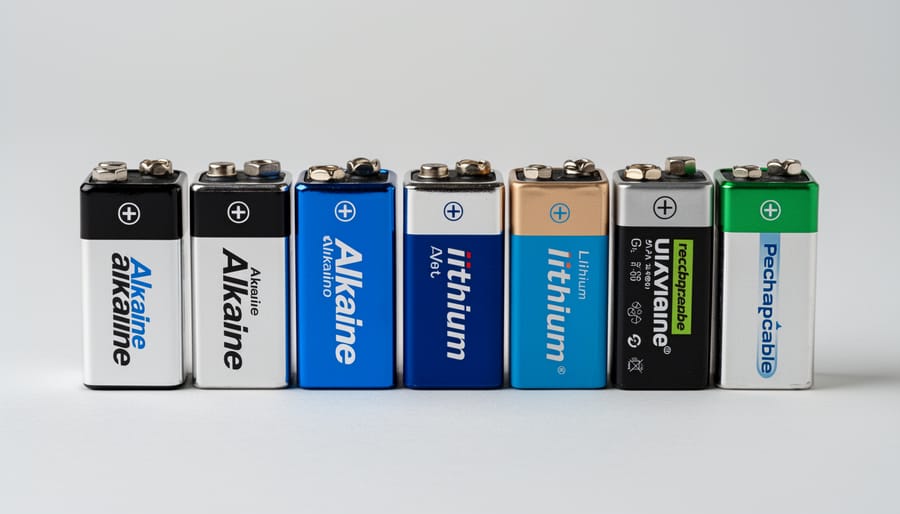
A close-up of different 9V battery types highlights how chemistry options can look similar but perform differently in the field.
Not all 9V batteries are created equal. The chemistry inside determines how much energy you can actually squeeze out of them, and if you’re planning a solar backup system or gearing up for a camping trip, knowing these differences can save you from dead devices at the worst possible time.
Alkaline 9V batteries are what you’ll find in most stores. They deliver between 400 and 565 mAh depending on the brand and specific model. Duracell’s CopperTop and Energizer’s standard alkaline typically land around 500-550 mAh. These are your workhorse batteries for smoke detectors and other low-drain devices where you’ll replace them once or twice a year.
Lithium 9V batteries pack the biggest punch at around 1200 mAh, more than double what alkaline offers. They’re also lighter and perform better in extreme temperatures, which matters if you’re running outdoor sensors in winter or summer heat. The downside is cost, expect to pay three to four times what alkaline runs you. But for emergency kits where batteries might sit unused for years, lithium’s 10-year shelf life makes the premium worthwhile.
Rechargeable NiMH 9V batteries confuse people because their capacity seems disappointing at 175-300 mAh. Here’s the thing: you’re not paying for capacity, you’re paying for reusability. A quality NiMH can handle 500-1000 charge cycles. Do the math on a guitar pedal you use weekly, and the lower capacity stops mattering. They’re perfect for devices you access easily and can swap batteries in regularly.
Rechargeable Li-ion 9V batteries split the difference at 500-650 mAh with 300-500 recharge cycles. They hold voltage better than NiMH as they discharge, which matters for devices sensitive to voltage drop. USB-rechargeable models have gotten popular for portable ham radios and field equipment where you’re already carrying a solar panel or power bank.
The rechargeable options cost more upfront and run down faster per charge, but if you’re using a device daily or weekly, they’ll pay for themselves within months while keeping batteries out of landfills.
Step-by-Step: Converting Battery Specs to Usable Runtime
Step 1: Find Your Device’s Current Draw
The first thing you need to know is how much current your device actually draws. This number determines everything else in your runtime calculation.
Check your device’s manual or the label on the back first. Look for specifications listed as “current draw,” “operating current,” or something measured in milliamps (mA) or amps (A). If you see amps, a quick mA conversion gets you the number you need (multiply amps by 1000).
Many devices only list wattage instead. No problem. For a 9V device, divide the wattage by 9 to get amps, then convert. Charles’s watts to amps calculator handles this instantly if you’d rather skip the math.
If specs aren’t available, measure with a basic multimeter set to measure DC current in series with your device. For a typical smoke detector, you’ll see around 8-10 mA. LED camping lanterns usually pull 50-150 mA depending on brightness. Guitar pedals vary wildly, anywhere from 5 mA for simple overdrives to 100+ mA for digital delays.
Write down this number. It’s your baseline for every calculation that follows.
Step 2: Identify Your Battery’s Actual Capacity
Once you know how much current your device draws, you need to find your battery’s actual capacity rating. For 9V batteries, this information isn’t always printed on the battery itself like it is with AA or AAA cells.
Check the packaging first, most quality brands list mAh capacity on the cardboard backing or box. If you’ve already tossed the package, visit the manufacturer’s website and search for the specific model number printed on the battery. You can also download PDF datasheets that include complete specifications.
Be skeptical of vague marketing terms like “long-lasting” or “high-capacity” without numbers. I’ve tested batteries claiming superior performance that delivered 30% less capacity than budget options with honest ratings. When manufacturer specs seem too good, assume the lower end of the range for your calculations. Real-world capacity often runs 10-15% below advertised figures, especially if the battery has been sitting in storage for months.
Step 3: Calculate Expected Runtime
Now that you know what your device draws and what your battery can deliver, the actual calculation is straightforward. The basic formula for runtime is:
Runtime (hours) = Battery Capacity (mAh) ÷ Device Current (mA)
This gives you theoretical hours of continuous use. Let me walk you through three real-world scenarios I’ve tested on camping trips and in my workshop:
Smoke detector (15 mA draw, 565 mAh alkaline 9V): 565 ÷ 15 = 37.7 hours of continuous operation, or about 1.5 years if the detector only chirps occasionally and draws power in short bursts.
Portable AM/FM radio (25 mA draw, 1200 mAh lithium 9V): 1200 ÷ 25 = 48 hours. That’s two full days of continuous listening, perfect for extended camping trips where you want weather updates.
LED string lights (40 mA draw, 300 mAh rechargeable NiMH 9V): 300 ÷ 40 = 7.5 hours. Enough to light up your tent for several evenings before needing a recharge from your solar panel setup.
Notice how the lithium battery in example two delivers the longest runtime despite the radio drawing more current than the smoke detector. That’s the power of higher capacity at work. These calculations assume fresh batteries and steady current draw, which brings us to our next critical step: accounting for real-world efficiency losses.
Step 4: Apply the Efficiency Factor
Your calculated runtime from Step 3 gives you a theoretical maximum, but real-world performance typically delivers only 70-85% of that number. Several factors eat into your battery’s usable capacity.
Temperature has the biggest impact on camping trips. When I tested a lithium 9V in my winter emergency kit last year, capacity dropped about 20% at freezing temperatures compared to room temperature performance. Alkaline batteries suffer even worse cold-weather losses. If you’re planning a cold-weather camping setup, multiply your calculated runtime by 0.7 to get a conservative estimate.
Battery age matters too. Even unused batteries lose 5-10% capacity per year in storage. That “fresh” battery sitting in your drawer for two years won’t deliver its rated 565 mAh anymore.
The device’s discharge rate also affects capacity. High-drain devices like active guitar pedals pull more current, which reduces the effective mAh you can extract. Low-drain devices like smoke detectors get closer to the rated capacity.
For reliable planning, I always multiply my Step 3 result by 0.75. This 75% efficiency factor accounts for normal conditions and gives me a safety margin for my solar backup calculations.
Converting Between Battery Types for Solar Projects
When you’re building a solar backup system or upgrading your camping power setup, understanding how to swap between battery types while maintaining the same capacity is crucial. A single 9V alkaline battery (around 500 mAh at 9 volts) stores roughly 4.5 watt-hours of energy. To match that with AA alkaline batteries (typically 2500 mAh at 1.5 volts), you’d need six AA cells in series, three to reach 4.5 volts, then another parallel string to double the capacity. But here’s what I learned the hard way on a winter camping trip: matching voltage doesn’t automatically match runtime.
The math gets interesting when converting to 18650 lithium cells, which have become the workhorse of DIY solar projects. A typical 18650 cell delivers 3000 mAh at 3.7 volts, giving you about 11 watt-hours per cell. That means one 18650 provides roughly 2.4 times the energy storage of a standard 9V alkaline battery, despite lower voltage. For solar applications where you’re stepping voltage up or down with regulators anyway, 18650s offer better energy density and hundreds of recharge cycles.
Series and parallel wiring requires careful attention in solar systems. Connecting batteries in series adds voltage while keeping capacity constant, whereas parallel connections maintain voltage but combine capacity. Never mix old and new batteries or different chemistries in the same string, the weakest cell limits the entire pack and can create dangerous imbalances during solar charging cycles.
For complex conversions involving mixed battery types or custom solar charging setups, I’ve built a battery capacity calculator tool that handles the watt-hour conversions and suggests safe wiring configurations. It’s saved me countless hours of manual calculations and prevented several potential disasters where mismatched capacities could have damaged equipment.
Verifying Your Calculations and Real-World Testing
The photo emphasizes careful measurement practices that help you validate battery capacity assumptions for longer-lasting solar projects.
Calculations give you a starting point, but real-world testing reveals the truth about your 9V battery’s actual performance. Here’s how to verify your numbers.
The simplest method? Run a timed test with your actual device. Note the starting voltage (should be around 9V for a fresh battery), turn on your device, and record how long it runs before the battery dies or the device stops functioning properly. Compare this to your calculated runtime, if you’re getting significantly less, your device might draw more current than specified, or the battery’s actual capacity falls short of its rating.
For more precise verification, a dedicated battery capacity tester discharges the battery at a controlled rate and measures total energy delivered. These devices cost $20-50 and prove invaluable if you’re designing solar backup systems where runtime matters.
Track voltage drop during use with a multimeter, checking every 30 minutes. Most devices stop working around 6-7V, not when the battery hits zero. A quick usage graph plotting voltage over time reveals your battery’s discharge curve and helps predict when replacement is needed.
Keep a log of your tests. Battery performance varies with temperature, age, and discharge rate. Your field data becomes a personalized reference that beats manufacturer specs every time.
Next Steps: Optimizing Battery Choice for Your Needs
Now that you can calculate runtime and capacity, let’s put that knowledge to work. Your conversion results should drive your battery purchasing decisions, not just confirm what you already bought.
For emergency kits and solar backup systems, lithium 9V batteries justify their higher cost. Their 1200 mAh capacity and 10-year shelf life mean your smoke detectors and emergency radios will actually work when you need them. I keep lithium 9Vs in my off-grid cabin’s backup communications gear because I only visit quarterly, alkaline batteries would be half-dead before I returned.
Rechargeable NiMH 9Vs make financial sense for devices you use weekly. Guitar pedals, multimeters, and portable ham radios that draw current regularly will pay back the initial investment within 20-30 charge cycles. Yes, their 200-300 mAh capacity is lower, but you’re not throwing away batteries every month.
Integrating 9V batteries into larger solar systems requires matching your capacity calculations to your overall power budget. If you’ve used our kWh output calculator to size your panels, apply that same methodology to your battery bank. A 9V battery pulling 50 mA for 8 hours daily needs 400 mAh minimum, plus your safety margin.
Consider solar charging solutions for rechargeable 9Vs if you’re already running a 12V system, small step-down converters paired with smart charging circuits let you top up backup batteries from excess solar capacity during peak generation hours.
Common Questions About 9V Battery Capacity
Over the years, I’ve fielded countless questions from readers puzzled by 9V battery behavior in their solar setups and camping gear. These are the questions that come up most often, with answers that’ll save you from the headaches I’ve experienced firsthand.
Can you recharge alkaline 9V batteries?
No, you should never attempt to recharge alkaline 9V batteries. They’re designed for single-use only, and charging them can cause leakage, swelling, or even rupture. If you want rechargeable 9V batteries, look for ones specifically labeled NiMH or Li-ion rechargeable.
How long do 9V batteries last in storage?
Alkaline 9V batteries typically retain about 80-85% of their capacity after five years of storage at room temperature, while lithium 9V batteries can last up to ten years. For solar backup kits that sit unused for long periods, lithium is worth the extra cost because of this superior shelf life.
Why do some 9V batteries feel lighter than others?
The weight difference comes from internal construction and chemistry. Alkaline 9V batteries contain six small AAAA cells stacked inside and feel heavier, while some cheaper carbon-zinc versions use a single-cell design that weighs less. Lithium batteries also tend to be lighter due to the chemistry itself.
Does stacking 9V batteries increase capacity or just voltage?
Connecting 9V batteries in series (positive to negative) increases voltage but keeps the same capacity in mAh. Connecting them in parallel (positive to positive, negative to negative) maintains 9V but adds the capacities together, though this requires careful matching of battery age and chemistry to avoid dangerous imbalances.
How does cold weather affect 9V battery capacity during winter camping?
Cold temperatures significantly reduce available capacity. At 32°F, alkaline 9V batteries drop to roughly 50-60% of their rated capacity, and at 0°F you might see only 30-40%. Lithium 9V batteries handle cold much better, maintaining about 90% capacity at freezing, which is why I always pack them for winter trips.
One reader recently shared that keeping a spare 9V in an inside pocket during a winter hike kept it warm enough to work properly when the one in his headlamp gave out. That’s the kind of practical workaround you learn after a few cold-weather camping trips go sideways.
Temperature isn’t the only storage concern. Humidity matters too. I keep my backup 9V batteries in a small waterproof container with a silica gel packet, especially the ones earmarked for emergency solar system monitoring equipment. It’s a simple step that extends their useful life and ensures they’ll actually work when I need them after months on the shelf.
Mastering 9V battery capacity conversion isn’t just about crunching numbers, it’s about making smarter choices for your solar projects and outdoor gear. When you understand how to translate mAh ratings into real-world runtime, you stop guessing and start building backup systems that actually deliver when you need them most.
I’ve watched too many DIY solar enthusiasts grab whatever battery is on sale, only to find their backup power failing halfway through a camping weekend or emergency situation. You now have the tools to avoid that frustration. Calculate your device’s current draw, match it to the right battery chemistry, and factor in those real-world efficiency losses we discussed. Your smoke detectors, trail cameras, and portable electronics will thank you with reliable performance.
The best part? This knowledge saves money and reduces waste. Instead of stockpiling batteries “just in case,” you’ll know exactly what you need and when rechargeables make sense versus single-use options.
Ready to put this into practice? Try our battery capacity calculator with your own devices, then share what you learn in the comments below. What surprised you most about your calculations? Let’s build a community that powers adventures with confidence, not crossed fingers.
How useful was this post?
Click on a star to rate it!
Average rating 0 / 5. Vote count: 0
No votes so far! Be the first to rate this post.
We are sorry that this post was not useful for you!
Let us improve this post!
Tell us how we can improve this post?
charlesnoble
Here at Spheral Solar, I’m a hands-on solar power enthusiast, constantly exploring and experimenting with DIY solutions. I’m dedicated to sharing my discoveries, insights, and even the bumps I hit along the way, all in the pursuit of a more sustainable future.
Why Your 9 Volt Battery Dies So Fast (And What It… by Charlesnoble April 30, 2026 Grab any 9-volt battery from your drawer and flip it over—you’ll rarely find capacity listed in milliamp-hours (mAh), yet this hidden specification determines whether your smoke detector dies at 2 AM or your guitar pedal cuts out mid-solo. Most alkaline 9V batteries hold between 400-600 mAh, while rechargeable versions typically…
How Batteries Actually Convert Energy (And Why It… by Charlesnoble April 27, 2026 A battery converts chemical energy stored within its cells into electrical energy that powers your devices—a fundamental transformation that makes everything from your smartphone to your off-grid solar setup possible. Understanding this energy conversion isn’t just academic knowledge; it’s the foundation for choosing the right batteries, calculating how long they’ll…
Stop Guessing Your Battery Power: The Conversion… by Charlesnoble October 28, 2025 Grab your battery specifications and check three numbers that matter: amp-hours (Ah) tells you total capacity like a fuel tank size, watt-hours (Wh) reveals actual energy storage accounting for voltage differences, and reserve capacity (RC) shows real-world runtime at a steady draw. These measurements aren’t interchangeable labels for the same…
Why Your Solar Battery Dies Faster Than Expected… by Charlesnoble May 12, 2026 Calculate your required solar battery capacity by multiplying your daily energy consumption in kilowatt-hours by the number of days of autonomy you want. If your home uses 30 kWh daily and you want three days of backup power, you need 90 kWh of usable storage capacity. Remember that most batteries…
Stop Tripping Your Solar System: Size Your 3-Phase… by Charlesnoble April 19, 2026 Calculate your three-phase breaker size by multiplying your load’s full-load current by 1.25, then selecting the next standard breaker rating above that value. For a 40-amp three-phase motor, you’d calculate 40 × 1.25 = 50 amps, meaning you need a 50-amp breaker minimum. Verify your voltage system first—208V, 240V, 480V,…
Calculate Your Solar Panel kWh Output Before You Buy… by Charlesnoble January 29, 2026 Grab your solar panel specs and electricity bill—you’re about to discover exactly how many kilowatt-hours your solar setup can generate and whether it’ll actually cover your energy needs. Most people dive into solar projects with enthusiasm but fuzzy math, leading to oversized systems that waste money or undersized ones that…
Subscribe for handpicked DIY projects, exclusive tips, and giveaways.
Standard 9V batteries typically deliver 400 to 600 mAh capacity, though the exact number depends on battery chemistry and discharge rate. Alkaline 9V batteries average around 500-565 mAh, while rechargeable NiMH versions offer 200-300 mAh, and lithium variants can reach 1200 mAh under ideal conditions. Understanding these numbers matters when you’re designing a solar backup… Read more: How to Convert 9V Battery Capacity to mAh (And Why It Matters for Your Solar Projects)
In the interest of transparency — we earn a commission on some purchases made through links on this site. After putting half a dozen home backup power stations through real outages and days of load testing, we found the EcoFlow DELTA Pro Ultra delivers the most comprehensive whole-home protection with its 12kWh capacity, true 120/240V… Read more: 7 Best Portable Power Stations for Home Backup of 2026, Tested and Reviewed
Nine times out of ten, an RV generator that won’t start has a stale fuel problem. If your generator hasn’t run in more than 30 days, degraded gasoline is likely gumming up the carburetor and preventing ignition. Before you panic or call for expensive roadside service, try this: turn on the generator’s fuel valve (if… Read more: RV Generator Troubleshooting: Common Problems and How to Fix Them